
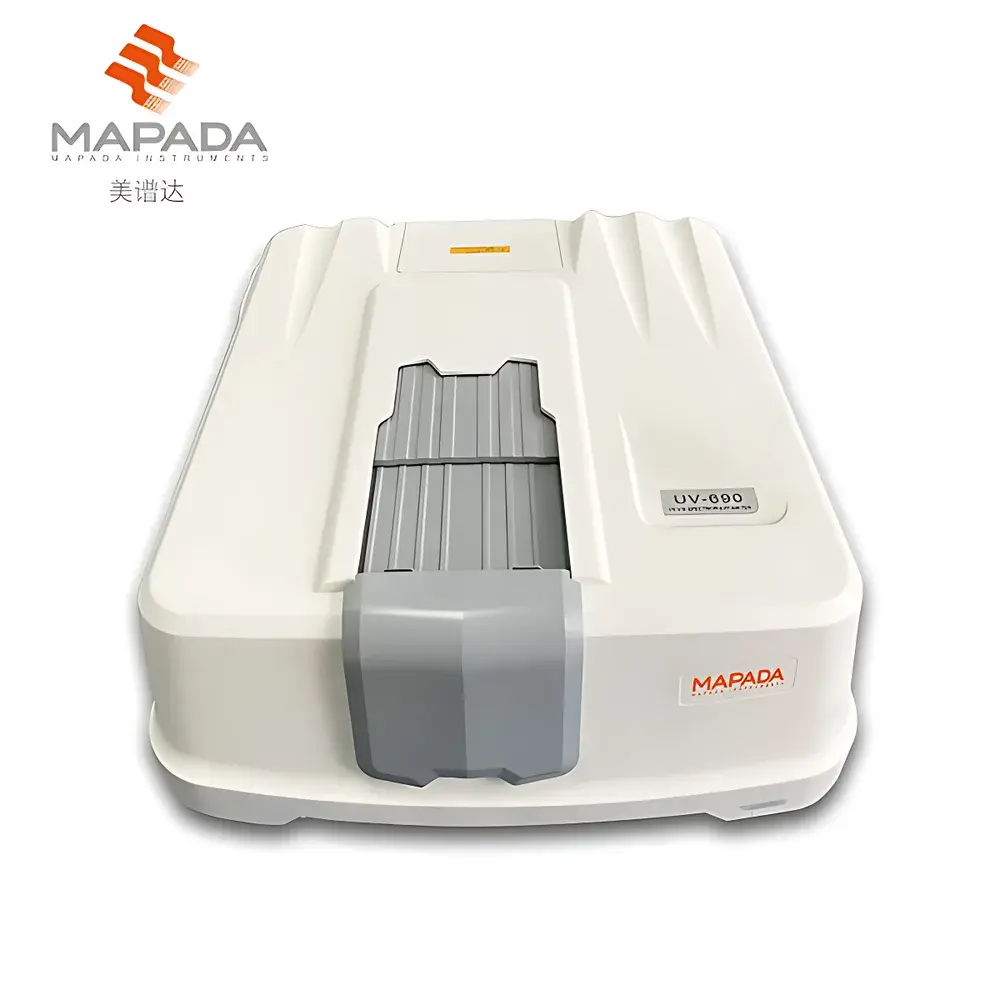
Mapada UV-650 Dual-Beam Ultraviolet-Visible Spectrophotometer
| Brand | Mapada |
|---|---|
| Origin | Shanghai, China |
| Manufacturer Type | Original Equipment Manufacturer (OEM) |
| Product Category | Domestic |
| Model | UV-650 |
| Price Range | USD 14,000–21,000 |
| Optical System | Dual-beam |
| Detector | Photomultiplier Tube (PMT) |
| Wavelength Range | 190–900 nm |
| Wavelength Accuracy | ±0.3 nm |
| Spectral Bandwidth | 1.8 nm |
| Wavelength Repeatability | ±0.1 nm |
| Scan Mode | Automatic Wavelength Scanning |
| Light Source | Imported Deuterium Lamp & Tungsten Halogen Lamp |
| Grating | Holographic, 1600 lines/mm |
| Measurement Modes | Absorbance (A), Transmittance (T), Concentration (C), Energy (E) |
| Data Interface | USB 2.0 port + Parallel Printer Port |
| Power Supply | AC 220 V / 50 Hz or AC 110 V / 60 Hz |
| Dimensions | 600 × 480 × 260 mm |
| Weight | 32 kg |
Overview
The Mapada UV-650 is a high-performance dual-beam ultraviolet-visible (UV-Vis) spectrophotometer engineered for precision quantitative and qualitative analysis across academic research laboratories, pharmaceutical quality control units, environmental testing facilities, and industrial R&D departments. Its optical architecture employs a stable dual-beam configuration with real-time reference beam compensation, minimizing drift caused by source intensity fluctuation or detector thermal instability. The instrument utilizes a holographic grating (1600 lines/mm) to deliver consistent spectral resolution and low stray light performance—critical for accurate absorbance measurements in complex matrices. Operating across a broad spectral range of 190–900 nm, the UV-650 supports both deep-UV nucleic acid/protein quantification and near-IR applications such as polymer characterization and colorimetric assays. The system integrates imported deuterium and tungsten-halogen lamps, ensuring continuous coverage from far-UV through visible to near-infrared regions without manual lamp switching.
Key Features
- Dual-beam optical design with real-time background correction for enhanced baseline stability and measurement reproducibility
- High-sensitivity photomultiplier tube (PMT) detector offering superior signal-to-noise ratio across the full wavelength range
- Automated wavelength scanning with ±0.3 nm accuracy and ±0.1 nm repeatability—meeting ASTM E275 and ISO 9001 calibration traceability requirements
- Fixed spectral bandwidth of 1.8 nm, optimized for compliance with pharmacopeial methods (e.g., USP and EP 2.2.25)
- Four operational modes: Absorbance (A), Transmittance (T), Concentration (C), and Energy (E), supporting direct quantitation using pre-loaded calibration curves
- Robust mechanical construction (32 kg mass) with vibration-damped optical bench, enabling reliable operation in shared laboratory environments
- Universal power compatibility (AC 110 V / 60 Hz or AC 220 V / 50 Hz) and integrated thermal management for extended duty cycles
Sample Compatibility & Compliance
The UV-650 accommodates standard 10 mm pathlength quartz, glass, or plastic cuvettes (including matched pairs for dual-beam referencing), as well as microvolume adapters and optional fiber-optic probes for non-contact or flow-through measurements. Its optical path design complies with ICH Q2(R2) guidelines for analytical method validation, particularly in specificity, linearity, and robustness assessments. Instrument qualification documentation supports IQ/OQ protocols aligned with FDA 21 CFR Part 11 requirements when used with compliant PC-based software. All optical components meet RoHS Directive 2011/65/EU specifications, and the housing conforms to IEC 61010-1 safety standards for laboratory electrical equipment.
Software & Data Management
Controlled via Windows-compatible software, the UV-650 enables full spectral acquisition, kinetic profiling, multi-wavelength quantitation, and derivative spectroscopy. Data export functions support CSV, TXT, and XML formats compatible with LIMS integration and statistical analysis platforms (e.g., JMP, OriginLab). Audit trail functionality records user actions, parameter changes, and calibration events—essential for GLP/GMP-regulated workflows. USB 2.0 interface ensures plug-and-play connectivity, while the parallel printer port provides direct hardcopy output for SOP-compliant record retention without dependency on network infrastructure.
Applications
- Pharmaceutical: Active pharmaceutical ingredient (API) assay, excipient interference screening, dissolution profile monitoring
- Life Sciences: DNA/RNA purity assessment (A260/A280), Bradford/Lowry protein quantification, enzyme kinetics (e.g., NADH oxidation at 340 nm)
- Environmental: Nitrate/nitrite determination in water (via diazotization), COD estimation, heavy metal chelate analysis
- Materials Science: Thin-film transmittance/reflectance, semiconductor bandgap estimation, dye degradation kinetics
- Food & Beverage: Color index measurement (e.g., AOAC 993.02), preservative concentration verification, antioxidant capacity assays
FAQ
Does the UV-650 support GMP-compliant data integrity practices?
Yes—when paired with validated software, it supports electronic signatures, audit trails, and secure user access levels per FDA 21 CFR Part 11.
Can the instrument be calibrated using NIST-traceable standards?
Yes—wavelength calibration is performed using holmium oxide and didymium filters; photometric calibration uses neutral density filters certified to NIST SRM 930e.
Is the PMT detector replaceable in the field?
Yes—the detector module is user-serviceable with factory-provided alignment fixtures and calibration routines.
What is the maximum scan speed for full-spectrum acquisition?
The instrument performs full 190–900 nm scans in under 18 seconds at 1 nm data interval, with configurable step resolution down to 0.1 nm.
Does the UV-650 include built-in validation tools for IQ/OQ?
It ships with a comprehensive qualification kit including wavelength accuracy test filters, photometric linearity standards, and a protocol template compliant with ISO/IEC 17025 Annex A.
Related Products




