
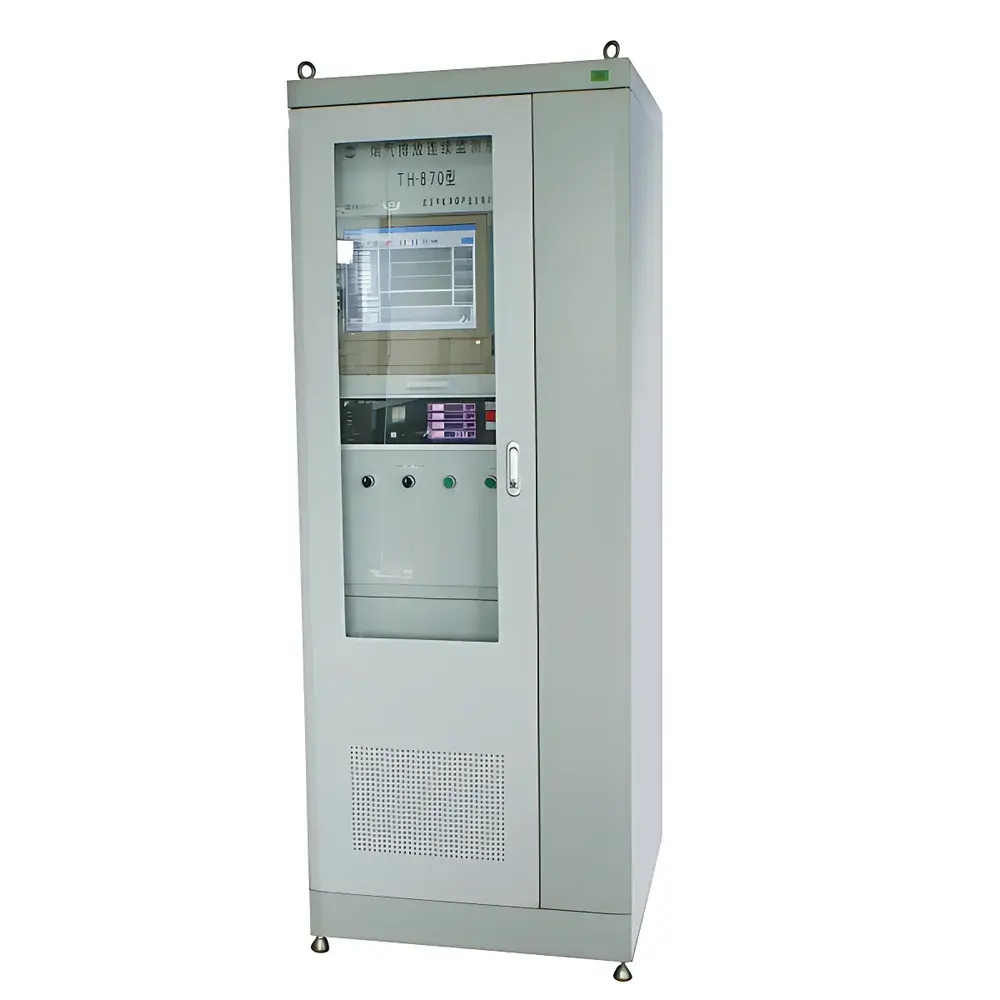
Tianhong TH-870 Continuous Emission Monitoring System (CEMS) for Ultra-Low Emissions
| Brand | Tianhong |
|---|---|
| Origin | Hubei, China |
| Model | TH-870 |
| Instrument Type | Flue Gas CEMS |
| Repeatability | ±2% FS |
| Response Time | ≤200 s |
| Stability | ±5% FS over 7 days |
| Measured Gases | SO₂, SO₃, NO, NO₂, HCl, HF, O₂, CO, CO₂ |
| Preconditioning | Nafion™ membrane-based dryers |
| Detection Principle | Low-range NDIR (SO₂, NOₓ, CO, CO₂), Electrochemical/Zirconia (O₂) |
Overview
The Tianhong TH-870 Continuous Emission Monitoring System (CEMS) is an engineered solution for regulatory-compliant, real-time monitoring of ultra-low concentration flue gas pollutants from coal-fired power plants, waste-to-energy facilities, industrial boilers, and cement kilns. Designed to meet stringent national and regional emission standards—including China’s GB 13223–2011 and EU IED Directive 2010/75/EU—the TH-870 integrates a robust, in-situ membrane-based sample conditioning subsystem with a high-stability, low-range non-dispersive infrared (NDIR) gas analyzer. Its core measurement architecture avoids catalytic conversion or chemical scrubbing, preserving molecular integrity of target analytes—including reactive species such as SO₃ and NO₂—throughout the sampling train. Unlike refrigerated or permeation-based chillers that risk condensate formation or analyte loss, the TH-870 employs selective Nafion™ membrane dehydration, enabling accurate quantification of sub-ppm level pollutants in high-humidity, low-temperature flue streams typical of wet FGD and SCR-deactivated exhausts.
Key Features
- Nafion™ Membrane Dryer Assembly: Installed adjacent to the stack, this two-stage membrane dryer removes water vapor via proton-exchange diffusion without altering analyte concentrations—preserving SO₂, SO₃, NO, NO₂, HCl, HF, CO, CO₂, and O₂ with >99.8% recovery efficiency.
- Dual-Stage Filtration: Stainless-steel sintered metal filters (≤1 µm) followed by PTFE-coated cyclonic separation ensure particulate removal down to 0.3 µm, minimizing optical interference and sensor fouling.
- Ammonia Scrubbing Module (Optional): Integrated acid-gas neutralization chamber eliminates NH₃ cross-interference and prevents ammonium salt deposition in downstream lines—critical for SCR-equipped installations.
- Low-Range NDIR Spectroscopy: Optimized optical path and thermoelectrically stabilized detectors enable detection limits of 0.5 ppm (SO₂), 0.3 ppm (NO), and 1 ppm (CO)—with dual-range auto-switching (e.g., 0–50 ppm / 0–500 ppm) to maintain linearity across dynamic load conditions.
- O₂ Measurement Flexibility: Configurable electrochemical cell (for ambient stability) or high-temperature zirconia sensor (for elevated flue temperatures up to 650 °C), both compliant with ISO 14956 and EN 14181 QA/QC requirements.
- Automated Maintenance Functions: Scheduled back-purge cycles, timed condensate drainage, and zero/span calibration routines reduce manual intervention and support unattended 7×24 operation.
Sample Compatibility & Compliance
The TH-870 accommodates flue gas streams with moisture content up to 25% v/v, temperature ranges from 60 °C to 200 °C (post-duct), and particulate loading ≤50 mg/Nm³. It conforms to key international performance validation protocols: EN 15267-3 (QAL1 certification readiness), EN 14181 (ASTM D6522 equivalent), and China’s HJ 75–2017 and HJ 76–2017 for CEMS technical specification and quality assurance. All analog outputs (4–20 mA) and digital interfaces (RS232/RS485) comply with MODBUS RTU and HART 7.0 protocols. Data logging meets GLP/GMP audit-trail requirements with timestamped event logs, calibration records, and fault diagnostics stored locally for ≥90 days.
Software & Data Management
Built-in embedded Linux controller hosts Tianhong’s CEMS-Manager v3.2 firmware, supporting automated QA/QC reporting per EN 14181 Level 1–3 requirements. The system generates standardized reports including daily drift checks, 7-day precision validation, and 30-day accuracy verification—exportable in CSV, PDF, and XML formats. Remote access is enabled via secure HTTPS with role-based authentication (admin/operator/auditor). Optional integration with enterprise SCADA or DCS platforms is achieved through OPC UA 1.04 or MQTT 3.1.1—supporting TLS 1.2 encryption and message queuing for intermittent network conditions. All data handling adheres to ISO/IEC 27001-aligned cybersecurity practices, with firmware signing and secure boot functionality.
Applications
- Continuous compliance monitoring for coal-, biomass-, and refuse-derived fuel (RDF)-fired power generation units subject to ultra-low emission limits (e.g., SO₂ ≤35 mg/Nm³, NOₓ ≤50 mg/Nm³).
- Process optimization in lime/limestone FGD systems where real-time SO₃ monitoring informs corrosion mitigation strategies.
- Post-SCR and post-ESP flue ducts requiring simultaneous detection of NO₂/NO ratio to assess ammonia slip and catalyst deactivation.
- Waste incineration plants complying with EU Waste Incineration Directive (2000/76/EC) for HCl and HF tracking at sub-10 mg/Nm³ levels.
- Carbon capture readiness assessments via high-precision CO₂ concentration trending and mass balance correlation with flow meters.
FAQ
Does the TH-870 support third-party calibration verification per EN 14181?
Yes—the system provides dedicated QAL2 interface mode, traceable span gas delivery ports, and configurable response time logging to facilitate independent verification by accredited laboratories.
Can the Nafion™ dryer handle flue gas containing >100 ppm NH₃?
When equipped with the optional ammonia scrubber module, the TH-870 maintains SO₂ and NOₓ accuracy under NH₃ concentrations up to 200 ppm without spectral interference or salt deposition.
Is the TH-870 compatible with existing CEMS data acquisition systems (DAS)?
All analog and digital outputs conform to IEC 61131-3 and ISA-88 standards; pre-configured DAS drivers are available for Siemens Desigo, Honeywell Experion, and Yokogawa CENTUM VP platforms.
What maintenance intervals are recommended for long-term reliability?
Filter replacement every 3 months, Nafion™ tube inspection every 12 months, and full optical alignment verification annually—documented in the built-in maintenance scheduler with SMS/email alerts.
Does the system meet FDA 21 CFR Part 11 requirements for electronic records?
While primarily deployed in environmental compliance—not pharmaceutical manufacturing—the TH-870’s audit-trail, electronic signature, and data integrity modules satisfy foundational ALCOA+ principles and may be validated for regulated industries upon site-specific IQ/OQ protocols.







