
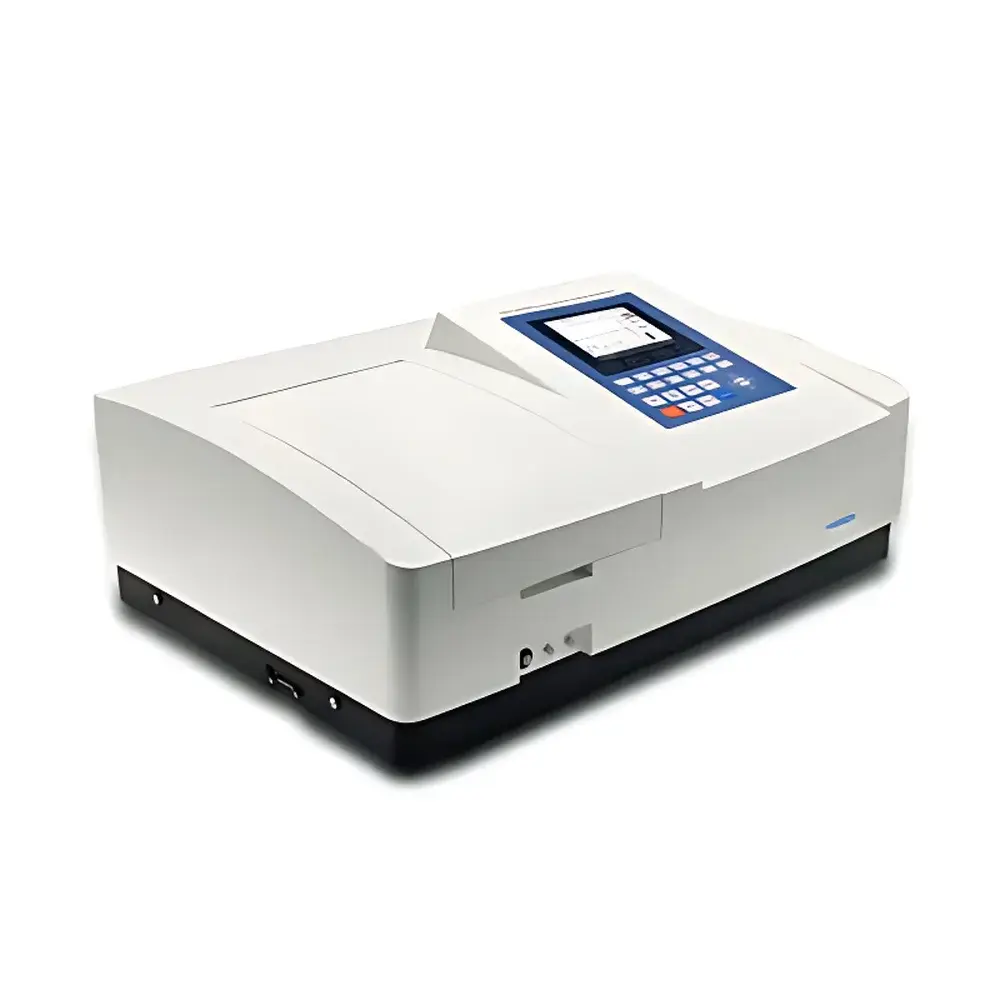
Mapada UV-3200S Scanning Ultraviolet-Visible Spectrophotometer
| Brand | Mapada |
|---|---|
| Origin | Shanghai, China |
| Manufacturer Type | Direct Manufacturer |
| Instrument Architecture | Pseudo-Double-Beam |
| Detector | Silicon Photodiode (Imported) |
| Wavelength Range | 190–1100 nm |
| Spectral Bandwidth | 0.5 / 1 / 2 / 4 / 5 nm (Selectable) |
| Wavelength Accuracy | ±0.3 nm |
| Display | 320×240 LCD (5-inch) |
| Scan Speed | Up to 3800 nm/min (High/Medium/Low Adjustable) |
| Photometric Range | 0–200% T, –4.0 to +4.0 A |
| Light Sources | Imported Long-Life Deuterium Lamp & Tungsten-Halogen Lamp |
| Sample Compartment | Accommodates Cuvettes from 5 mm to 100 mm Pathlength |
| Data Interface | USB Port |
| Print Interface | Parallel Port |
| Power Supply | AC 220 V/50 Hz or AC 110 V/60 Hz |
| Dimensions | 590 × 420 × 260 mm |
| Weight | 20 kg |
Overview
The Mapada UV-3200S is a high-performance scanning ultraviolet-visible (UV-Vis) spectrophotometer engineered for routine and research-grade quantitative and qualitative analysis in pharmaceutical, environmental, biochemical, and materials science laboratories. Based on the pseudo-double-beam optical architecture, it minimizes baseline drift caused by source intensity fluctuations and detector thermal noise—ensuring high photometric stability during extended measurements. The instrument employs a 1200 lines/mm holographic grating for efficient dispersion across the full 190–1100 nm spectral range, enabling precise identification of absorption maxima, quantification of analyte concentrations via Beer-Lambert law, and characterization of electronic transitions in organic and inorganic compounds. Its modular lamp design—featuring socket-mounted, imported deuterium and tungsten-halogen sources—supports rapid lamp replacement without realignment, reducing instrument downtime and maintenance complexity.
Key Features
- 5-inch high-resolution 320×240 LCD display with intuitive Chinese–English bilingual interface for real-time visualization of absorbance spectra, kinetic time courses, multi-wavelength scans, and calibration curves;
- Selectably adjustable spectral bandwidth (0.5, 1, 2, 4, or 5 nm) to balance resolution and signal-to-noise ratio based on sample matrix and regulatory requirements;
- Optimized long-path optical design enhancing wavelength resolution and improving detection sensitivity for low-concentration samples;
- Ozone-reduced deuterium lamp system compliant with occupational health guidelines for laboratory safety;
- Integrated lamp-hour monitoring for both deuterium and tungsten sources, supporting predictive maintenance and GLP-compliant recordkeeping;
- GLP self-validation function allowing on-demand verification of wavelength accuracy (±0.3 nm) and photometric accuracy per internal reference standards;
- Spacious sample compartment accommodating standard quartz, glass, or plastic cuvettes with pathlengths from 5 mm to 100 mm;
- Dual data output: USB interface for direct PC connectivity and parallel port for optional thermal or dot-matrix printer integration;
- Robust mechanical construction (20 kg mass, rigid chassis) minimizing vibration-induced spectral artifacts during high-speed scanning (up to 3800 nm/min);
- Comprehensive photometric modes: Transmittance (%T), Absorbance (A), Concentration (C), and Energy (E) — fully traceable to NIST-traceable calibration references.
Sample Compatibility & Compliance
The UV-3200S supports a broad range of liquid-phase samples in standard cuvette formats, including aqueous solutions, organic solvents, colloidal suspensions, and enzymatic reaction mixtures. Its wide 190–1100 nm spectral coverage enables characterization of π→π* transitions (e.g., conjugated aromatics at ~254 nm), n→π* transitions (~270–300 nm), charge-transfer bands, and near-IR overtones (e.g., O–H stretching harmonics >900 nm). The instrument meets core performance criteria outlined in ISO 6425, ASTM E275, and USP for UV-Vis spectrophotometers. Its GLP self-diagnostic routines support audit-ready documentation required under FDA 21 CFR Part 11 when paired with validated Mapada scanning software. All optical components are housed in a sealed, dust-resistant enclosure to maintain long-term wavelength fidelity.
Software & Data Management
Bundled Mapada Professional Scanning Software provides full instrument control via USB connection, enabling method-driven acquisition, spectral overlay, derivative spectroscopy, peak search, and linear/nonlinear calibration modeling. Raw spectral data are saved in ASCII-compatible .txt format for interoperability with third-party analysis platforms (e.g., OriginLab, MATLAB, R). The software enforces user-level access control, electronic signature logging, and full audit trail generation—including timestamped parameter changes, calibration events, and report exports—meeting GLP/GMP data integrity requirements. Internal memory retains up to 500 spectra and 200 quantitative methods, while external storage via USB flash drive extends archival capacity indefinitely.
Applications
- Pharmaceutical QC: Assay of active pharmaceutical ingredients (APIs) per USP monographs using fixed-wavelength or multi-point calibration;
- Environmental testing: Nitrate, phosphate, and heavy metal ion quantification (e.g., Cr(VI) at 540 nm) in wastewater per EPA Method 353.2;
- Biochemical analysis: Protein concentration determination via Bradford or BCA assays; DNA/RNA purity assessment (A260/A280 ratios); enzyme kinetics (e.g., NADH oxidation at 340 nm);
- Materials science: Bandgap estimation of semiconductor nanoparticles via Tauc plot analysis;
- Food & beverage: Colorimetric quantification of antioxidants (e.g., anthocyanins), preservatives (e.g., sulfites), and adulterants;
- Academic research: Teaching fundamental spectroscopic principles, method validation, and spectral library development.
FAQ
What is the optical design architecture of the UV-3200S, and how does it improve measurement stability?
The UV-3200S uses a pseudo-double-beam configuration with time-shared reference and sample beam paths. This design compensates for source intensity drift and detector sensitivity variation without requiring a physical beam splitter, thereby delivering improved baseline repeatability compared to single-beam systems.
Does the instrument support compliance with FDA 21 CFR Part 11?
Yes—when operated with validated Mapada Professional Scanning Software, the system supports electronic signatures, audit trails, and role-based user authentication required for regulated environments.
Can I perform kinetic measurements over extended time periods?
Yes—the instrument supports time-scan mode with user-defined intervals (100 ms to 60 s), enabling monitoring of slow enzymatic reactions, polymerization kinetics, or photolysis processes.
Is the wavelength accuracy verified during routine operation?
Yes—the built-in GLP self-validation function allows users to run automated wavelength and photometric accuracy checks using internal holmium oxide or neutral density filters, generating printable compliance reports.
What cuvette pathlengths are supported in the sample compartment?
The standardized sample chamber accommodates rectangular cuvettes with optical pathlengths ranging from 5 mm to 100 mm, including microvolume adapters for low-sample-volume applications.




