
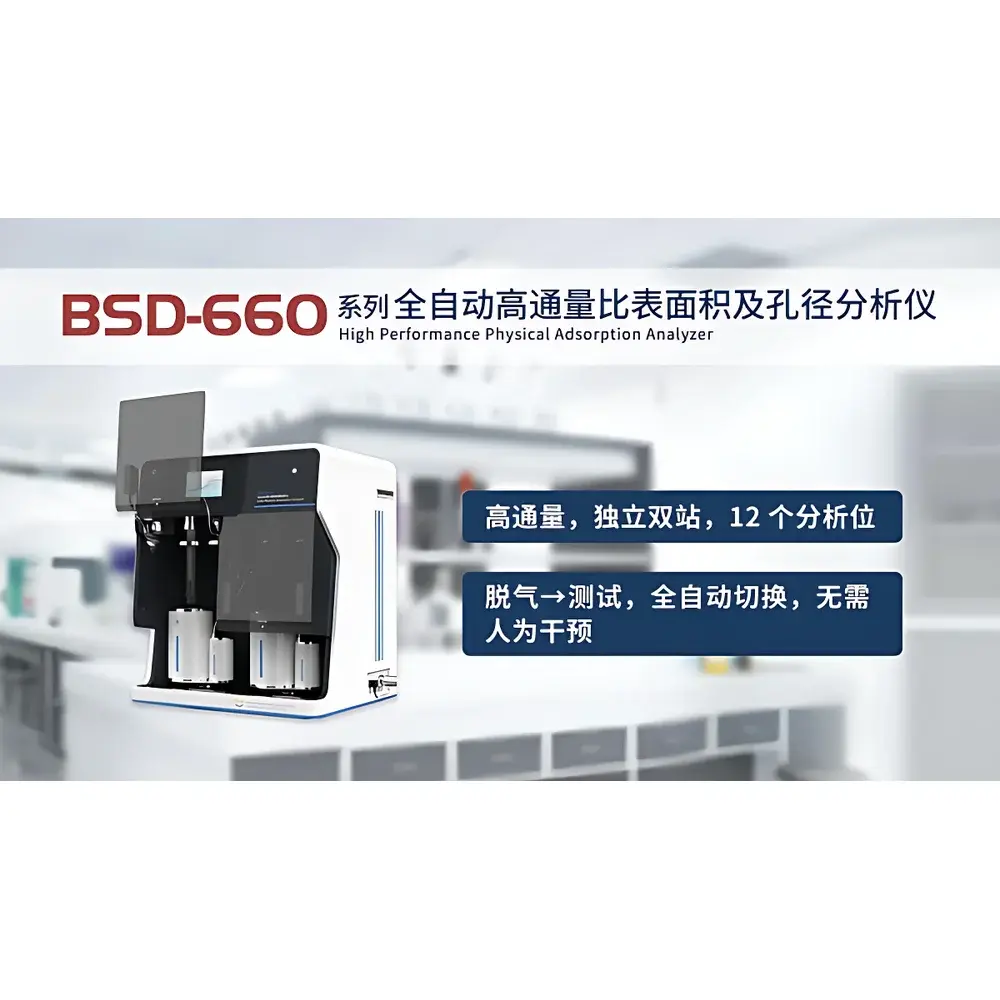
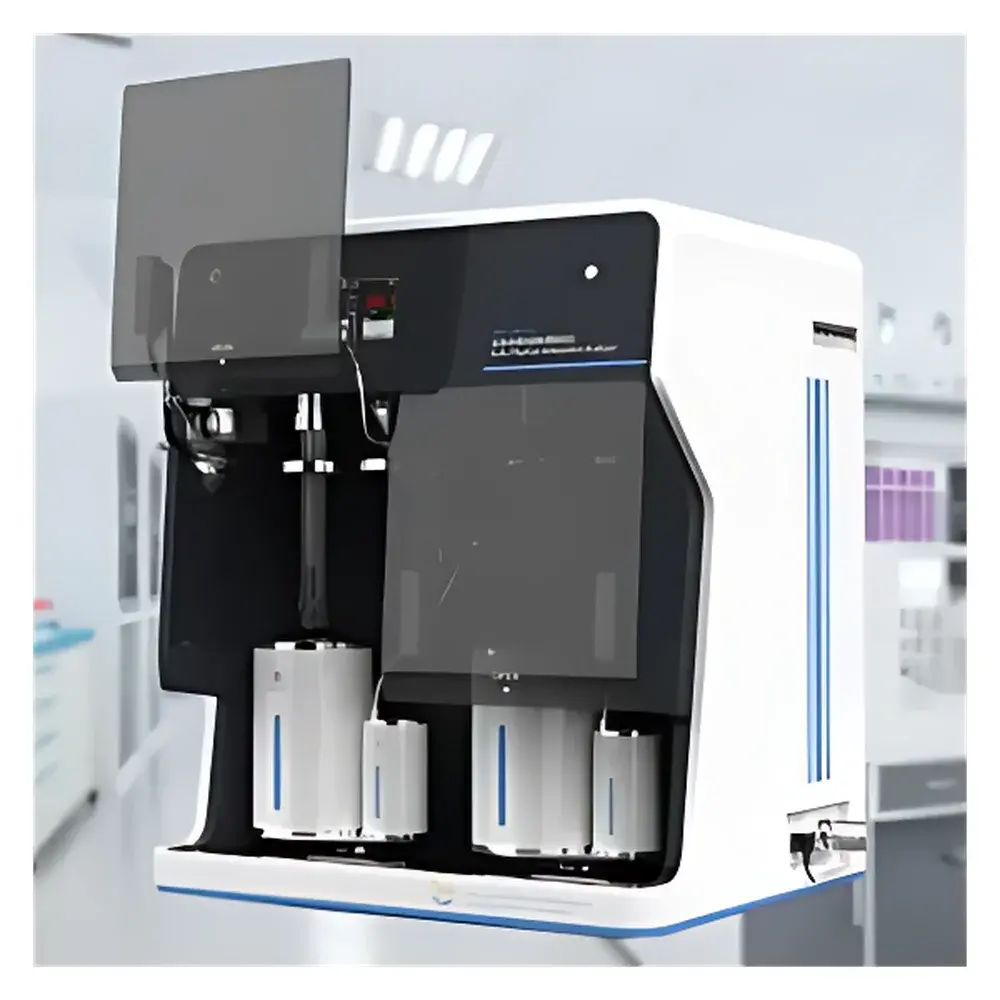
Beishide BSD-660M High-Throughput High-Performance Specific Surface Area and Pore Size Analyzer
| Brand | Beishide Instrument |
|---|---|
| Origin | Beijing, China |
| Manufacturer Type | Manufacturer |
| Instrument Type | Specific Surface Area and Pore Size Analyzer |
| Principle | Static Volumetric Method (Static Capacity Method) |
| Analysis Stations | 3 / 6 / 9 / 12 configurable |
| Surface Area Range | ≥0.0005 m²/g |
| Pore Diameter Range | 0.35–500 nm |
| Repeatability | ±0.01 (RSD) |
Overview
The Beishide BSD-660M is a high-throughput, fully automated specific surface area and pore size analyzer engineered for precision gas adsorption characterization of porous and non-porous solid materials. It operates on the static volumetric principle—measuring equilibrium gas uptake at controlled pressures and temperatures to determine BET surface area, micropore volume (via t-plot, DR, HK, or DA methods), mesopore size distribution (via BJH, DH, or NLDFT models), and total pore volume. Designed for laboratories requiring rigorous, reproducible physical adsorption data under GLP/GMP-aligned workflows, the BSD-660M supports nitrogen, argon, carbon dioxide, oxygen, hydrogen, methane, ethane, and other non-corrosive or corrosive gases (with optional configurations). Its architecture integrates ultra-high vacuum capability (≤1×10⁻⁹ Pa), temperature-stabilized gas handling (±0.01 °C), and intelligent thermal management to ensure metrological integrity across micro-, meso-, and macroporous regimes.
Key Features
- Fully automated operation: Integrated sample degassing → gas dosing → adsorption measurement sequence with zero manual intervention between stations.
- Modular station configuration: Selectable analysis positions—3, 6, 9, or 12—enabling parallel throughput optimization without compromising calibration traceability.
- Helium-free dead-volume calibration: Patented sequential workflow—helium pycnometry at ambient temperature → high-vacuum thermal degassing → adsorption analysis—eliminates helium carryover into micropore measurements, improving accuracy for ultramicroporous materials (e.g., MOFs, zeolites, COFs).
- Pressure-controlled ramped degassing (PCRD): Real-time pressure feedback modulates furnace temperature and vertical position to suppress sample fluidization during thermal treatment—critical for fine powders (e.g., battery cathodes, catalysts, metal oxides).
- Auto-regulating temperature zone: Servo-controlled isothermal zone maintains adsorption chamber thermal stability with <0.10% 24-hour drift in equivalent dead volume—exceeding ISO 15901-2 requirements for reproducible mesopore analysis.
- Electric turbo liquid nitrogen pump: Contactless, variable-speed LN₂ transfer ensures contamination-free cryogen delivery and eliminates manual refilling hazards.
- Full-system thermostating: Entire gas manifold maintained at 40 °C ±0.01 °C to minimize condensation artifacts and vapor-phase interference during vapor adsorption (optional).
- Open LIMS interface: Native support for ASTM E1482-compliant data export and bidirectional communication with laboratory information management systems per FDA 21 CFR Part 11 audit trail requirements.
Sample Compatibility & Compliance
The BSD-660M accommodates diverse material classes—including lithium-ion battery cathode/anode powders (LiCoO₂, Si/C composites), metal–organic frameworks (MOFs), covalent organic frameworks (COFs), activated carbons, silica gels, zeolites, metal oxides (TiO₂, Al₂O₃), hydroxides, salts, and polymer-based adsorbents. It complies with international standards governing gas adsorption analysis: ISO 9277:2010 (BET surface area), ISO 15901-1:2005 (mercury intrusion), ISO 15901-2:2006 (mesopores), and ISO 15901-3:2007 (micropores), as well as GB/T 19587–2017, GB/T 21650.1–2008, and GB/T 21650.3–2011. All hardware and software modules are validated for use in regulated environments where documentation of instrument qualification (IQ/OQ/PQ), calibration history, and electronic signature enforcement are mandatory.
Software & Data Management
The proprietary AdsorptionStudio™ software provides ISO/IEC 17025-aligned data acquisition, real-time QC monitoring (pressure stability, temperature deviation, isotherm convergence), and model-agnostic fitting engines for NLDFT, QSDFT, and Monte Carlo kernel libraries. Each analysis session generates timestamped, digitally signed reports containing raw isotherms, uncertainty propagation metrics, and metadata compliant with ASTM E2655 for inter-laboratory comparability. Audit trails record all user actions, parameter changes, and calibration events. Raw data files (.ads) are structured in HDF5 format for long-term archival and third-party reprocessing. Optional integration with enterprise LIMS enables automatic result ingestion, sample lifecycle tracking, and compliance reporting for ISO/IEC 17025 accreditation audits.
Applications
- Quality control of battery electrode materials: Quantifying specific surface area shifts post-cycling to assess structural degradation.
- MOF/COF development: Discriminating between ultramicropores (<0.7 nm) and narrow micropores (0.7–2 nm) using CO₂ at 273 K and N₂ at 77 K.
- Catalyst formulation: Correlating mesopore volume distribution (2–50 nm) with diffusion-limited reaction kinetics.
- Pharmaceutical excipient characterization: Measuring surface heterogeneity and pore accessibility in amorphous silica carriers.
- Carbon capture material screening: Evaluating CO₂ working capacity and selectivity via multi-gas isotherms (CO₂/N₂ binary mixtures).
- Adsorption cycle stability testing: Automated repeated adsorption–desorption sequences to quantify performance decay over 100+ cycles.
FAQ
What gases can be used for analysis on the BSD-660M?
Nitrogen, argon, carbon dioxide, oxygen, hydrogen, methane, ethane, and other non-corrosive gases are supported natively; corrosive gases (e.g., NH₃, H₂S) and vapors (e.g., water, ethanol) require optional corrosion-resistant valves and temperature-controlled vapor dosing modules.
How does the system ensure helium-free micropore analysis?
It executes a deterministic sequence: helium pycnometry first (at ambient temperature), followed by full vacuum degassing, then adsorption—isolating helium from the adsorption step to prevent overestimation of micropore volume.
Is the instrument suitable for GMP-regulated labs?
Yes—software includes 21 CFR Part 11-compliant electronic signatures, role-based access control, and immutable audit trails; hardware meets IQ/OQ/PQ validation protocols for pharmaceutical and medical device manufacturing environments.
Can the BSD-660M perform dynamic vapor sorption (DVS)?
Not natively—but with the optional vapor dosing module and environmental chamber, it supports isothermal vapor adsorption up to 80 °C for hygroscopicity and solvent affinity studies.
What is the minimum detectable surface area?
The validated lower limit is 0.0005 m²/g, achievable using high-sensitivity transducers and extended equilibration times for ultra-low-surface-area metals and dense ceramics.



