
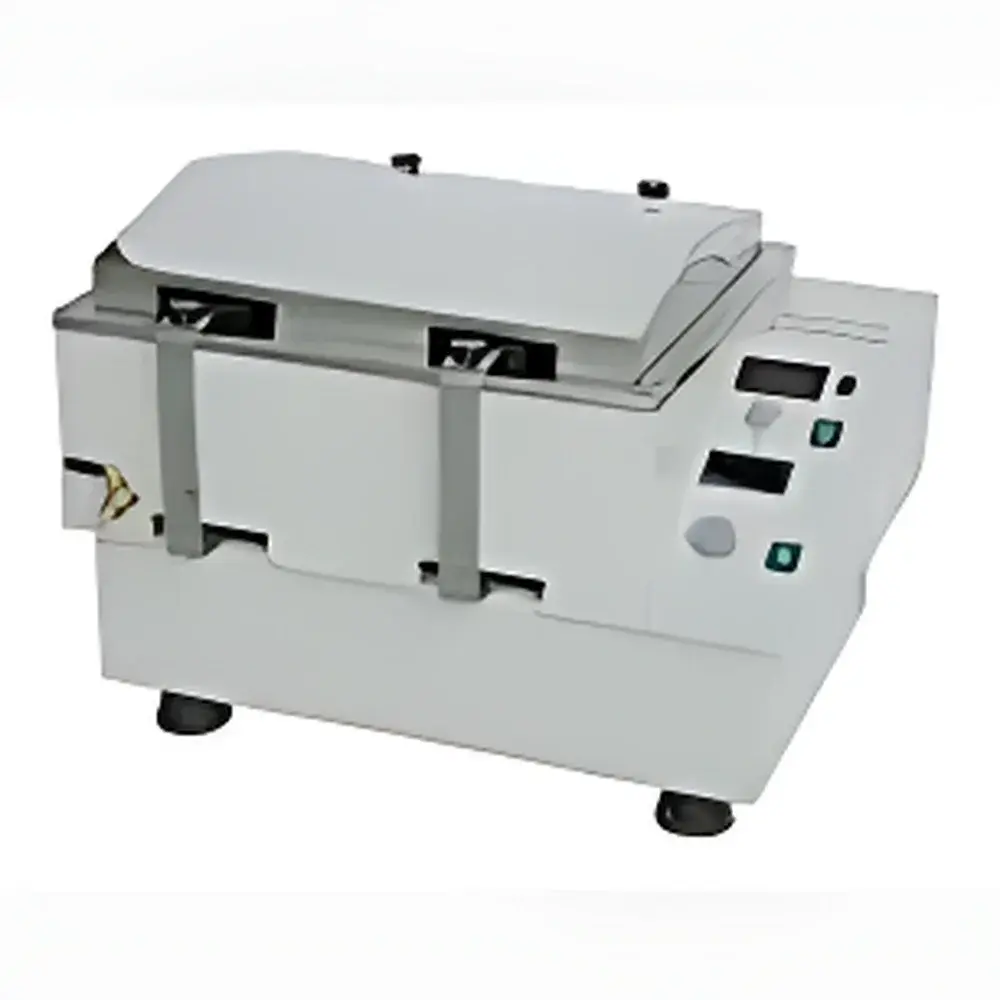
Beifen Sanpu THZ-82(A) Water Bath Incubator Shaker
| Brand | Beifen Sanpu |
|---|---|
| Origin | Hebei, China |
| Manufacturer Type | Direct Manufacturer |
| Instrument Type | Water Bath Incubator Shaker |
| Model | THZ-82(A) |
| Timing Range | 0–120 min |
| Oscillation Frequency | Adjustable, 0–300 rpm |
| Oscillation Amplitude | 20 mm |
| Temperature Range | Ambient to 100 °C |
| Temperature Accuracy | ±0.5 °C |
| Oscillation Mode | Orbital (standard for THZ-82 series) |
| Tray Quantity | 1 |
| Power Supply | 220 V, 50 Hz |
| Heating Power | 1800 W |
| Water Bath Chamber Dimensions | 490 × 390 × 170 mm (L×W×H) |
| Overall Dimensions | 700 × 550 × 490 mm (L×W×H) |
| Construction | Stainless Steel Interior |
Overview
The Beifen Sanpu THZ-82(A) Water Bath Incubator Shaker is an orbital-type laboratory shaker engineered for precise temperature-controlled agitation of biological and biochemical samples in aqueous environments. It integrates a thermostatically regulated water bath with a mechanically stable orbital shaking platform, enabling uniform heat transfer and consistent mixing across flasks, test tubes, and culture vessels. Based on the principle of convective thermal equilibrium and controlled mechanical oscillation, the instrument maintains sample integrity during extended incubation protocols—particularly critical for microbial growth, enzyme kinetics, cell suspension cultures, and solubility studies. Designed for routine use in academic teaching labs, clinical diagnostics support units, and QC/QA environments in biopharmaceutical and food safety laboratories, the THZ-82(A) operates within a validated temperature range of ambient to 100 °C with ±0.5 °C stability under steady-state conditions. Its orbital motion (as opposed to reciprocating or linear shaking) minimizes shear stress on sensitive cells while ensuring homogeneous suspension—making it suitable for applications requiring gentle yet effective mixing.
Key Features
- Orbital shaking mechanism with continuously adjustable speed (0–300 rpm), delivering reproducible motion profiles without mechanical backlash or resonance-induced vibration.
- Digital PID temperature controller with real-time LED display, enabling accurate setpoint programming and monitoring; temperature deviation remains within ±0.5 °C across the full operating range.
- Stainless steel water bath chamber (490 × 390 × 170 mm) resistant to corrosion from saline, buffer, and mild chemical solutions—ensuring long-term reliability and ease of cleaning.
- Single-tier platform with universal spring-loaded clamps accommodating multiple vessel types (e.g., Erlenmeyer flasks up to 2 L, test tubes, microcentrifuge tubes) without adapter kits.
- Mechanical timer with 0–120 minute range (plus “continuous run” mode), providing fail-safe operation without dependency on software or external controllers.
- Robust structural design: reinforced chassis, non-slip rubber feet, and balanced motor mount reduce noise and positional drift during high-speed operation.
Sample Compatibility & Compliance
The THZ-82(A) supports aqueous-phase samples in standard laboratory glassware and polypropylene containers. It is routinely deployed in protocols aligned with ISO 8601 (time-stamped experimental logging), CLSI M22-A3 (microbial growth methodology), and USP / (microbiological enumeration). While not certified to IEC 61000-6-3 (EMC) or UL 61010-1 out-of-the-box, its electrical architecture complies with general safety principles for Class I laboratory equipment operating at 220 V / 50 Hz. The stainless steel interior meets ASTM A240 requirements for 304-grade material exposure to neutral pH aqueous media. No refrigeration or vacuum capability is integrated; therefore, it is not intended for low-temperature or anaerobic applications.
Software & Data Management
The THZ-82(A) is a standalone analog-digital hybrid instrument with no embedded firmware, network interface, or data export functionality. All operational parameters—including temperature setpoint, timing duration, and speed—are configured manually via front-panel controls. This architecture eliminates cybersecurity vulnerabilities, ensures deterministic behavior under power fluctuation, and aligns with GLP environments where audit trails must originate from operator logs rather than automated systems. For laboratories requiring electronic recordkeeping, integration with external data loggers (e.g., Omega OM-DAQPRO-5300 series) via 4–20 mA or 0–5 V analog outputs is feasible using optional signal conditioning modules.
Applications
- Microbial culture expansion (E. coli, yeast, Bacillus spp.) in liquid broth media under controlled thermal and agitation conditions.
- Enzyme assay preparation requiring uniform substrate dispersion and thermal stabilization prior to spectrophotometric analysis.
- Solubility and dissolution testing of pharmaceutical excipients per USP , particularly for temperature-dependent release profiling.
- Antibiotic susceptibility testing (AST) using broth microdilution methods where consistent aeration and mixing influence MIC endpoint determination.
- Cell line maintenance for suspension-adapted mammalian cultures (e.g., CHO, Sf9) during early-stage process development.
- Environmental microbiology workflows including coliform enrichment and BOD5 incubation per APHA Standard Methods 9221.
FAQ
What oscillation mode does the THZ-82(A) support?
The THZ-82(A) is configured exclusively for orbital (circular) shaking. Reciprocating or dual-mode operation requires the SHA-B variant.
Can this unit operate below ambient temperature?
No. The THZ-82(A) is a heating-only water bath shaker with a minimum operating temperature equal to ambient room temperature.
Is the water bath chamber drain-equipped?
No. Drainage requires manual siphoning or tilting; no integrated valve or port is provided.
Does the device comply with FDA 21 CFR Part 11?
No. As a manually operated, non-networked instrument without electronic audit trail generation, it falls outside the scope of Part 11 requirements.
What is the maximum load capacity of the platform?
The platform supports up to 15 kg evenly distributed—sufficient for twelve 500 mL Erlenmeyer flasks or equivalent volume configurations.




