
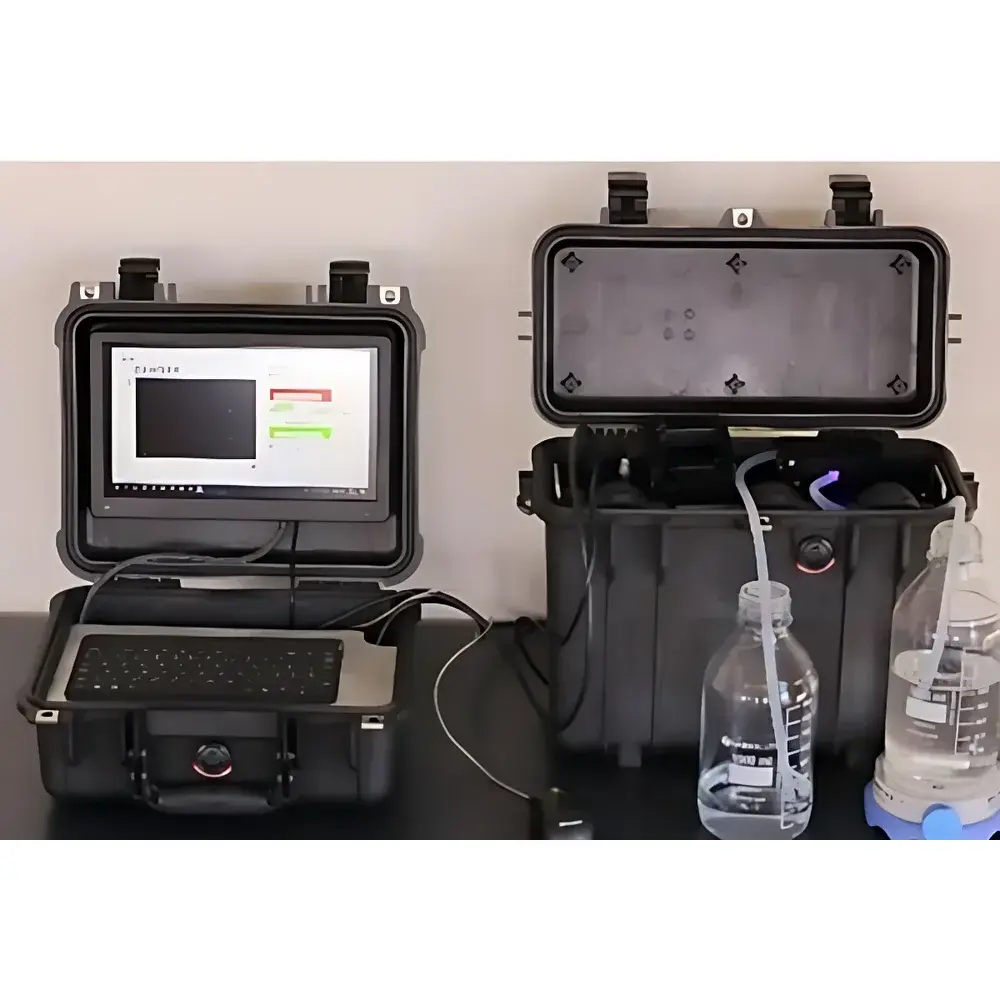
Microwise BallastWISE Ballast Water Viability Analyzer
| Brand | Microwise |
|---|---|
| Origin | Denmark |
| Model | BallastWISE |
| Portability | Portable |
| Biological Target | Algal and zooplanktonic organisms |
| Operating Temperature | 0–40 °C |
| Reagent Storage Temperature | 0–40 °C |
| Repeatability | ±1% |
| Sample Throughput | Per batch |
| Analysis Time | 5 s |
| Detection Principle | Dual-mode fluorescence imaging + motility-based viability assessment |
| Size Classes Quantified | 10–50 µm and >50 µm |
Overview
The Microwise BallastWISE Ballast Water Viability Analyzer is an ISO/IEC 17025-aligned, field-deployable instrument engineered for rapid, regulatory-compliant assessment of viable organisms in ballast water discharges. It directly addresses the quantitative verification requirements of the International Maritime Organization (IMO) Ballast Water Management Convention Regulation D-2 and the U.S. Coast Guard (USCG) Type Approval standards. Unlike bulk fluorescence or ATP-based methods, BallastWISE employs a patented dual-parameter optical detection principle: simultaneous high-resolution imaging of chlorophyll-a autofluorescence (for phototrophic organisms) and real-time motion tracking (for heterotrophic and non-photosynthetic viable organisms). This enables species-agnostic viability determination across the critical size fractions—10–50 µm and >50 µm—without chemical staining, sample concentration, filtration, or fixation. The system’s core architecture integrates a scientific-grade CMOS camera, pulsed LED excitation at 450 nm and 530 nm, embedded microprocessing, and a disposable flow-through imaging chamber. Its design complies with IMO G8 guidelines for alternative compliance monitoring and supports GLP-aligned data integrity under FDA 21 CFR Part 11 when operated with audit-trail-enabled software configurations.
Key Features
- Regulatory-Aligned Dual-Mode Viability Detection: Combines chlorophyll-a fluorescence imaging (for algae and cyanobacteria) with autonomous motility analysis (for copepods, rotifers, crustacean nauplii, and other non-photosynthetic organisms), ensuring comprehensive coverage of D-2-relevant taxa.
- No Reagents, No Sample Prep: Eliminates reliance on CMFDA, FDA, or other viability dyes—removing inter-laboratory variability, biosafety handling requirements, and dye-induced false negatives in metabolically active but non-staining species.
- Single-Organism Sizing & Classification: Each detected object is individually segmented, measured (minimum resolvable diameter: 8 µm), and classified into IMO-defined size bins using calibrated pixel-to-micron mapping and morphological filtering.
- Field-Ready Rugged Design: IP65-rated enclosure, shock-absorbing chassis, and battery-operated operation (optional 12 V DC or AC input) enable deployment on vessel decks, port-side inspection zones, or mobile labs without climate-controlled infrastructure.
- Real-Time Visual Verification: Live feed from the imaging chamber is streamed to the integrated display or external monitor, allowing operators to visually confirm fluorescent signal intensity, motility patterns, and chamber cleanliness during analysis.
- Disposable Imaging Chambers: Pre-sterilized, single-use polymeric chambers prevent cross-contamination between samples and eliminate maintenance downtime associated with cleaning microfluidic channels or objective lenses.
Sample Compatibility & Compliance
BallastWISE accepts raw, unfiltered seawater, brackish, and freshwater ballast samples—including turbid, sediment-laden, or low-biomass matrices—without pre-treatment. Validation studies conducted at DHI’s ETV-accredited facility (in accordance with ISO/IEC 17025:2017) demonstrated linearity (r² ≥ 0.92) and statistical equivalence (p < 0.05) against manual epifluorescence microscopy for both size classes across 53 natural and spiked samples. The system meets IMO G8 “Alternative Monitoring Method” criteria for type approval support and satisfies USCG Environmental Technology Verification (ETV) protocol requirements for precision, robustness, and method comparability. All firmware and analysis algorithms are version-controlled and traceable per IEC 62304 Class B software safety requirements. Data export formats include CSV, PDF reports compliant with ISO 19960-1:2021, and XML structured for integration with port state control (PSC) reporting platforms.
Software & Data Management
The BallastWISE Control Suite (v3.2+) runs on embedded Linux and provides full audit trail functionality per FDA 21 CFR Part 11, including user authentication, electronic signatures, session logging, and immutable record archiving. Each analysis generates a timestamped, digitally signed report containing raw image thumbnails, size distribution histograms, viability confidence scores (0–100%), and pass/fail status relative to IMO D-2 thresholds (10 viable organisms/mL for 10–50 µm; 10 viable organisms/m³ for >50 µm). Data can be exported via USB, Ethernet, or optional LTE module. Remote diagnostics and firmware updates are supported through TLS-encrypted OTA channels. For laboratory integration, the system supports HL7 and ASTM E1384-compliant data exchange protocols.
Applications
- Onboard verification of ballast water treatment system (BWTS) performance prior to discharge
- Port State Control (PSC) inspections under IMO and USCG enforcement frameworks
- Type approval testing and routine surveillance for BWTS manufacturers
- Third-party compliance monitoring by classification societies and accredited laboratories
- Research applications in marine bioinvasion risk assessment and treatment efficacy benchmarking
- Long-term trend analysis of ballast water viability profiles across geographic regions and seasons
FAQ
Does BallastWISE require calibration with reference organisms?
No. The system uses geometric calibration (via NIST-traceable stage micrometers) and optical intensity normalization against stable LED references. Biological validation is performed per IMO G8 Annex 4 using certified live cultures (e.g., Tetraselmis sp., Brachionus plicatilis), not daily calibration.
Can it detect bacteria or viruses?
No. BallastWISE is validated exclusively for the IMO D-2 size classes (10–50 µm and >50 µm). Organisms below 10 µm—including most bacteria and all viruses—fall outside its optical resolution and regulatory scope.
Is training required to operate the system?
Operators require ≤4 hours of competency-based training covering sample loading, chamber insertion, software navigation, and report interpretation. No microscopy or microbiology expertise is necessary.
How is data integrity ensured during offline operation?
All analyses are locally stored in encrypted SQLite databases with SHA-256 hashing. Upon network reconnection, timestamps, hashes, and operator IDs are synchronized to central repositories with blockchain-style ledger verification.
What maintenance is required?
Only periodic replacement of disposable chambers and annual optical alignment verification by authorized service centers. No consumables beyond chambers; no lamps, filters, or reagents to manage.







