
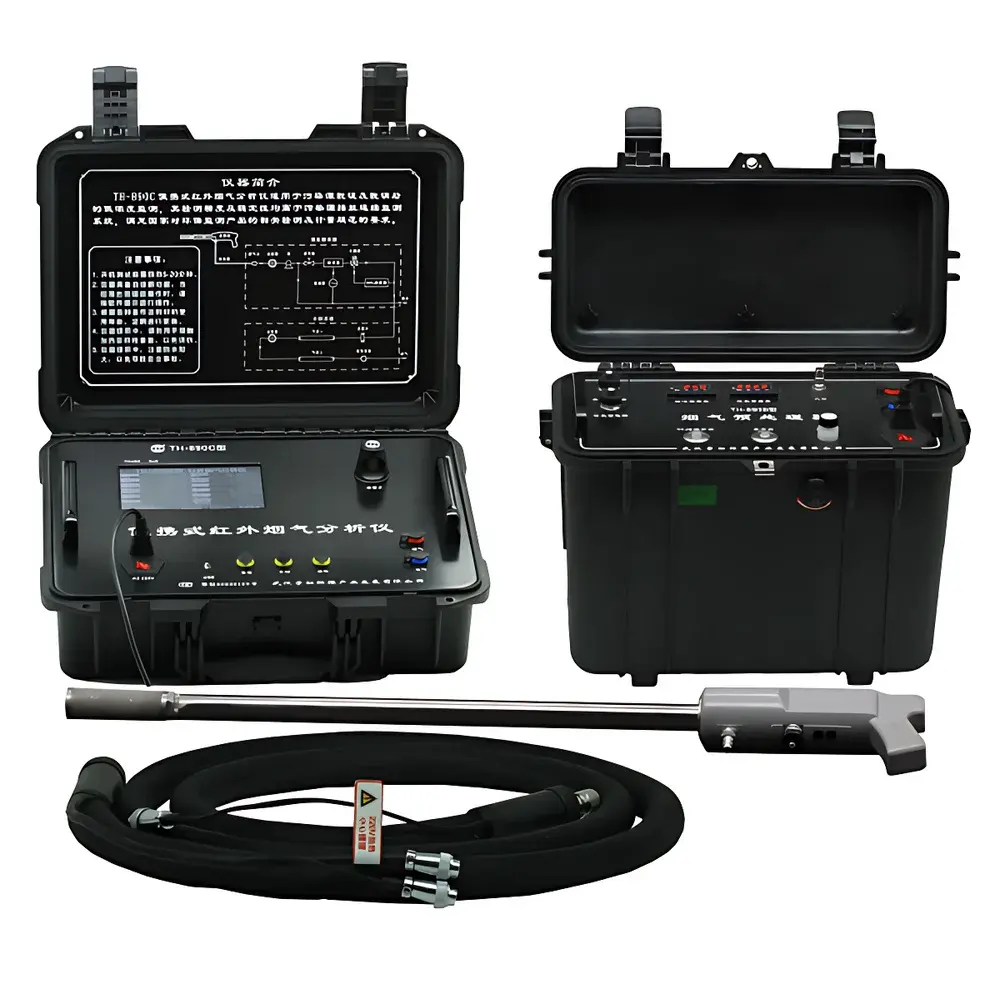
Yuhong TH-890C Portable Infrared Flue Gas Analyzer
| Brand | Yuhong |
|---|---|
| Model | TH-890C |
| Measurement Principle | Non-Dispersive Infrared (NDIR) Spectroscopy |
| Gas Channels | 5 (SO₂, NOₓ, CO, CO₂, O₂) |
| Dual-Range per Channel | Yes (e.g., SO₂/NOₓ: 0–100 ppm / 0–2000 ppm) |
| Accuracy | ±1% FS |
| Repeatability | ≤1% FS |
| Response Time (T₉₀) | ≤60 s |
| Zero Drift (24 h) | ≤1% FS |
| Sample Flow Rate | 3 L/min |
| Dew Point Control Range | 2–4 °C |
| Heated Sampling Probe | PID-controlled, corrosion-resistant, low-adsorption |
| Built-in NOₓ Converter | Optional |
| Data Storage | ≥5 years (internal) |
| Compliance | Designed for EPA Method 6C, EN 15267, ISO 12039, and GLP/GMP-aligned data integrity practices |
| Power Supply | Rechargeable Li-ion battery + AC adapter |
Overview
The Yuhong TH-890C Portable Infrared Flue Gas Analyzer is a field-deployable, NDIR-based gas measurement system engineered for regulatory-grade flue gas monitoring at stationary emission sources. It employs dual-beam non-dispersive infrared spectroscopy with thermopile detectors to quantify trace and major combustion gases—including SO₂, NOₓ (as NO and NO₂), CO, CO₂, and O₂—without chemical reagents or consumables. The instrument integrates a heated sampling probe, thermoelectrically cooled gas conditioning module, and precision flow control into a single ruggedized chassis, enabling reliable operation in high-humidity, particulate-laden, and temperature-variable stack environments. Its architecture complies with the physical and metrological requirements of reference method validation under EPA Performance Specification 2 (PS-2) and EN 15267-3 for portable analyzers used as CEMS audit tools.
Key Features
- Dual-range NDIR channels for SO₂ and NOₓ (0–100 ppm / 0–2000 ppm), delivering 1:20 range ratio flexibility across low-efficiency scrubber outlets and raw flue ducts.
- Peltier-cooled gas conditioner maintaining dew point at 2–4 °C, minimizing water vapor interference while preserving reactive species integrity.
- Heated, corrosion-resistant sampling probe with integrated PID temperature control (up to 180 °C), featuring low-adsorption fluoropolymer surfaces and sub-micron particulate filtration.
- Self-contained gas handling: imported diaphragm vacuum pump (3 L/min nominal flow), peristaltic condensate removal pump, auto-regulating needle valve, and real-time flow monitoring.
- Onboard NOₓ catalytic converter (optional), enabling total NOₓ quantification via NO₂-to-NO conversion prior to detection.
- High-resolution capacitive touchscreen interface with embedded operating system; supports multi-language UI, on-device calibration logging, and real-time spectral diagnostics.
- Battery-powered operation (>4 hours continuous use) with hot-swappable Li-ion modules and AC/DC universal input compatibility.
Sample Compatibility & Compliance
The TH-890C is validated for use with flue gases from coal-, oil-, gas-, biomass-, and waste-fired combustion systems, including utility boilers, municipal solid waste incinerators, cement kilns, steel reheating furnaces, and chemical process heaters. Its sample conditioning design meets ISO 12039 requirements for moisture management and particulate rejection. All internal wetted surfaces are chemically inert (316L SS, PTFE, FEP), ensuring minimal adsorption of SO₂ and NOₓ. Data acquisition firmware implements time-stamped audit trails, user authentication, and electronic signature support—aligning with FDA 21 CFR Part 11 and EU Annex 11 expectations for regulated environmental reporting. Calibration records, zero/span events, and system diagnostics are stored with immutable timestamps and exportable in CSV or XML format.
Software & Data Management
Embedded firmware provides full-cycle data lifecycle control: real-time concentration plotting, automatic curve fitting for peak integration, configurable averaging intervals (6–300 s), and dynamic unit switching (ppm ↔ mg/m³ at user-defined T/P conditions). Historical datasets—spanning ≥5 years—are organized by test ID, location tag, operator ID, and calibration certificate number. Data export occurs via USB mass storage mode (no driver required) or optional Wi-Fi module (IEEE 802.11n, WPA2-Enterprise). The system supports direct thermal printing via Bluetooth or USB-connected printers and generates PDF reports compliant with EN 14181 QA/QC documentation standards. Remote firmware updates and configuration backup/restore are performed over secure HTTPS.
Applications
- Reference measurement for CEMS performance evaluation and relative accuracy testing (RAT) per EPA PS-2 and EN 15267.
- Stack testing during boiler commissioning, SCR/SNCR optimization, and FGD system troubleshooting.
- Periodic compliance audits for national emission standards (e.g., China’s GB 13223, EU IED BREFs, U.S. NSPS Subpart Db).
- Process control feedback in lime kilns, rotary dryers, and thermal oxidizers where rapid gas composition shifts occur.
- Research-grade emission profiling in university combustion labs and third-party verification institutes.
- Mobile source emissions screening when coupled with pitot tube arrays and differential pressure transducers (optional add-ons).
FAQ
What calibration gases are required for routine operation?
Certified NIST-traceable span gases (e.g., 50 ppm SO₂ in N₂, 200 ppm NO in air) and zero air (hydrocarbon-free, <0.1 ppm THC) are recommended. Air-based zero checks are permissible for daily verification but not for formal calibration.
Can the TH-890C measure NH₃ or HCl?
No—NH₃ and HCl fall outside the operational spectral window of standard NDIR detectors. These require tunable diode laser (TDLAS) or FTIR-based platforms.
Is the built-in NOₓ converter certified for EN 15267-3 equivalence?
When installed and validated per manufacturer protocol, the converter enables total NOₓ compliance with EN 15267-3 Annex D requirements for catalytic reduction efficiency (>95% at 300–400 °C).
How is data integrity ensured during power interruption?
All active measurements are buffered in non-volatile memory; unsaved data is retained across battery swaps and AC loss. Timestamps derive from an onboard RTC with ±2 sec/year drift.
Does the system support remote diagnostics via modem or cellular link?
Yes—via optional 4G LTE module with static IP assignment and TLS 1.2 encrypted telemetry, compatible with SCADA-level integration using Modbus TCP or MQTT protocols.







