
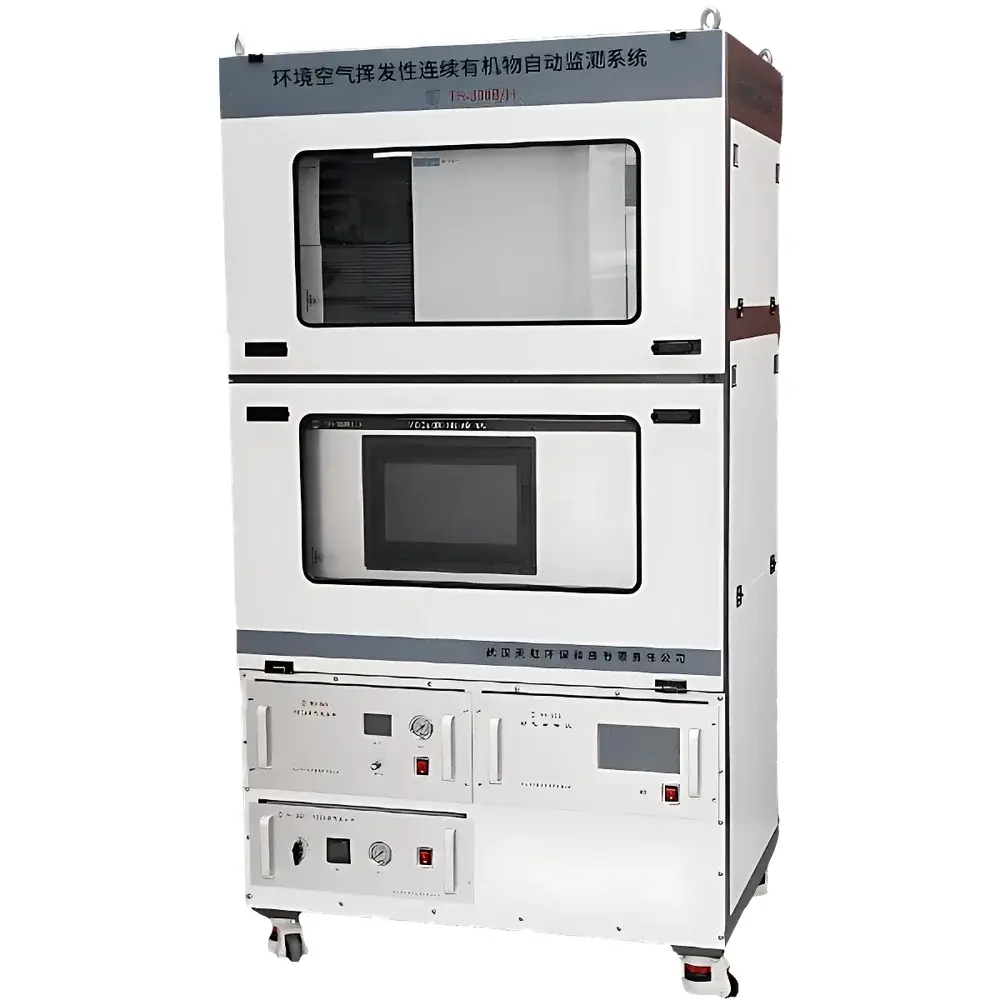
Tianhong TH-300B/H Environmental Air Volatile Organic Compounds Continuous Automatic Monitoring System (116-Component Full Speciation)
| Brand | Tianhong |
|---|---|
| Origin | Hubei, China |
| Manufacturer Type | Authorized Distributor |
| Country of Origin | China |
| Model | TH-300B/H |
| Detection Principle | Gas Chromatography–Mass Spectrometry (GC-MS) with Flame Ionization Detection (FID) |
| Instrument Type | Online Analytical System |
| Typical Configuration | Integrated VOC Speciation Analyzer |
| Sampling Method | Active Whole-Air Sampling with Cryogenic Preconcentration |
| Detection Range | 0–50 nmol/mol (ppbv) |
| Accuracy | ±10% of Reading |
| Compliance Standard | HJ 1010–2018 |
Overview
The Tianhong TH-300B/H Environmental Air Volatile Organic Compounds Continuous Automatic Monitoring System is an online analytical platform engineered for unattended, high-temporal-resolution speciation of 116 priority volatile organic compounds (VOCs) in ambient air. It operates on a dual-channel cryogenic preconcentration–gas chromatography–mass spectrometry (GC-MS) architecture, augmented by parallel flame ionization detection (FID) for enhanced hydrocarbon quantification and cross-validation. The system implements patented ultra-low-temperature empty-tube trapping, achieving cryofocusing at –190 °C to retain highly volatile species—including formaldehyde precursors, C2–C5 alkenes, and chlorinated methanes—that are typically lost in conventional sorbent-based systems. Integrated cryogenic water removal at –60 °C ensures matrix robustness without chemical derivatization or permeation dryers, preserving analyte integrity across humidity ranges from 10% to 90% RH. Designed to meet the operational and reporting requirements of HJ 1010–2018, the TH-300B/H delivers continuous 30-minute cycle time with zero sampling dead time—enabling hourly speciated VOC profiles compliant with regional photochemical assessment monitoring networks.
Key Features
- Dual independent cryogenic enrichment channels with programmable trapping temperatures from –190 °C to –40 °C, enabling method-specific optimization for target compound classes (e.g., PAMS, TO-15, carbonyls)
- Integrated cryo-desiccation stage operating at –60 °C ± 0.5 °C, providing selective water removal without CO2 or polar VOC loss
- Simultaneous GC-MS/FID analysis on two parallel columns: one optimized for polar carbonyls and oxygenates (DB-624), the other for non-polar hydrocarbons (DB-1ms), eliminating need for heart-cutting hardware
- Automated calibration verification using certified gas standards traceable to NIM (National Institute of Metrology, China); full calibration curve generation every 24 hours
- Onboard data acquisition with 100 ms MS dwell time per ion, supporting library-based identification (NIST 2017) and isotopic ratio confirmation for critical markers (e.g., benzene-d6, toluene-d8)
- Ruggedized industrial enclosure rated IP54, designed for rooftop or fence-mounted deployment in ambient temperature range –20 °C to +45 °C
Sample Compatibility & Compliance
The TH-300B/H is validated for direct analysis of ambient air without sample dilution or pre-treatment. It quantitatively resolves all 57 PAMS (Photochemical Assessment Monitoring Stations), 47 TO-15 compounds (including vinyl chloride, 1,3-butadiene, and chloroform), and 12 C1–C4 carbonyls—including formaldehyde, acetaldehyde, and acetone—as specified in HJ 1010–2018. The system meets the standard’s requirements for limit of detection (LOD ≤ 0.05 nmol/mol), precision (RSD ≤ 15% at 5×LOD), and long-term stability (drift ≤ ±5% over 7 days). While not certified to ISO/IEC 17025 under third-party accreditation, its firmware and audit trail log structure support GLP-compliant operation, including electronic signatures, user-level access control, and immutable event logging aligned with principles of FDA 21 CFR Part 11 Annex 11.
Software & Data Management
The embedded Tianhong VOC-Analyzer v4.2 software provides real-time chromatogram visualization, automated peak integration using retention time locking (RTL), and multi-point calibration management. Raw data files (.raw, .cdf) are stored locally on redundant SSDs with automatic daily backup to network-attached storage (NAS) via configurable SFTP. Export formats include CSV (EPA Comma-Separated Values), NetCDF (for atmospheric modeling input), and XML (compatible with national environmental data platforms). Remote diagnostics, firmware updates, and method deployment are supported through TLS 1.2-secured web interface accessible via authenticated HTTPS. Audit logs record all user actions—including method edits, calibration injections, and instrument status changes—with timestamps synchronized to NTP servers.
Applications
- Urban and suburban ambient air quality monitoring networks requiring speciated VOC data for ozone and secondary organic aerosol (SOA) precursor analysis
- Source apportionment studies using positive matrix factorization (PMF) or chemical mass balance (CMB) models
- Industrial fence-line monitoring near petrochemical, coating, and printing facilities
- Validation of satellite-based VOC retrievals (e.g., TROPOMI formaldehyde columns) through ground-truth time series
- Long-term trend analysis of regulatory compounds under China’s “Blue Sky Defense Campaign” and regional air pollution prevention plans
- Research applications involving diurnal cycling of biogenic VOCs (isoprene, monoterpenes) and anthropogenic tracers (ethylbenzene, m/p-xylene)
FAQ
What VOC compound classes does the TH-300B/H quantify beyond the mandated 116-species list?
The system supports semi-quantitative identification of additional VOCs—including halogenated ethers, nitriles, and sulfur-containing compounds—via NIST spectral matching and retention index interpolation, provided they elute within the configured GC temperature program window.
Is the system compatible with external meteorological sensors or particulate monitors?
Yes—RS-485 and Modbus TCP interfaces allow synchronous ingestion of co-located PM2.5, NOx, O3, temperature, relative humidity, and wind vector data for integrated environmental correlation analysis.
How is method validation documented for regulatory reporting?
Each 24-hour operational cycle generates a QC report containing calibration verification results, system suitability metrics (retention time shift, peak symmetry), and blank subtraction logs—all exportable as PDF with digital signature and timestamp.
Can the cryogenic trapping module be serviced in situ without system downtime?
The dual-channel design enables hot-swap maintenance: while one channel undergoes regeneration (bake-out at 250 °C), the second continues uninterrupted sampling and analysis.
Does the system support remote method reconfiguration during field deployment?
Yes—pre-approved method templates (e.g., “Summer High-Formaldehyde Mode”, “Winter Low-VOC Mode”) can be selected and activated remotely via secure web console without physical access or reboot.







