
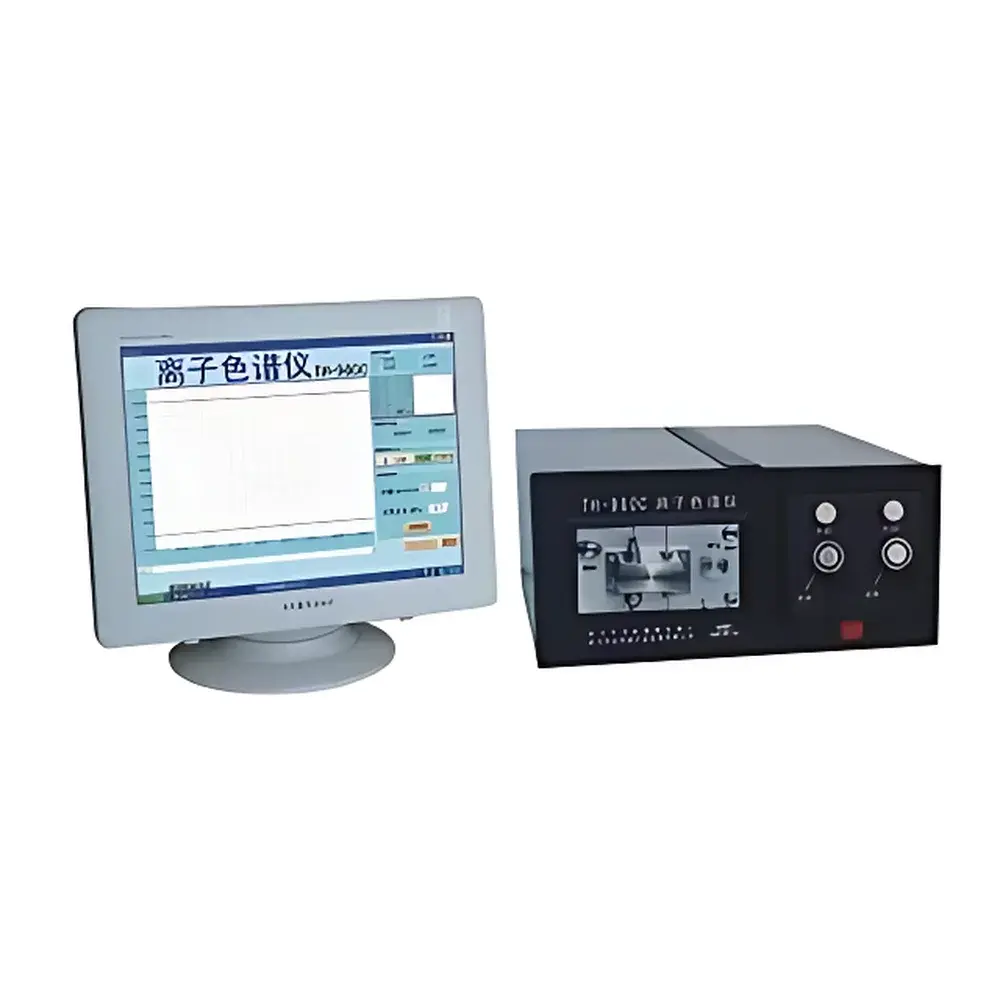
TH-980C Ion Chromatograph
| Origin | Hubei, China |
|---|---|
| Manufacturer Type | Distributor |
| Origin Category | Domestic |
| Model | TH-980C |
| Instrument Type | Laboratory |
| Anion Separation | 7 anions in ≤16 min |
| Anion Detection Limit | ≤5 µg/L (as Cl⁻) |
| Anion RSD | ≤3% (as SO₄²⁻) |
| Linear Range | ≥10² |
| Cation Separation | Li⁺, Na⁺, NH₄⁺, K⁺ in ≤16 min |
| Na⁺ Detection Limit | <50 µg/L |
| Conductivity Detector Resolution | ≤1/20,000 |
| Conductivity Range | 1–1000 µS |
| Pump Flow Rate | 0.1–5 mL/min |
| Max Pressure | 0–15 MPa |
| Flow Stability | ±1% |
| Pressure Fluctuation | ±1% |
Overview
The TH-980C Ion Chromatograph is a laboratory-grade, domestically engineered ion chromatography system designed for high-precision quantitative analysis of common inorganic anions and cations in aqueous matrices. Based on suppressed conductivity detection and high-efficiency ion-exchange separation, the TH-980C employs a dual-pulse conductivity detector coupled with an auto-regenerating chemical suppressor to deliver enhanced sensitivity, extended linear dynamic range, and robust baseline stability. Its modular architecture integrates gradient-capable high-pressure liquid delivery, thermally stabilized separation columns, real-time temperature monitoring with automatic compensation, and fully computer-controlled operation via dedicated chromatography software. The system is optimized for routine compliance-driven applications where regulatory traceability, method reproducibility, and low-maintenance operation are critical — including environmental water testing, food safety screening, pharmaceutical excipient analysis, and public health surveillance.
Key Features
- Integrated benchtop design with compact footprint and ergonomic layout, minimizing laboratory space requirements while maintaining mechanical rigidity and thermal stability.
- Dual-pulse conductivity detection system delivering improved signal-to-noise ratio and expanded linear response (≥10²), enabling accurate quantification across wide concentration ranges without manual range switching.
- Self-regenerating chemical suppressor operating continuously without daily acid replacement — significantly reducing consumable dependency, operator intervention, and long-term operational cost.
- Digitally controlled high-pressure pump with flow accuracy of ±1% and pressure stability of ±1% over full range (0.1–5 mL/min, up to 15 MPa), supporting both isocratic and gradient elution protocols.
- On-board temperature sensing with real-time baseline drift correction: column oven and detector cell temperatures are monitored and compensated automatically to maintain baseline offset near zero over multi-hour runs.
- Embedded digital signal processing eliminates legacy data acquisition cards, resulting in sub-microsiemens baseline noise and enhanced reproducibility (RSD ≤3% for SO₄²⁻).
Sample Compatibility & Compliance
The TH-980C accepts clarified, filtered aqueous samples with minimal pretreatment — typically dilution and 0.22 µm membrane filtration — making it suitable for direct analysis of drinking water, wastewater, rainwater, beverage extracts, and leachates. It supports standard EPA Methods 300.0, 300.1, and 314.0 for anion analysis, as well as ISO 10304-1:2012 for multi-ion determination in water. While not pre-certified for 21 CFR Part 11, its software architecture supports audit-trail-enabled user authentication, electronic signature logging, and immutable raw data storage — facilitating GLP/GMP-aligned validation when deployed within controlled laboratory environments. All hardware components comply with IEC 61010-1 safety standards for laboratory electrical equipment.
Software & Data Management
Control and data processing are performed using a Windows-based chromatography workstation offering intuitive method setup, real-time peak integration, customizable calibration curves (linear, quadratic, or weighted), and automated report generation. Batch processing supports sequence queues with sample ID tagging, retention time locking, and QC flagging based on user-defined acceptance criteria (e.g., %RSD, signal-to-noise, retention time window). Raw chromatograms, processed results, and instrument logs are stored in vendor-neutral formats (CSV, PDF, XML) to ensure long-term accessibility and third-party data interoperability. Software updates are delivered via secure offline packages to preserve system integrity in regulated settings.
Applications
- Environmental monitoring: Quantification of F⁻, Cl⁻, NO₂⁻, Br⁻, NO₃⁻, PO₄³⁻, SO₄²⁻ in surface water, groundwater, and effluent per national and regional water quality standards.
- Food & beverage QA/QC: Determination of nitrate/nitrite in dairy products, sulfite in wines, bromide in bottled water, and sodium/potassium in nutritional labeling.
- Pharmaceutical analysis: Testing of counterions (Na⁺, K⁺, Cl⁻) in APIs and excipients; residual ion profiling in purified water (PW) and water-for-injection (WFI) systems.
- Public health laboratories: Rapid screening of anions in drinking water distribution networks and outbreak-related samples under WHO and CDC guidelines.
- Industrial process control: Monitoring of chloride ingress in cooling water systems, sulfate in desalination brines, and ammonium in fermentation broths.
FAQ
What anions and cations can the TH-980C quantify simultaneously in a single run?
The TH-980C is configured for sequential rather than fully simultaneous multi-ion analysis. Standard methods resolve up to seven common anions (F⁻, Cl⁻, NO₂⁻, Br⁻, NO₃⁻, PO₄³⁻, SO₄²⁻) within 16 minutes, and six cations (Li⁺, Na⁺, NH₄⁺, K⁺, Mg²⁺, Ca²⁺) in two separate injections (≤16 min and ≤12 min respectively). Method development allows optimization for specific ion subsets.
Is the suppressor truly maintenance-free?
The self-regenerating suppressor operates without daily acid replenishment and requires only periodic regeneration solution replacement every 2–4 weeks depending on usage frequency and eluent concentration. No manual recharging or disassembly is needed during normal operation.
Does the system support external standards or internal standard calibration?
Yes — the workstation supports both external calibration curves and internal standard correction (e.g., using 2,4-dinitrobenzoic acid for anions or Li⁺ for cations), with configurable integration of IS peak area ratios into final concentration calculations.
Can the TH-980C be validated for ISO/IEC 17025 accreditation?
Yes — the system’s documented performance specifications (detection limits, precision, linearity, carryover), combined with software audit trail capability and full instrument parameter logging, provide foundational evidence required for method validation and laboratory accreditation under ISO/IEC 17025:2017 Clause 7.2 and 7.7.
What is the typical service life of the analytical column under routine use?
With proper mobile phase filtration, regular guard column replacement, and avoidance of particulate-laden or highly contaminated samples, the recommended lifespan of the standard anion-exchange column is 1,500–2,000 injections; cation columns typically exceed 2,500 injections under equivalent conditions.




