
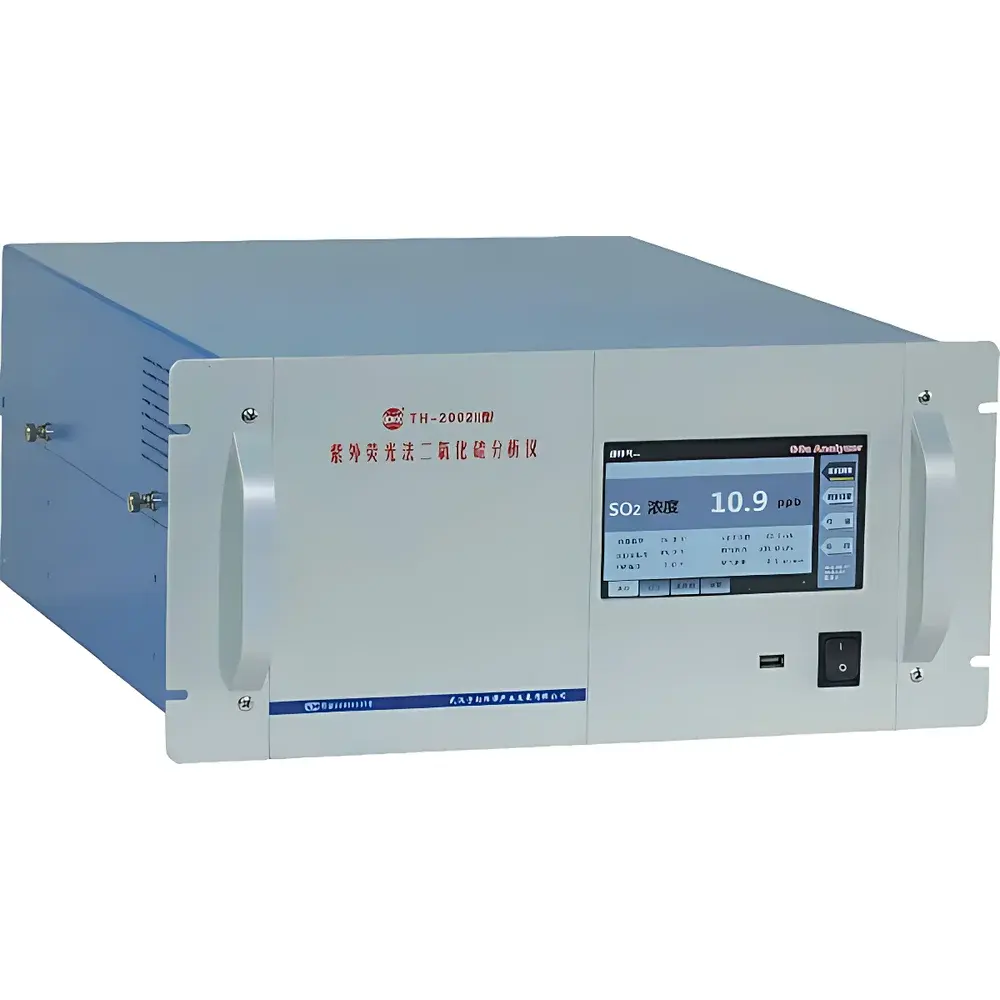
Tianhong TH-2002H UV Fluorescence Sulfur Dioxide (SO₂) Analyzer
| Brand | Tianhong |
|---|---|
| Origin | Hubei, China |
| Manufacturer Type | Authorized Distributor |
| Country of Manufacture | China |
| Model | TH-2002H |
| Price Range | USD 9,800 – 14,000 |
| Detection Principle | Ultraviolet Fluorescence (UVF) |
| Measurement Range | 0–100 ppb to 0–20 ppm (selectable auto-ranging) |
| Interface | RS-232 serial port |
| Compensation | Automatic temperature and pressure compensation |
| Signal Processing | Kalman digital filtering algorithm |
| Dual-Beam Optical Design | Sample channel + reference channel (Zn lamp monitoring) |
| Display & Control | Full Chinese GUI interface |
| Overrange Handling | Auto-range switching at >90% of full scale |
Overview
The Tianhong TH-2002H UV Fluorescence Sulfur Dioxide (SO₂) Analyzer is a fixed-site ambient air quality monitoring instrument engineered for continuous, high-sensitivity quantification of sulfur dioxide in outdoor and indoor environments. It operates on the well-established ultraviolet fluorescence principle: SO₂ molecules are excited by pulsed 214 nm UV light emitted from a stabilized zinc vapor lamp; upon relaxation, they emit characteristic fluorescence at ~350 nm, which is detected by a low-noise photomultiplier tube (PMT). The intensity of this fluorescence is linearly proportional to SO₂ concentration over six orders of magnitude, enabling precise measurement across sub-ppb to multi-ppm ranges. Designed for unattended operation in regulatory-grade monitoring networks, the TH-2002H integrates optical stability, environmental compensation, and robust signal processing—making it suitable for compliance with national ambient air quality standards (e.g., China’s GB 3095-2012), as well as international reference methods aligned with EPA Method 40 CFR Part 53 and ISO 7935:1996.
Key Features
- Dual-beam optical architecture: Simultaneous monitoring of sample fluorescence signal and reference Zn-lamp intensity mitigates drift caused by source aging or thermal fluctuation—ensuring long-term baseline stability without frequent recalibration.
- Intelligent auto-ranging capability: Dynamically switches between user-configurable concentration spans (e.g., 0–100 ppb, 0–1 ppm, 0–20 ppm) based on real-time signal level—triggering range upshift when output exceeds 90% of current full scale and downshift upon return below 80%—eliminating manual intervention during transient pollution events.
- Real-time environmental compensation: Integrated temperature and barometric pressure sensors feed data into correction algorithms that normalize measured fluorescence yield to standard reference conditions (25 °C, 101.325 kPa), improving inter-instrument comparability and reducing site-specific calibration burden.
- Kalman digital filtering: Implements a recursive state-estimation algorithm optimized for minimum mean-square error, balancing response time (T₉₀ ≤ 90 s) and signal-to-noise ratio (SNR ≥ 40 dB at 10 ppb)—critical for resolving rapid SO₂ fluctuations near industrial fence lines or traffic corridors.
- RS-232 serial communication interface: Enables seamless integration into centralized telemetry systems (e.g., SCADA, EPA AQS, or local EMS platforms) for remote configuration, data polling, alarm reporting, and firmware updates—supporting Modbus RTU protocol for interoperability.
Sample Compatibility & Compliance
The TH-2002H is validated for direct analysis of ambient air, stack effluent (with optional heated sampling line and particulate filter), and indoor ventilation ducts. Sample gas enters via a Nafion™-based permeation dryer or chilled mirror dew point controller (external accessory) to maintain relative humidity below 40%—preventing quenching effects and condensation-induced optical interference. All wetted materials comply with ASTM D5502-17 requirements for SO₂ analyzers. While not certified under U.S. EPA EQCM or EU MCERTS schemes, its measurement performance aligns with the technical specifications referenced in EN 14212:2012 (ambient air—SO₂ determination) and supports GLP-compliant data acquisition when paired with audit-trail-enabled data loggers.
Software & Data Management
The analyzer includes embedded firmware supporting configurable data logging intervals (1–3600 seconds), internal storage for ≥30 days of 1-minute averaged values, and timestamped event logs (power cycles, range changes, calibration actions). Raw fluorescence counts, compensated concentration outputs, diagnostic voltages, and sensor status flags are transmitted via RS-232 in ASCII format. Third-party software compatibility includes EPA’s AIRNow-compatible parsers, LabVIEW drivers, and Python-based ingestion scripts using pySerial—facilitating integration into cloud-hosted environmental dashboards (e.g., ThingSpeak, AWS IoT Core) with TLS-secured MQTT publishing. Audit trail functionality meets basic GLP traceability requirements; full 21 CFR Part 11 compliance requires external validation of the host data acquisition system.
Applications
- Ambient air quality monitoring networks operated by municipal EPBs and provincial ecological environment bureaus
- Continuous emissions monitoring systems (CEMS) for coal-fired power plants, sulfuric acid production facilities, and metal smelters
- Urban roadside and school-zone exposure assessment studies requiring high temporal resolution
- Indoor air quality audits in industrial workplaces subject to OSHA PEL or ACGIH TLV limits for SO₂
- Method validation and field intercomparison campaigns supporting ISO/IEC 17025-accredited laboratories
FAQ
What is the lower detection limit (LDL) of the TH-2002H under typical operating conditions?
The instrument achieves an LDL of ≤2 ppb (signal-to-noise ratio = 3) with 1-minute averaging, verified per ISO 11843-1:1997 protocols.
Does the analyzer require zero/span calibration gases during routine operation?
Yes—daily automated zero checks using synthetic zero air (≤0.5 ppb SO₂) and biweekly span verification with NIST-traceable SO₂ standards (e.g., 50% of selected range) are recommended for regulatory-grade data validity.
Can the TH-2002H be deployed in high-humidity environments without external drying?
No—uncompensated humidity above 60% RH causes measurable fluorescence quenching; installation must include either a Nafion dryer or chilled-mirror conditioner upstream of the inlet.
Is remote firmware update supported over RS-232?
Yes—field-upgradable firmware binaries can be loaded via XMODEM protocol using terminal emulation software (e.g., Tera Term, PuTTY) with proper access credentials.
What maintenance intervals are specified for the UV lamp and PMT detector?
The Zn lamp has a rated lifetime of ≥12,000 hours; the PMT is warrantied for 5 years against gain degradation exceeding 15%—both components are user-replaceable with optical alignment fixtures provided.
Related Products







