
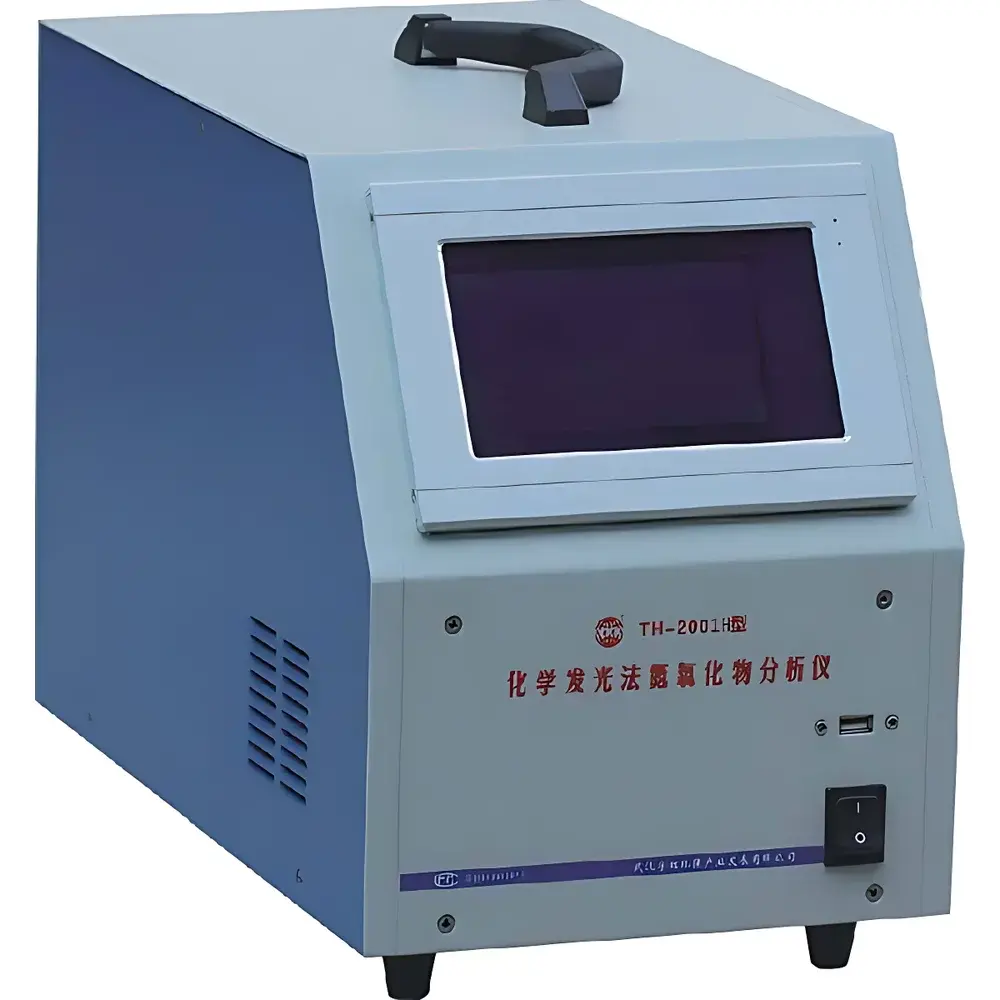
Yuhong TH-2001H Portable Nitrogen Oxides (NOₓ) Analyzer
| Brand | Yuhong |
|---|---|
| Model | TH-2001H |
| Detection Principle | Chemiluminescence (CLD) |
| Measurement Parameters | NO, NO₂, NOₓ (calculated) |
| Display | 7-inch capacitive touchscreen |
| Units | ppb, ppm, µg/m³, mg/m³ (user-selectable) |
| Data Logging | Interval-stamped records every 5 minutes |
| Power Supply | Rechargeable Li-ion battery (≥5 h operation) + AC adapter |
| Operating Environment | 0–40 °C, 10–90% RH (non-condensing) |
| Compliance | Designed for field-deployable environmental monitoring per EPA Method 42 & ISO 7935 (principles), GLP-aligned data integrity |
| Gas Path | Dual-stream, time-shared single reaction chamber with catalytic NO₂-to-NO converter |
| Automatic Compensation | Temperature and barometric pressure |
| Connectivity | Remote calibration & diagnostics via embedded communication interface |
| Alarm | Multi-parameter configurable thresholds |
Overview
The Yuhong TH-2001H Portable Nitrogen Oxides (NOₓ) Analyzer is a field-deployable, chemiluminescence-based gas measurement system engineered for quantitative determination of nitric oxide (NO), nitrogen dioxide (NO₂), and total reactive nitrogen oxides (NOₓ) in ambient air, stack emissions, and emergency response scenarios. Its core detection principle relies on the gas-phase chemiluminescent reaction between NO and ozone (O₃), generating electronically excited NO₂* that emits photons at ~600–3000 nm upon relaxation. The intensity of this emission is linearly proportional to NO concentration over six orders of magnitude. To resolve NO₂ independently, a portion of the sampled gas stream passes through a heated molybdenum or stainless-steel catalytic converter (operating at ≥325 °C), quantitatively reducing NO₂ to NO prior to reaction with O₃. By alternately routing sample gas through the direct and converted paths using precision solenoid valves, the instrument derives NO₂ as the difference between total NOₓ and NO — eliminating inter-channel bias inherent in dual-detector architectures. This time-shared single-reaction-chamber design ensures high reproducibility and minimizes calibration drift across measurement cycles.
Key Features
- 7-inch high-resolution capacitive touchscreen display with intuitive, menu-driven navigation supporting both English and Chinese language modes
- Automatic range switching across ppb to ppm and mass concentration units (µg/m³, mg/m³), with real-time unit conversion without manual recalibration
- Dynamic graphical visualization of time-series concentration data; pinch-to-zoom and pan functionality for trend analysis
- Integrated temperature and barometric pressure sensors enabling automatic density correction per ISO 10780 and EPA 40 CFR Part 60, Appendix A-4
- Adaptive signal processing algorithm optimizing detector response time (T₉₀ < 12 s typical) and signal-to-noise ratio under variable flow and humidity conditions
- Remote diagnostic capability and over-the-air calibration verification via secure serial or Bluetooth interface — compliant with remote maintenance protocols used in mobile monitoring fleets
- Dual-stream, single-channel sampling architecture ensuring identical optical path geometry and thermal history for both NO and NOₓ measurements
- Rechargeable lithium-ion battery providing ≥5 hours of continuous operation; hot-swappable battery option available for extended deployments
- Pre-heating mode enables rapid stabilization (<15 min warm-up) prior to site arrival — critical for time-sensitive compliance audits and incident response
Sample Compatibility & Compliance
The TH-2001H accepts gaseous samples with particulate loading ≤10 µm and moisture content below dew point of 5 °C at operating flow (0.8–1.2 L/min). It is validated for use with ambient air, diluted flue gas (after Nafion or permeation dryer conditioning), and indoor air matrices. Instrument design adheres to fundamental principles outlined in EPA Method 42 (Nitrogen Oxides by Chemiluminescence), ISO 7935:1990 (Stationary source emissions — Determination of nitrogen oxides — Chemiluminescence method), and EN 14792:2017 (Air quality — Determination of nitrogen dioxide and total nitrogen oxides — Chemiluminescence method). Data logging meets GLP traceability requirements: each record includes timestamp (UTC), operator ID (optional), instrument serial number, calibration status flag, and environmental compensation parameters. Audit trails are retained internally for ≥12 months (≥100,000 records).
Software & Data Management
Onboard firmware supports SD card export of CSV-formatted datasets with full metadata headers. PC-based Yuhong DataLink software (Windows/macOS compatible) enables spectral review, batch calibration curve management, QA/QC report generation (including MDL/IDL verification logs), and automated PDF export compliant with ISO/IEC 17025 documentation standards. All stored records include digital signatures verifying immutability post-acquisition. Remote access supports read-only parameter interrogation and scheduled zero/span validation — satisfying FDA 21 CFR Part 11 predicate rules when paired with user-defined electronic signature workflows.
Applications
- Emergency response to industrial NOₓ releases (e.g., chemical spills, boiler upsets)
- Regulatory stack testing and continuous emission monitoring system (CEMS) performance audits
- Urban air quality mapping campaigns and roadside pollution gradient studies
- Verification of low-NOₓ burner efficiency during commissioning
- Mobile laboratory deployments aboard environmental survey vehicles
- Comparative measurement against reference-grade analyzers in inter-laboratory round-robin studies
- Research into atmospheric NOₓ partitioning dynamics under varying photolysis conditions
FAQ
What is the minimum detectable limit (MDL) for NO under standard conditions?
The instrument achieves an MDL of ≤0.5 ppb (1σ, 60-second average) at 25 °C and 101.3 kPa when operated with certified zero air and calibrated O₃ generator.
Does the analyzer require external ozone generation?
Yes — it integrates a solid-state UV ozone generator (185 nm) with real-time O₃ concentration feedback control to maintain stoichiometric excess over the full NO range.
Can the catalytic converter be regenerated or replaced in the field?
The Mo-based converter is sealed and non-serviceable; replacement is performed at authorized service centers following ISO 17025-compliant procedures.
Is the data logger compliant with EPA’s Electronic Reporting Tool (ERT) format?
Raw output is CSV-compatible; optional ERT mapping module available for direct upload to CDX portal.
How often is calibration verification required under routine field use?
Daily zero/span checks are recommended; full multi-point calibration every 7 days or after transport-induced shock events, per ASTM D6522 guidance.







