
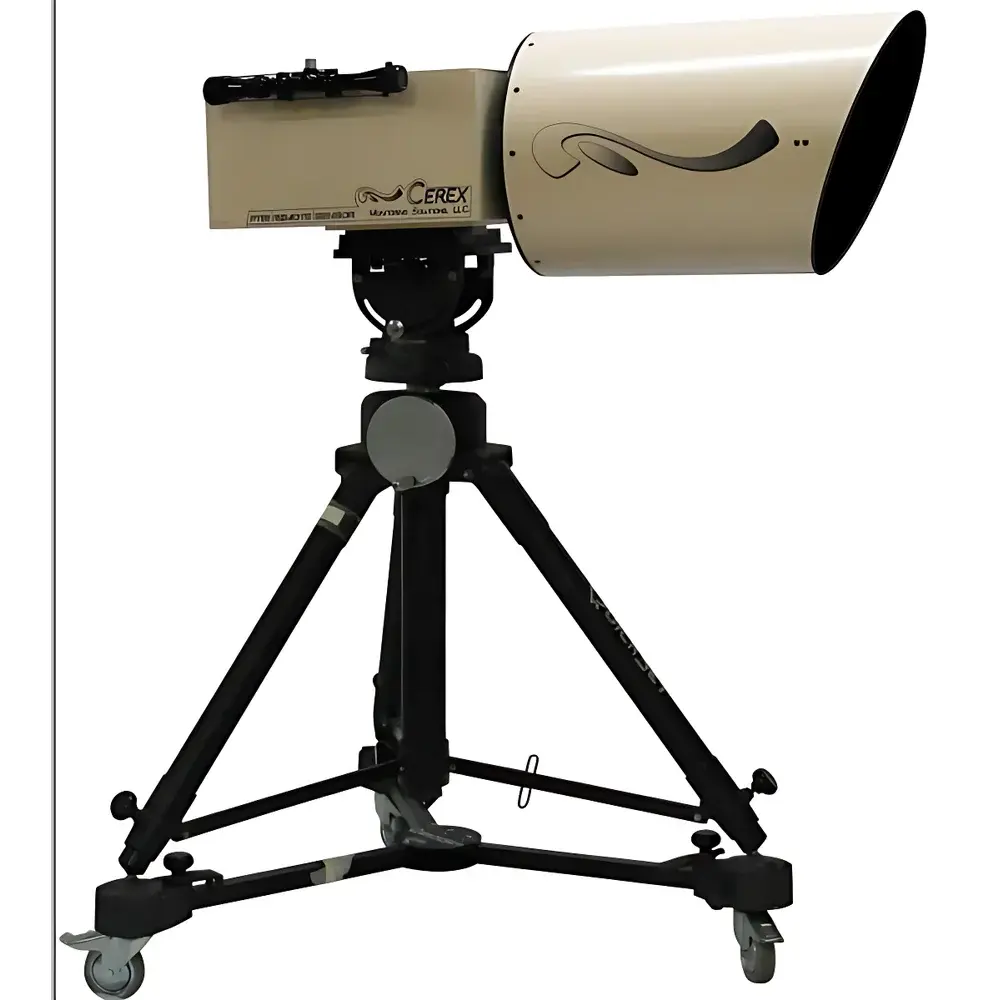
Cerex AirSentry Open Path-FTIR Gas Analyzer
| Brand | Cerex |
|---|---|
| Origin | USA |
| Manufacturer Type | Authorized Distributor |
| Origin Category | Imported |
| Model | Open Path-FTIR |
| Detection Principle | Fourier Transform Infrared (FTIR) Spectroscopy |
| Instrument Type | Online Continuous Emission Monitor |
| Typical Configuration | Multi-Gas VOC & HAPs Analyzer |
| Detection Range | 0–100 ppb (gas-dependent) |
| Spectral Resolution | 0.05–0.5 cm⁻¹ (not nm — corrected per FTIR standard) |
| Accuracy | ±1–3% of reading |
| Response Time | 1 Hz (1 spectrum per second) |
| Detector | Liquid-Nitrogen-Free Stirling-Cooled MCT |
| Cooling System | Integrated Stirling Cryocooler (MTBF ≥20,000 hrs) |
| Consumables | IR Source & Cryocooler (replacement interval: every 3 years) |
| Gas Coverage | >385 gases, including 100+ EPA-listed Hazardous Air Pollutants (HAPs), acids, aldehydes, aromatics, CFCs, greenhouse gases, hydrocarbons, and combustion byproducts |
Overview
The Cerex AirSentry Open Path-FTIR Gas Analyzer is a field-deployable, real-time atmospheric monitoring system engineered for quantitative, multi-component gas analysis using Fourier Transform Infrared (FTIR) spectroscopy. Unlike extractive or point-sensor technologies, the AirSentry employs an open-path configuration—transmitting and receiving infrared radiation across distances of up to several hundred meters—enabling path-integrated concentration measurements without physical sampling. This architecture eliminates inlet-line artifacts, adsorption losses, and calibration drift associated with pumped systems. The instrument operates on the principle of broadband mid-infrared absorption (typically 600–4000 cm⁻¹), where molecular vibrational transitions produce unique spectral fingerprints. Quantification is performed via least-squares spectral fitting against high-fidelity reference libraries compliant with HITRAN and NIST databases. Designed for unattended, continuous operation in ambient environments, the AirSentry meets performance criteria for regulatory-grade monitoring under EPA Method 320 and ISO 14956 for open-path optical gas detection.
Key Features
- Stirling-cooled Mercury Cadmium Telluride (MCT) detector—eliminates reliance on liquid nitrogen, reducing operational overhead and enabling true plug-and-play deployment
- Integrated industrial PC running Windows® OS with embedded Cerex CMS software—no external computing hardware required
- Self-calibrating optical path: internal reference cell and automated background acquisition ensure long-term baseline stability without manual intervention
- Real-time spectral acquisition at 1 Hz with selectable integration time (1–60 s), supporting dynamic plume tracking and transient event capture
- Multi-gas quantification engine capable of simultaneous detection and quantitation of >385 compounds—including EPA Toxic Release Inventory (TRI) chemicals, VOCs, HAPs, GHGs (CO₂, CH₄, N₂O), and inorganic acids (HF, HCl, SO₂, NO₂)
- Configurable alarm hierarchy with user-defined thresholds, hysteresis, and delay logic; supports email/SMS alerts via integrated cellular or Ethernet connectivity
- Robust mechanical design rated IP65, qualified for outdoor installation on tripods, rooftops, or fixed towers; operating temperature range: –20 °C to +50 °C (extended options available)
Sample Compatibility & Compliance
The AirSentry is optimized for ambient air, stack effluent, landfill perimeter air, and industrial fence-line monitoring. Its open-path geometry inherently accommodates heterogeneous, turbulent, or low-concentration plumes—making it suitable for leak detection, emergency response, and fugitive emission verification. The system complies with ASTM D6348–22 (standard test method for determination of gaseous compounds by FTIR), EPA Performance Specification 18 (PS-18) for open-path analyzers, and ISO 12039:2021 (stationary source emissions—determination of carbon monoxide, carbon dioxide and oxygen). Data integrity is maintained under 21 CFR Part 11-compliant audit trail logging when CMS software is configured with electronic signatures and role-based access control. All measurement reports include traceable metadata: spectral SNR, optical path length, atmospheric pressure/temperature/humidity corrections, and library fit residuals.
Software & Data Management
Cerex CMS (Continuous Monitoring Software) serves as the unified interface for instrument control, spectral processing, data visualization, and regulatory reporting. Built on Microsoft .NET Framework, CMS provides intuitive drag-and-drop workflow configuration, customizable dashboards, and export-ready outputs—including CSV, XML, and PDF formats compliant with EPA CDX and NetDMR submission requirements. Raw interferograms and calibrated absorbance spectra are archived with timestamp, GPS coordinates (if equipped), and environmental metadata. Remote access is enabled via VNC, HTTPS, or MODBUS TCP, allowing full instrument supervision from SCADA or centralized EMS platforms. Optional integration includes MQTT publishing for IIoT architectures, OPC UA server support, and bidirectional communication with meteorological stations for dispersion modeling inputs.
Applications
- Fence-line and community air monitoring for petrochemical, semiconductor, and pharmaceutical manufacturing facilities
- Landfill gas migration studies and biogas composition verification (CH₄, CO₂, H₂S, siloxanes)
- Emergency response to chemical releases—rapid identification and concentration mapping of toxic vapors (e.g., ammonia, chlorine, phosgene)
- Greenhouse gas flux quantification in urban and agricultural settings using differential absorption path-length techniques
- Combustion efficiency and pollutant profiling in power plants, waste incinerators, and cement kilns
- Indoor air quality assessment in laboratories, cleanrooms, and confined spaces with hazardous process materials
- Regulatory compliance reporting under Title V, NSPS Subpart Ja, and EU Industrial Emissions Directive (IED) monitoring obligations
FAQ
What is the minimum detectable concentration (MDC) for target gases?
The MDC varies by compound and path length but typically achieves sub-ppb to low-ppb sensitivity for strong absorbers (e.g., CO, NO, SO₂) and single-digit ppb for weaker absorbers (e.g., benzene, formaldehyde) over 100–200 m paths.
Does the system require periodic calibration with certified gas standards?
No—AirSentry uses internal reference cells and automated background subtraction; however, annual performance verification per PS-18 is recommended using NIST-traceable permeation tubes or dynamic dilution systems.
Can the analyzer operate in high-humidity or dusty environments?
Yes—the optical path is purged with dry air or nitrogen; optional heated optics and weatherproof enclosures extend reliability in rain, fog, or particulate-laden air.
Is raw spectral data accessible for third-party analysis?
Yes—CMS exports fully formatted interferograms (.ifg) and absorbance spectra (.spc) with wavelength calibration and instrument metadata, compatible with GRAMS/AI, OPUS, or Python-based chemometric tools.
How is data security and user access managed?
CMS implements Windows-native Active Directory integration, AES-256 encrypted local storage, TLS 1.2 for remote sessions, and configurable audit logs meeting GLP/GMP and ISO/IEC 17025 documentation requirements.







