
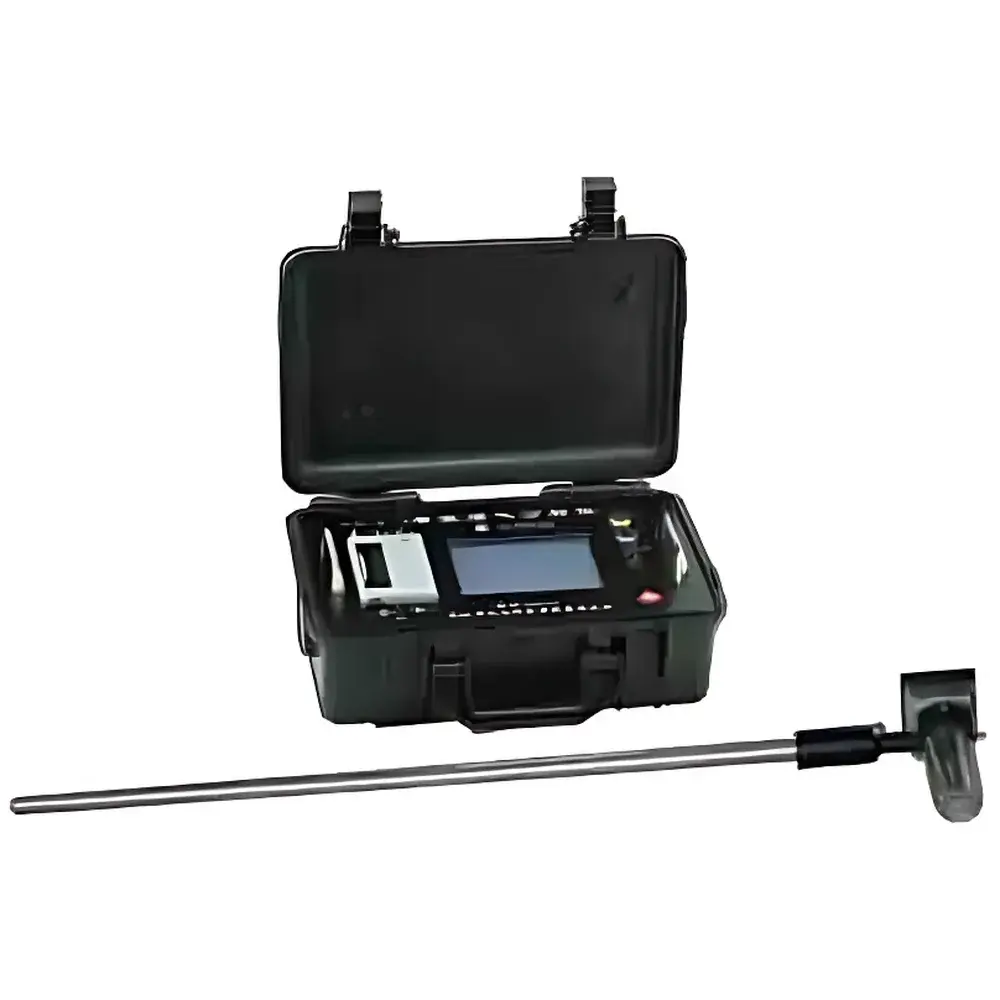
Tianhong TH-990F(III) Portable Flue Gas Analyzer
| Brand | Tianhong |
|---|---|
| Origin | Hubei, China |
| Model | TH-990F(III) |
| Instrument Type | Portable Flue Gas Analyzer |
| Measurement Accuracy (Full Scale) | ±5% |
| Repeatability | ±2% |
| Response Time (T90) | 90 s |
| Drift (24 h) | ±5% |
| Measured Gases | SO₂, CO, NO, NO₂, O₂ |
| Display | 5.7-inch 4-level grayscale LCD with full-touch interface |
| Power Supply | AC/DC dual-mode |
| Dimensions | 380 × 170 × 265 mm |
| Weight | 6 kg |
| Data Storage Capacity | >100,000 records |
| Compliance | GB/T 16157–1996, HJ/T 46–1999, JJG 968–2002, HJ 693–2014, Q/WTH 07–2013 |
Overview
The Tianhong TH-990F(III) Portable Flue Gas Analyzer is an engineered solution for in-situ measurement of key combustion exhaust gases—including sulfur dioxide (SO₂), carbon monoxide (CO), nitric oxide (NO), nitrogen dioxide (NO₂), and oxygen (O₂)—in industrial flue ducts and stack emissions. It operates on the principle of electrochemical sensing, where each gas-specific sensor generates a current proportional to its concentration under controlled diffusion and catalytic reaction conditions. The instrument is designed for field-deployable environmental compliance monitoring, particularly at stationary emission sources such as coal-fired boilers, waste incinerators, and thermal power plants. Its architecture integrates real-time gas thermodynamics compensation—via integrated high-precision temperature, pressure, differential pressure, and mass flow sensors—to maintain metrological integrity across variable ambient and stack conditions. All measurements adhere to Chinese national standards governing fixed-source emission testing, including GB/T 16157–1996 for sampling methodology and HJ 693–2014 for NOₓ quantification via potentiostatic electrolysis.
Key Features
- Intelligent electrochemical sensor modules with plug-and-play functionality: automatic component recognition, range validation, and maintenance scheduling based on operational hours and signal drift trends.
- Dual-mode power system supporting both AC mains (100–240 VAC, 50/60 Hz) and DC input (12–24 VDC), enabling uninterrupted operation during extended field surveys or mobile inspections.
- 5.7-inch industrial-grade grayscale LCD with four-level contrast optimization for daylight readability; supports full-screen capacitive touch navigation and optional infrared remote keypad input for gloved-hand use.
- Active flow control loop maintaining constant sample aspiration rate (±1% deviation) across backpressure fluctuations up to 15 kPa—critical for representative sampling in turbulent or low-velocity duct environments.
- Multi-stage cross-interference correction algorithm: iteratively applies empirical response matrices and non-linear curve fitting to decouple overlapping electrochemical signals (e.g., NO₂ interference on NO channel), significantly improving selectivity without hardware filtering.
- Onboard calculation engine compliant with standard emission reporting protocols: automatically computes normalized concentrations (e.g., 6% O₂ reference), boiler combustion efficiency (η = 1 − Qloss/Qin), and flue gas heat loss (Qloss) using ASME PTC 4–2013-derived correlations.
Sample Compatibility & Compliance
The TH-990F(III) is validated for direct insertion into flue gas streams with temperatures up to 180 °C (with optional heated probe extension) and particulate loading ≤50 mg/m³. It meets electromagnetic compatibility requirements per GB/T 18268.1–2010 (IEC 61326–1:2012) and satisfies essential safety provisions under GB 4793.1–2007 (IEC 61010–1:2010). Regulatory alignment includes mandatory calibration traceability to national metrological standards (CNAS-accredited reference gases), documented verification per JJG 968–2002, and functional conformity with HJ/T 46–1999 for SO₂ analyzers and HJ 693–2014 for NOₓ detection systems. While not certified to ISO 16145 or EN 15267, its design basis ensures interoperability with QA/QC workflows required under China’s “Blue Sky Protection Campaign” enforcement framework.
Software & Data Management
Data acquisition and post-processing are managed through embedded firmware supporting timestamped storage of ≥100,000 measurement records—including raw sensor voltages, compensated concentrations, environmental parameters, and operator annotations. Export is facilitated via USB 2.0 interface to FAT32-formatted USB drives; files are generated in CSV format with UTF-8 encoding and header metadata compliant with HJ 75–2017 data transmission specifications. No proprietary software is required for basic review; however, optional PC-based analysis tools support statistical trending (e.g., 7-day rolling average), audit trail generation (user login, parameter change log), and PDF report templating aligned with provincial ecological environment bureau submission templates. Firmware updates are delivered via signed binary packages to ensure integrity and version control.
Applications
- Regulatory stack testing for environmental impact assessments and permit renewal under China’s Emission Permit System (EPMS).
- Routine combustion optimization in industrial boilers, identifying air-to-fuel ratio deviations and incomplete combustion signatures via simultaneous O₂/CO correlation analysis.
- Post-installation performance verification of flue gas desulfurization (FGD) and selective catalytic reduction (SCR) systems.
- Mobile source emission screening at temporary construction heating units or emergency diesel generators.
- Educational use in environmental engineering laboratories for teaching principles of electrochemical gas sensing and emission inventory development.
FAQ
What calibration gases are required for field verification?
Certified reference gas mixtures traceable to NIM (National Institute of Metrology, China) are required: SO₂/N₂ (100 ppm), CO/N₂ (500 ppm), NO/N₂ (200 ppm), NO₂/N₂ (100 ppm), and O₂/N₂ (20.9%). Calibration must be performed before each daily measurement session.
Can the analyzer operate continuously inside a hot flue without external cooling?
No. The base unit is rated for ambient operating temperatures of 0–40 °C. For flue insertion, a dedicated heated sampling probe (optional accessory) with Teflon-lined stainless steel tubing and thermoelectric cooling stage must be used to condition the gas stream prior to sensor exposure.
Is data export compatible with third-party LIMS platforms?
Yes. CSV output follows ANSI X12-compliant delimiter conventions and includes column headers mapped to EPA Method 204B and HJ 75–2017 field data schema. Custom mapping scripts are available upon request.
How does the instrument handle condensate formation during sampling?
Integrated dual-stage condensate removal: first-stage Peltier-cooled membrane dryer (-5 °C dew point), followed by hydrophobic sintered stainless steel filter (pore size 5 µm) upstream of the sensor chamber. Drainage port allows manual purge every 2 hours under high-humidity conditions.
Does the device support remote diagnostics or firmware updates over cellular networks?
Not natively. Firmware updates require physical USB connection. Remote diagnostic capability is limited to Bluetooth 4.2 LE for local configuration mirroring via Android/iOS companion app (Tianhong FieldLink v2.1).
Related Products







