
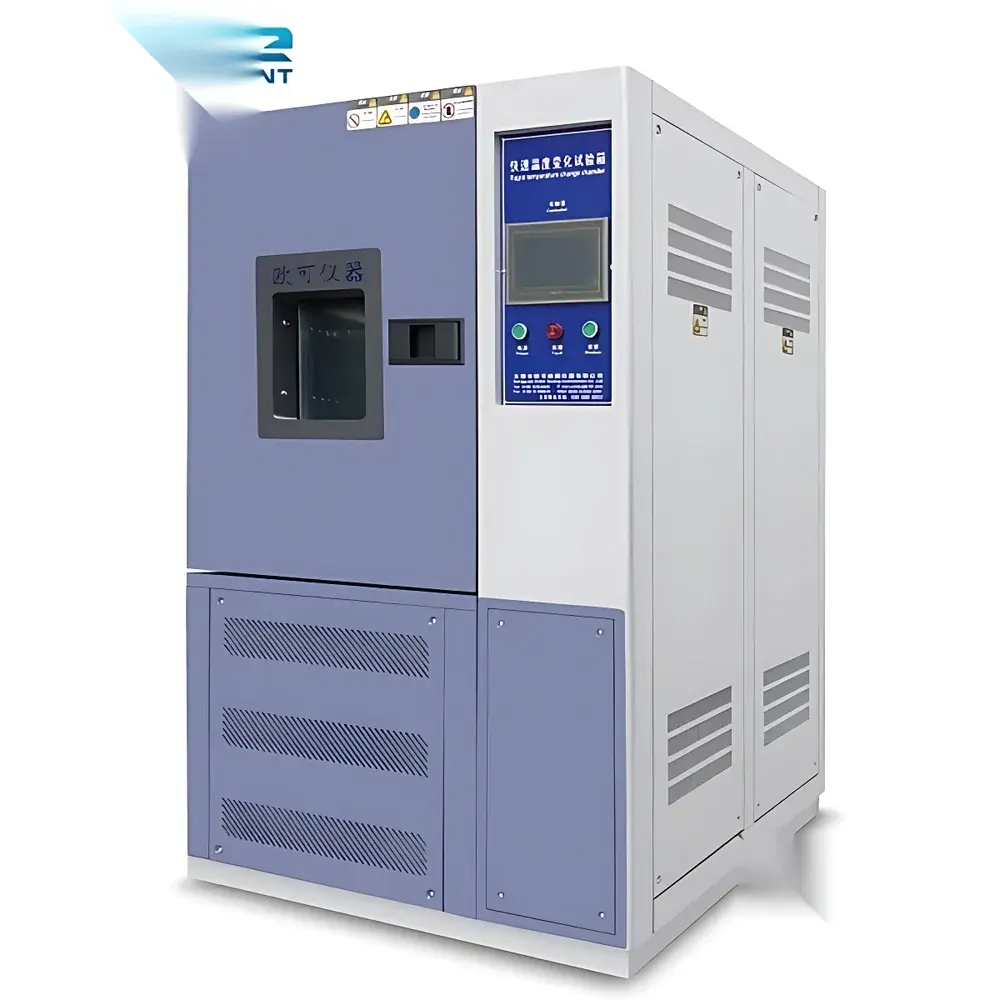
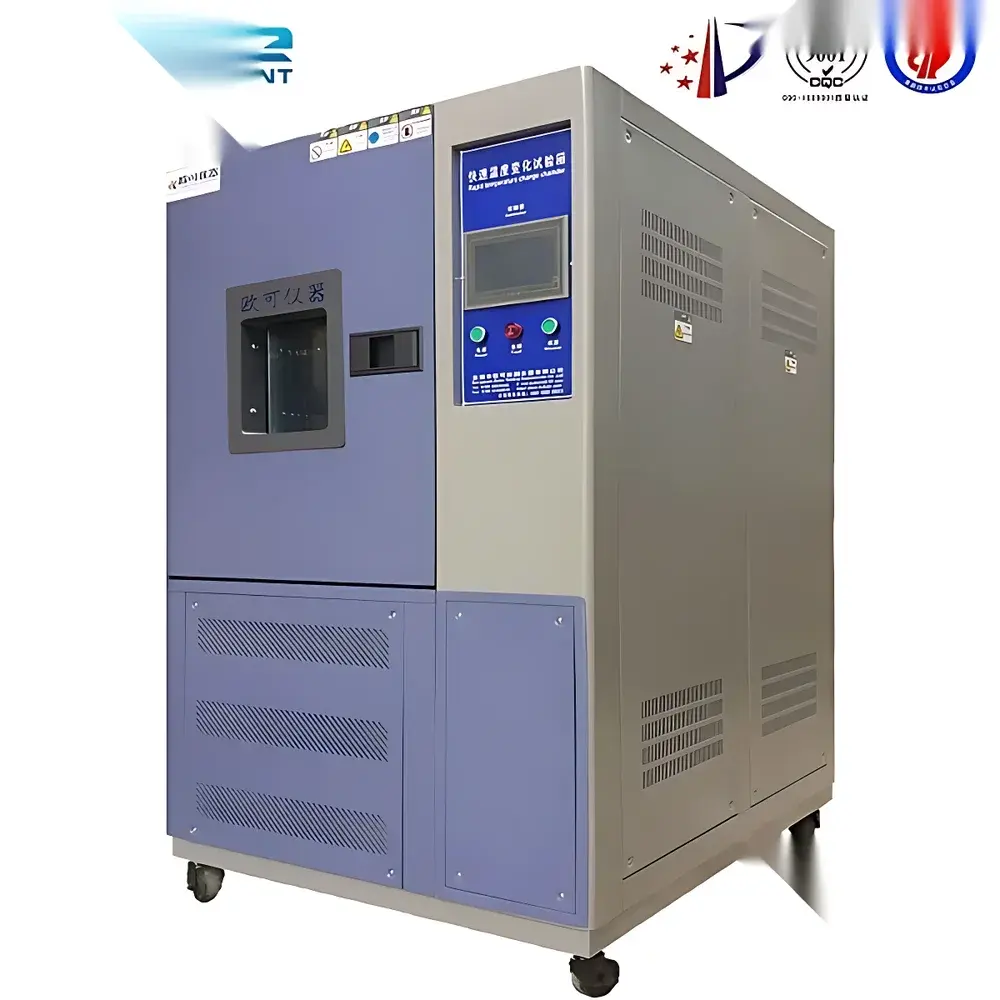
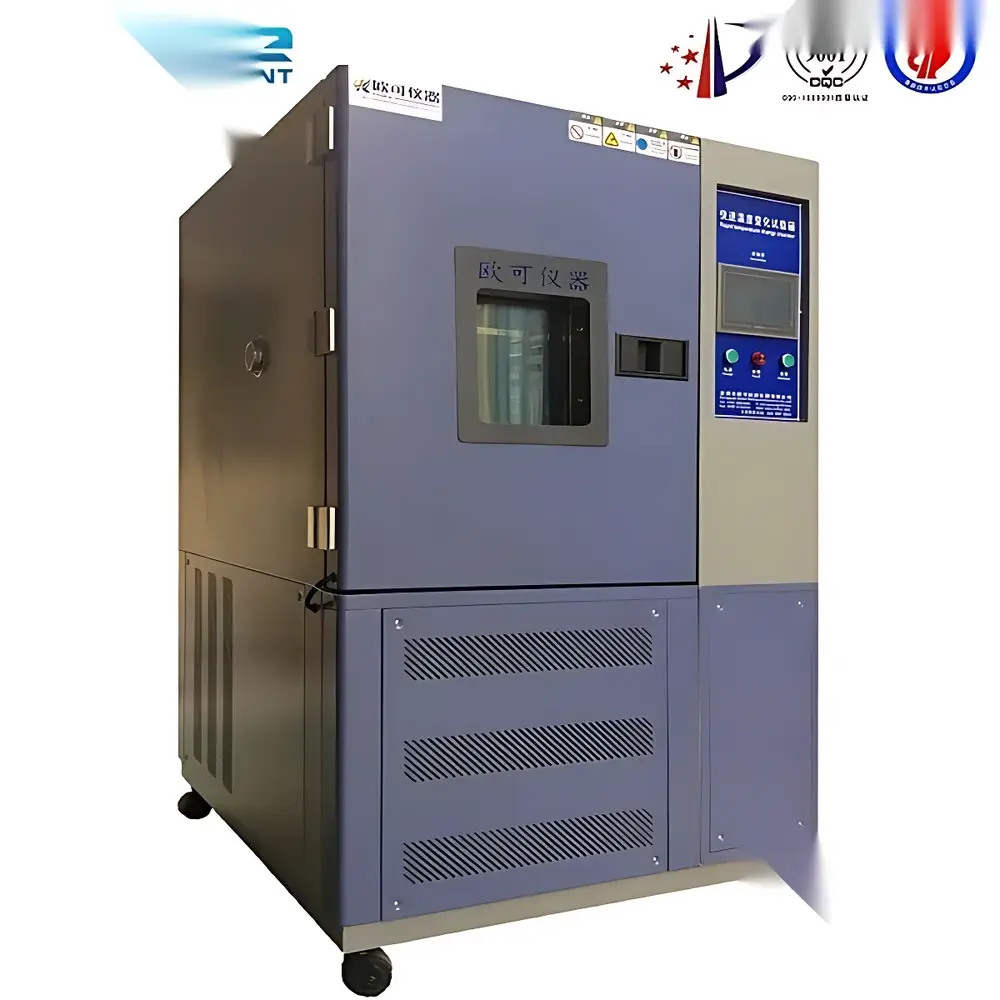
Nonlinear Rapid Temperature Cycling Chamber
| Brand | Other Brands |
|---|---|
| Origin | Imported |
| Manufacturer Type | Authorized Distributor |
| Temperature Range | –70 °C to +150 °C (Rapid Cycling Range: –45 °C to +85 °C) |
| Linear Ramp Rate | 3–15 °C/min |
| Nonlinear Ramp Rate | 3–20 °C/min |
| Humidity Range (Optional) | 5–98% RH |
| Temperature Resolution/Accuracy | 0.1 °C / ±0.5 °C |
| Humidity Resolution/Accuracy | 0.1% RH / ±2.5% RH |
| Temperature Uniformity | ±2.0 °C |
| Humidity Uniformity | ±3.0% RH |
| Interior Material | SUS304 Stainless Steel |
| Insulation | High-Density Polyurethane Foam with Ethyl Chloroformate Base |
| Cooling System | Air-Cooled or Water-Cooled |
| Refrigerant | R-404A & R-23 (DuPont Certified, Eco-Compliant) |
| Compressor | Tecumseh (France) |
Overview
The Nonlinear Rapid Temperature Cycling Chamber is an advanced environmental stress screening (ESS) system engineered for precise, programmable thermal cycling under non-isothermal conditions. Unlike conventional linear thermal chambers, this unit implements a proprietary nonlinear control algorithm that enables continuous, stepless ramp-rate modulation across the full operational temperature span—from –70 °C to +150 °C—with rapid transition capability between –45 °C and +85 °C. Its core architecture integrates dual-stage refrigeration (R-404A/R-23 cascade), high-efficiency heat exchangers, and adaptive PID+Fuzzy logic controllers to maintain traceable thermal stability and reproducible cycling profiles. Designed in accordance with IEC 60068-2-14 (Change of Temperature), MIL-STD-810H Method 503.6, and JEDEC JESD22-A104D, it supports accelerated reliability testing of electronic assemblies, automotive ECUs, aerospace components, and medical device packaging under thermally induced mechanical stress.
Key Features
- Programmable nonlinear ramp profiles with continuously adjustable rates from 3 °C/min to 20 °C/min—enabling realistic simulation of real-world thermal transients such as engine start-up, solar loading, or power-on surges.
- LCD-based controller with multi-segment programming capability: supports up to 999 cycles, 99 segments per cycle, and simultaneous temperature/humidity scheduling (when humidity option is installed).
- Double-sealed insulated door with silicone gasket and anti-sweat heating element ensures minimal thermal leakage and eliminates condensation on observation window during low-temperature operation.
- Reinforced SUS304 stainless steel interior and exterior housing, electropolished and matte-finished for corrosion resistance and cleanroom compatibility.
- High-density polyurethane insulation with ethyl chloroformate base provides superior thermal resistance (>0.022 W/m·K) and dimensional stability across extreme temperature gradients.
- Integrated test port (Φ50 mm, sealed with silicone plug) allows external signal/power feedthrough without compromising chamber integrity.
- Front-mounted casters with locking mechanism facilitate safe repositioning in lab or production environments; footprint optimized for ISO Class 7 cleanroom integration.
- Compressor-driven cooling system utilizes Tecumseh (France) hermetic compressors and DuPont-certified low-GWP refrigerants compliant with EU F-Gas Regulation (EU) No 517/2014.
Sample Compatibility & Compliance
This chamber accommodates standard test specimens up to 500 L internal volume (custom configurations available). It supports mounting fixtures for PCBs, battery modules, sensor housings, and hermetically sealed packages. All materials in direct contact with test samples—including shelves, brackets, and gaskets—meet USP Class VI biocompatibility requirements where applicable. The system complies with electromagnetic compatibility (EMC) per EN 61326-1, safety per IEC 61010-1, and environmental compliance per RoHS Directive 2011/65/EU and REACH Regulation (EC) No 1907/2006. Optional humidity configuration meets ASTM E1822 for hygrothermal cycling and supports validation against ISO 16750-4 (Road vehicles — Environmental conditions and testing for electrical and electronic equipment).
Software & Data Management
The embedded controller logs timestamped temperature and humidity data at user-defined intervals (1–60 seconds) and stores ≥30 days of continuous history onboard. Data export is supported via USB 2.0 interface in CSV format for post-processing in MATLAB, JMP, or Minitab. Optional Ethernet-enabled upgrade adds Modbus TCP/IP and OPC UA connectivity for integration into MES/SCADA platforms. Audit trail functionality records all parameter changes, operator logins, and alarm events—supporting GLP/GMP-aligned documentation per FDA 21 CFR Part 11 when paired with qualified electronic signature software.
Applications
- Thermal shock qualification of solder joints and wire bonds per IPC-9701A.
- Temperature cycling life testing of Li-ion battery cells under variable ramp rates (UN 38.3 Section 38.3.4).
- Stress screening of avionics modules prior to HALT/HASS protocols.
- Validation of thermal interface material (TIM) performance under dynamic load conditions.
- Environmental aging studies of polymer encapsulants and conformal coatings (IPC-CC-830B).
- Pre-compliance testing for automotive electronics per AEC-Q200 Rev D.
FAQ
What is the difference between linear and nonlinear temperature ramping in this chamber?
Linear ramping maintains a constant rate (e.g., 10 °C/min) throughout the entire segment. Nonlinear ramping applies variable rates within a single segment—for example, accelerating from 5 °C/min at low ΔT to 18 °C/min near target setpoint—to emulate transient thermal behavior more accurately.
Can the chamber operate at –70 °C while maintaining 5% RH?
No. Humidity control below 0 °C is physically constrained by dew point limitations. The optional humidity system operates only within the +10 °C to +85 °C range; sub-zero humidity is not supported.
Is third-party calibration certification included?
Factory calibration is performed using NIST-traceable reference sensors. Full ISO/IEC 17025 calibration certificate (with uncertainty budget) is available as a paid option upon request.
What maintenance intervals are recommended for the refrigeration system?
Compressor oil analysis and refrigerant purity verification are advised every 2,000 operating hours or annually—whichever occurs first. Condenser coil cleaning is required quarterly in non-filtered ambient environments.



