
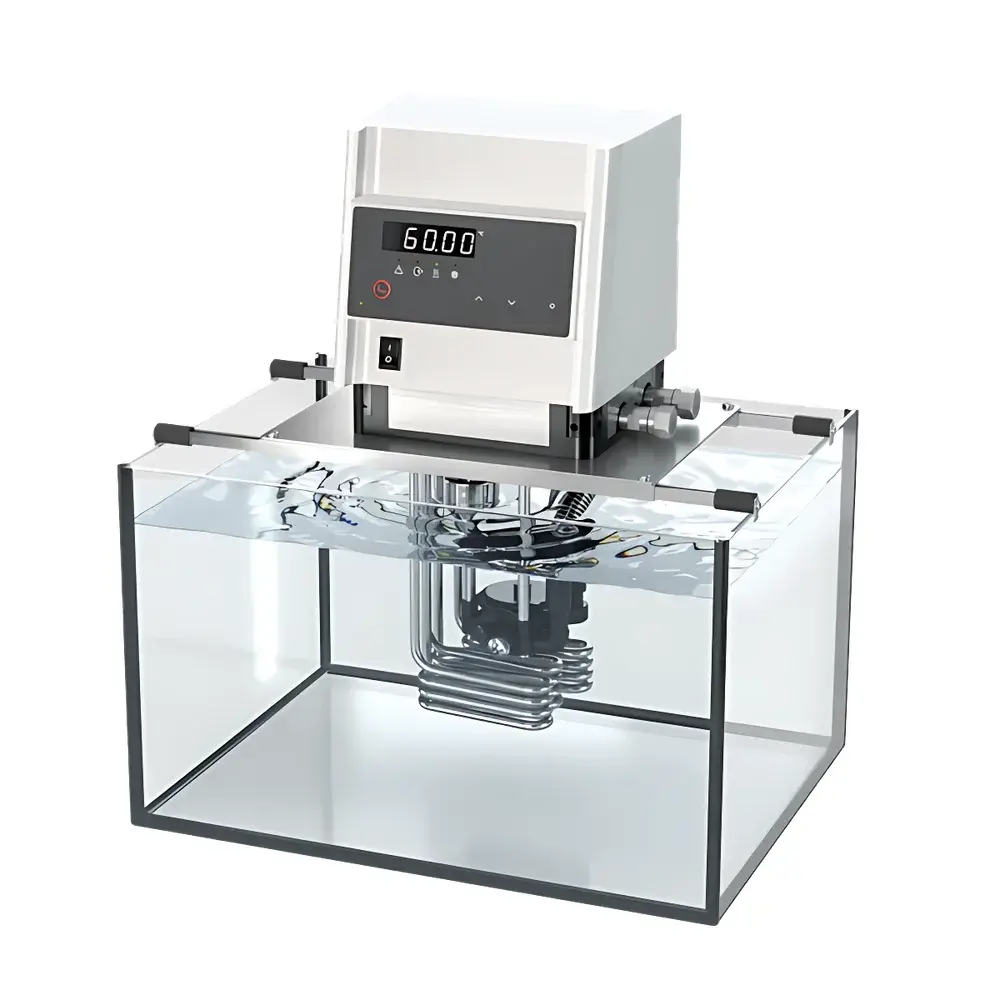
LAUDA Proline PBD Bridge Circulator for Bath Applications, 30–300 °C, ±0.01 °C Stability
| Brand | LAUDA |
|---|---|
| Origin | Germany |
| Model | PBD |
| Temperature Range | 30–300 °C (with external cooling: 20–300 °C |
| extended range | −30–300 °C) |
| Temperature Stability | ±0.01 K |
| Heating Power | 3.6 kW |
| Max. Pump Pressure | 1.1 bar |
| Max. Flow Rate | 32 L/min |
| Dimensions (W×D×H) | 320 × 185 × 400 mm |
| Weight | 8 kg |
| Pump Type | LAUDA Varioflex (8-step adjustable pressure/suction) |
| Interface Options | RS232/485, Profibus, analog/digital I/O, Ethernet-USB module (optional upgrade) |
Overview
The LAUDA Proline PBD is a high-performance bridge-type circulation thermostat engineered for precise, stable temperature control of external liquid baths—particularly in demanding laboratory and industrial R&D environments. Unlike traditional immersion or bath-integrated thermostats, the PBD employs a bridge configuration that decouples the heating/cooling unit from the bath vessel, enabling flexible integration with custom or third-party baths up to 550 mm wide and 320 mm deep. Its core thermal architecture combines a 3.6 kW resistive heating system with a robust Varioflex pump capable of delivering up to 32 L/min at 1.1 bar differential pressure—ensuring rapid heat transfer and uniform thermal distribution even in high-viscosity or large-volume applications. Temperature regulation is achieved via a digital PID controller with adaptive tuning, delivering long-term stability of ±0.01 K across its full operational range of 30–300 °C (extendable to −30 °C when coupled with an external chiller). The unit complies with IEC 61000-6-3 (EMC) and IEC 61010-1 (safety), and its design supports GLP-compliant operation through traceable setpoint logging and configurable alarm thresholds.
Key Features
- Bridge-mount architecture with retractable telescopic support rod—adjustable for bath widths from 310 mm to 550 mm and depths up to 320 mm
- LAUDA Varioflex dual-mode pump (pressure/suction), offering eight discrete flow-pressure settings for optimized fluid dynamics across varying bath geometries and fluid viscosities
- High-resolution LED display with intuitive 3-button interface and built-in self-diagnostic assistant for real-time system health assessment
- PowerAdapt energy management system dynamically adjusts heater output based on grid voltage fluctuations and load demand—maintaining thermal consistency while minimizing peak power draw
- Dual-location pump ports (rear and side) with integrated bypass valve for seamless plumbing integration and minimal dead volume
- Low-setpoint overtemperature protection with audible alarm—certified for use with both flammable and non-flammable heat-transfer fluids per EN 60519-1
- Expandable communication suite: optional modules for RS232/485, Profibus DP, analog 0–10 V / 4–20 mA I/O, dry-contact alarms, and Ethernet-to-USB gateway for remote monitoring and data export
Sample Compatibility & Compliance
The PBD is compatible with a broad spectrum of heat-transfer media—including water, silicone oils, glycol/water mixtures, and specialized synthetic heat-transfer fluids—provided they remain thermally stable within the −30 °C to 300 °C envelope. Its stainless-steel wetted parts (pump head, inlet/outlet manifolds, and internal tubing) resist corrosion from mildly acidic or alkaline solutions, supporting extended service life in QC and formulation labs. The device meets CE marking requirements under the EU Machinery Directive 2006/42/EC and Low Voltage Directive 2014/35/EU. For regulated environments, its optional Ethernet-USB module enables audit-trail-capable data logging compliant with FDA 21 CFR Part 11 when paired with validated third-party software platforms. All firmware versions are documented and version-controlled per ISO 9001:2015 quality management standards.
Software & Data Management
While the PBD operates autonomously via its front-panel interface, its optional digital modules enable integration into centralized lab infrastructure. The RS485 interface supports Modbus RTU protocol for PLC-based process orchestration, while the Ethernet-USB gateway allows connection to Windows-based PCs running LAUDA’s proprietary Thermostat Control Suite (TCS) or third-party SCADA systems. TCS provides real-time graphing, setpoint ramping profiles, event-triggered data capture, and CSV export with timestamped metadata—including ambient temperature, pump speed, heater duty cycle, and error codes. All logged parameters are stored locally on the host PC with SHA-256 hash integrity verification, satisfying ALCOA+ data governance principles for GxP workflows.
Applications
- Calibration of reference thermometers and RTDs in metrology labs (per ISO/IEC 17025)
- Temperature conditioning of rheometers, viscometers, and DSC sample stages requiring sub-0.02 K stability
- Controlled-cure testing of adhesives, composites, and polymer resins in materials science labs
- Stabilization of optical benches and interferometric setups sensitive to thermal drift
- Process validation studies for pharmaceutical freeze-drying cycles and lyophilization shelf qualification
- Long-duration aging tests of electronic components and battery cells under elevated thermal stress
FAQ
What is the minimum external chiller capacity required to achieve the −30 °C operating point?
A chiller with ≥1.5 kW cooling capacity at −40 °C supply temperature and ≥10 L/min flow rate is recommended for stable sub-zero operation.
Can the PBD be operated in open-bath mode without recirculation?
No—the unit is designed exclusively for closed-loop external circulation; direct open-bath immersion is not supported due to safety and control architecture constraints.
Is the Varioflex pump serviceable in the field?
Yes—pump heads and impellers are user-replaceable using standard Torx tools; LAUDA provides OEM spare kits with calibration certificates for critical wear components.
Does the PBD support NIST-traceable temperature validation?
Yes—its internal Pt100 sensor is factory-calibrated against NIST-traceable standards; optional on-site verification services include as-found/as-left reports with uncertainty budgets per ISO/IEC 17025.
How does PowerAdapt affect heater lifetime under continuous 300 °C operation?
PowerAdapt reduces thermal cycling stress by maintaining >92% heater duty cycle at steady state—extending element life beyond 12,000 hours under typical GMP usage conditions.
Related Products



