
Xenon Arc Weathering Test Chamber – Customizable Environmental Test System for Accelerated UV & Climate Aging
| Key | Working Chamber Size: Customizable |
|---|---|
| Humidity Range | 40–98% RH |
| Temperature Range | 10–70 °C |
| Black Panel Temperature | 40–110 °C |
| Temperature Uniformity | ±2 °C |
| Temperature Stability | ≤±0.5 °C |
| Humidity Deviation | ≤±3% RH |
| Rainfall Cycle | 1–9999 min (adjustable, continuous or periodic) |
| Light Source | Long-Arc Air-Cooled Xenon Lamp |
| Lamp Power Options | 1.5 / 2.5 / 3.0 / 6.0 kW per lamp |
| Lamp Lifetime | ≥1500 h |
| Total Exposure Area | ≥6000 cm² |
| Irradiance Range | 0–1100 W/m² (solar-spectrum-weighted) |
| Spectral Range | 280–900 nm |
| Irradiance Monitoring Points | 340 nm, 300–400 nm, 420 nm |
| Light Intensity Control | 5–100% |
| Light/Dark Cycle | 10 min – 99.99 min |
| Cooling Method | Air-cooled heat exchanger + air-cooled compressor |
| Filter System | Borosilicate & soda-lime optical glass filters (manual exchange for indoor/outdoor simulation) |
| Control Interface | Touchscreen HMI with embedded control software, data logging ≥2 years, USB export capability |
| Structural Material | 1.2 mm SUS316L stainless steel |
| Observation Window | 300 × 700 mm multilayer insulated radiation-shielded glass with UV-filtering overlay |
| Compliance | ASTM G155, ASTM D4459, GB/T 2423.24, GB/T 5137.3 |
Overview
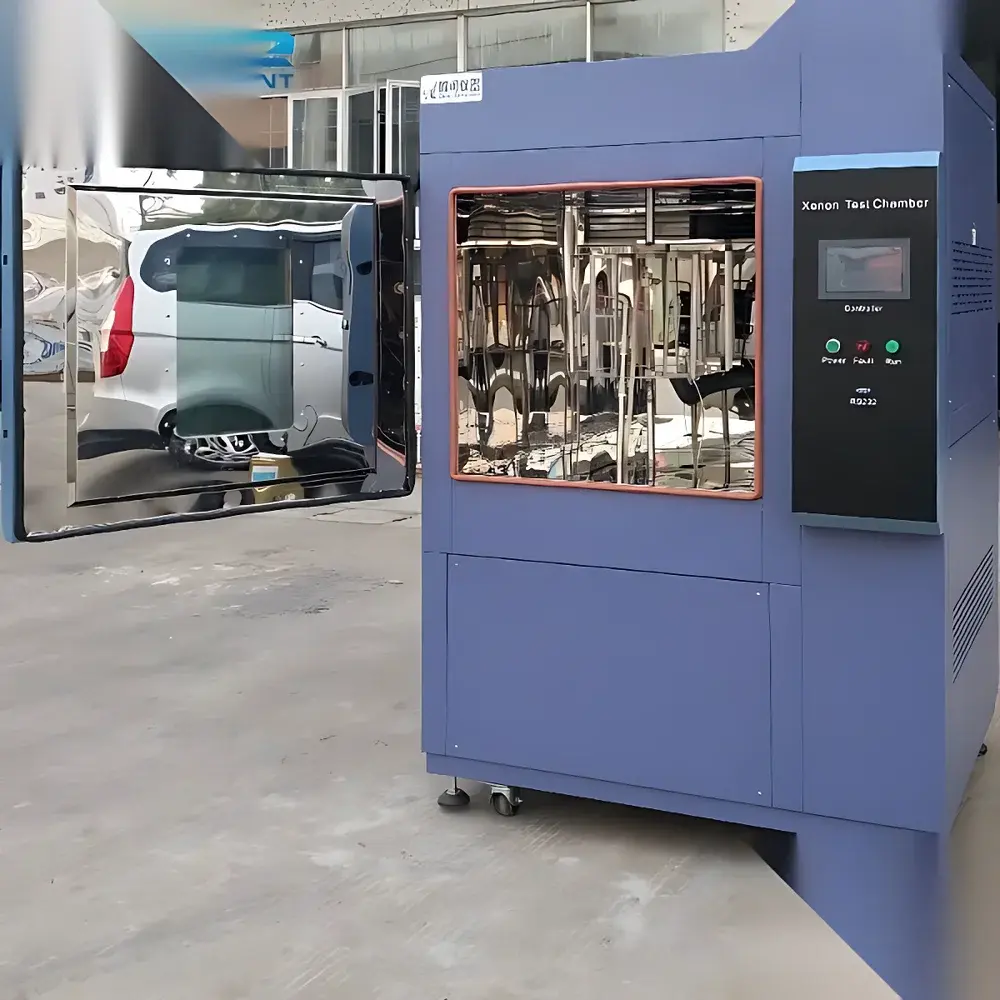
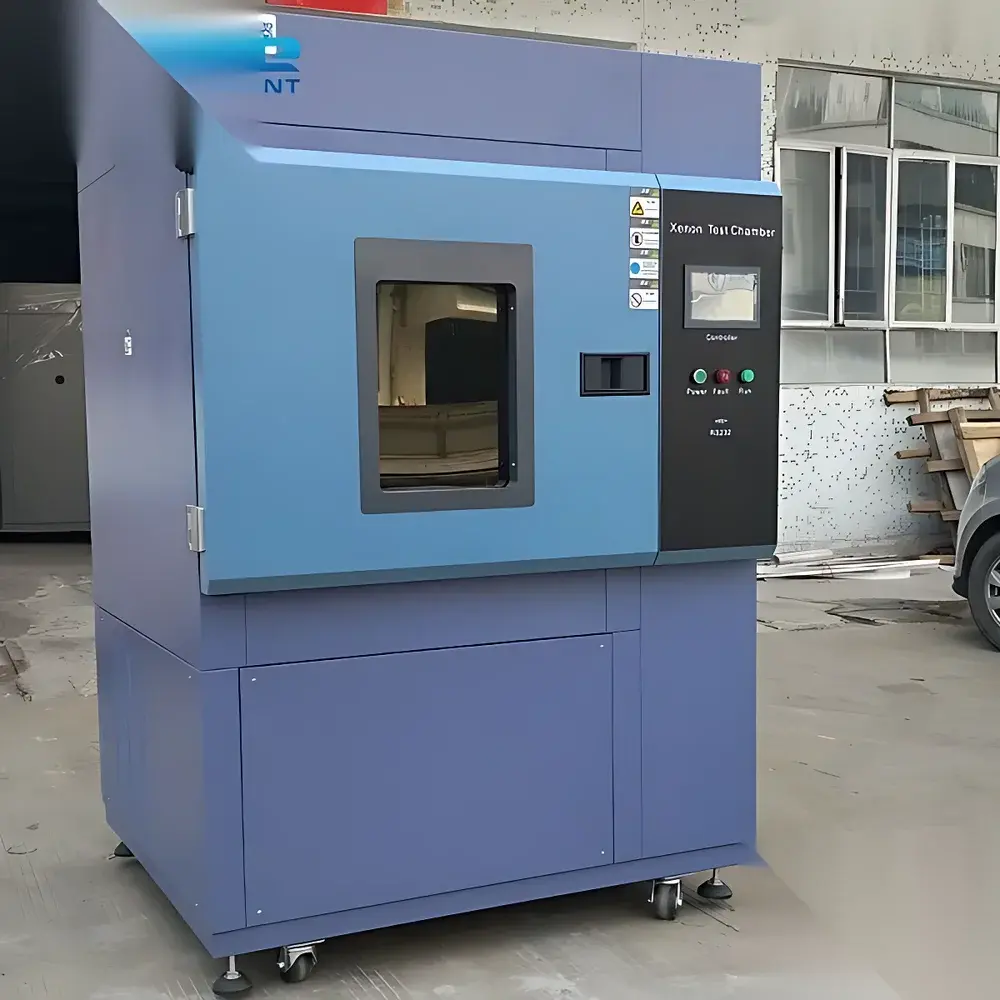
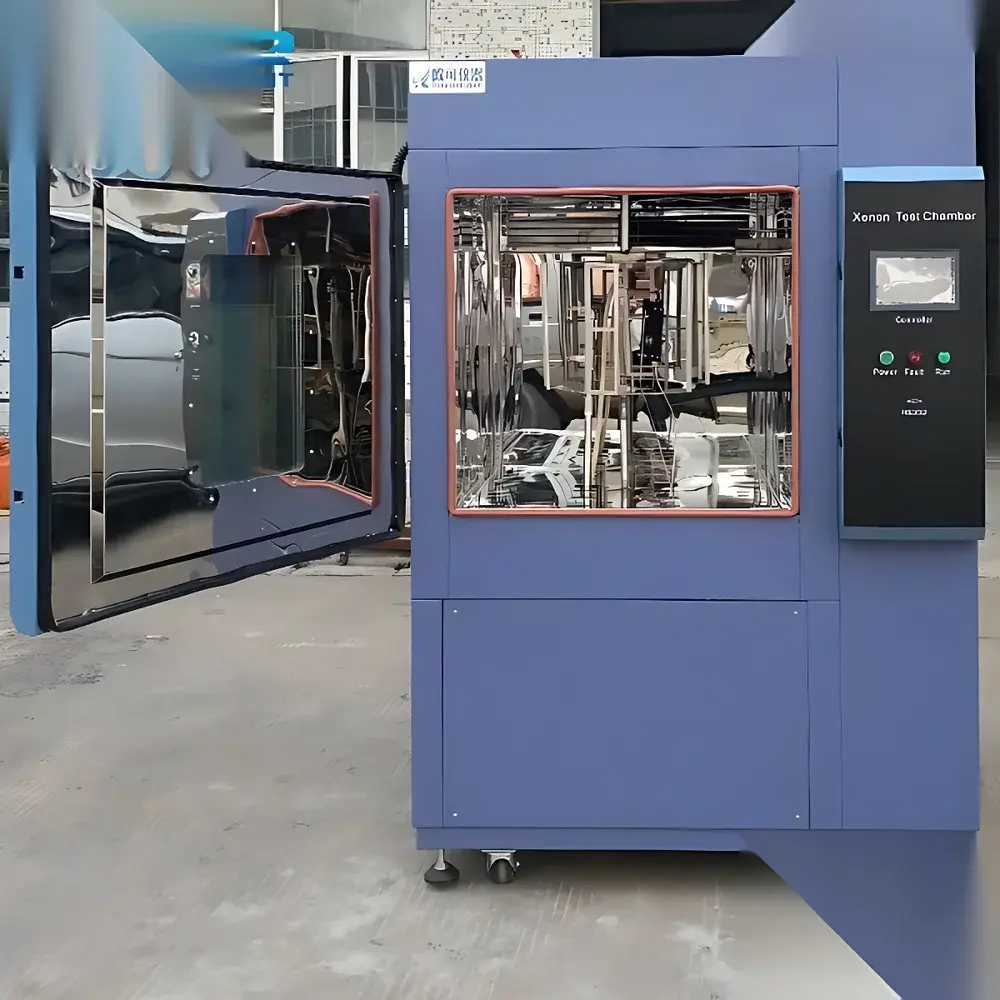
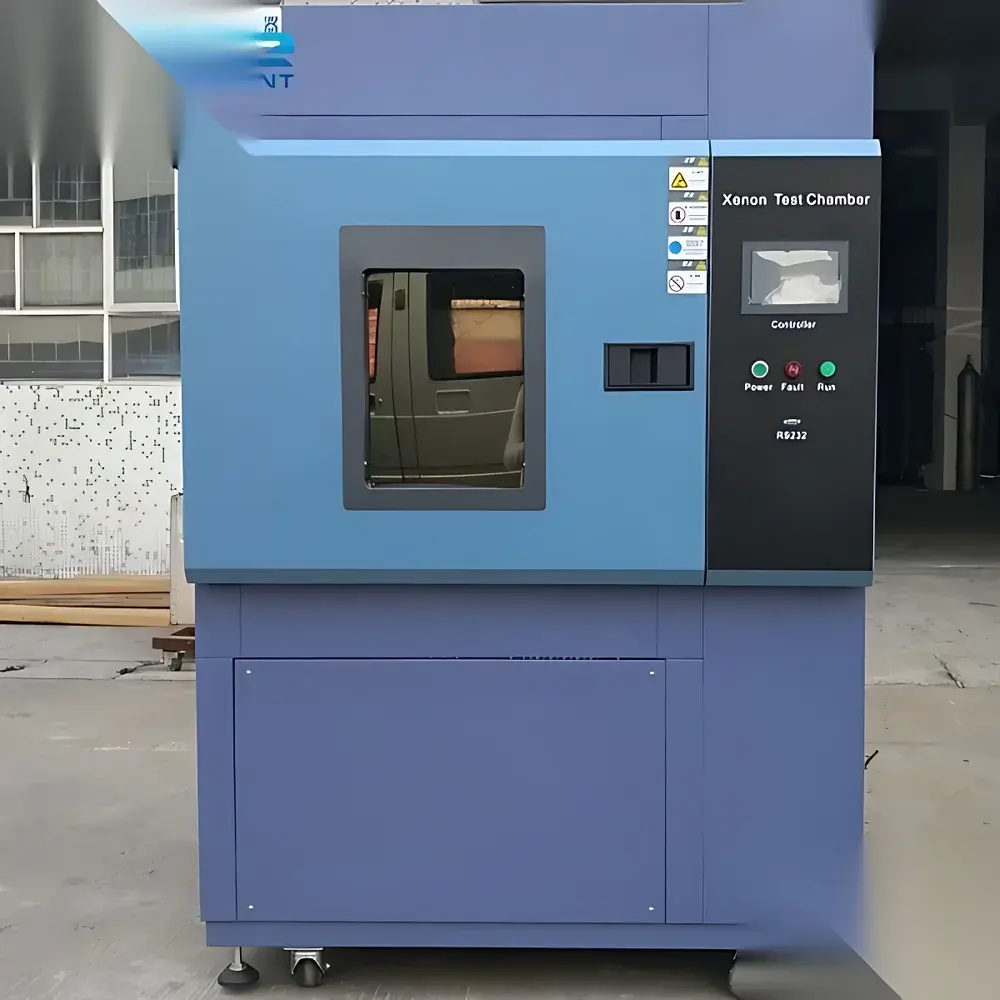
The Xenon Arc Weathering Test Chamber is an engineered environmental simulation system designed to replicate the combined degrading effects of solar radiation, temperature, and humidity—critical for predicting long-term material performance under real-world exposure conditions. Utilizing long-arc air-cooled xenon lamps, it delivers a full-spectrum irradiance closely matching natural sunlight (280–900 nm), enabling accelerated aging tests in accordance with internationally recognized standards including ASTM G155, ASTM D4459, and GB/T 2423.24. Unlike narrowband UV sources, xenon arc technology provides balanced spectral output across UV, visible, and near-infrared regions—essential for evaluating photochemical degradation mechanisms in polymers, coatings, textiles, automotive trim, and architectural materials. The chamber’s closed-loop thermal and hygrothermal control architecture ensures high reproducibility across repeated test cycles, supporting both R&D validation and quality assurance protocols in regulated environments.
Key Features
- Custom-engineered working chamber dimensions to accommodate diverse sample configurations—from small coupons to full-size automotive components.
- Precise black panel temperature control (40–110 °C) with stability ≤±0.5 °C and uniformity ±2 °C, critical for simulating surface thermal loading during solar exposure.
- Humidity regulation from 40–98% RH with deviation ≤±3% RH, achieved via integrated steam generator and condensation management system.
- Modular optical filter system using borosilicate and soda-lime glass combinations—manually interchangeable to simulate outdoor (Daylight-Q/B) or indoor (Window-Glass) spectral profiles per ISO 4892-2 and ASTM G155 Annex A1.
- Programmable spray cycle (1–9999 min), operable synchronously with irradiation or in dark phases, replicating dew, rain, and thermal shock effects.
- Real-time irradiance monitoring at three calibrated wavelengths (340 nm, 300–400 nm, 420 nm) with automatic lamp power compensation to maintain setpoint intensity despite lamp aging.
- SUS316L stainless steel construction (1.2 mm thickness) ensures corrosion resistance in high-humidity, saline, or chemically aggressive test environments.
- Large observation window (300 × 700 mm) with multilayer low-emissivity, UV-absorbing glass—prevents operator exposure while minimizing condensation and thermal bridging.
Sample Compatibility & Compliance
This chamber accommodates flat-panel specimens up to 6000 cm² total exposure area, supporting standard sample holders per ASTM D4459 and ISO 4892-2. It is validated for testing polymer films, paint systems, elastomers, composite laminates, safety glazing (per GB/T 5137.3), and aerospace sealants. All operational parameters—including irradiance traceability, temperature/humidity calibration intervals, and data audit trails—are structured to align with GLP and pre-GMP documentation requirements. While not inherently 21 CFR Part 11 compliant, the embedded control software supports user-level access control, electronic signature readiness, and timestamped event logging—facilitating internal validation for regulated industries.
Software & Data Management
The proprietary touchscreen HMI interface features intuitive menu navigation, multilingual support (English default), and real-time graphical display of irradiance, black panel temperature, chamber humidity, and elapsed cycle time. All sensor data—including alarm triggers, calibration events, and filter change logs—are stored internally for ≥2 years with automatic timestamping. Export functionality via USB enables seamless integration into LIMS or statistical process control platforms. The system supports custom test profile creation with up to 99 programmable steps, each defining irradiance level, temperature setpoint, humidity target, spray activation, and light/dark duration. Data integrity safeguards include write-protected memory partitions and cyclic redundancy checksum verification.
Applications
- Automotive OEMs and Tier-1 suppliers validating exterior trim, headlamp lenses, and interior upholstery against ISO 11341 and SAE J2527.
- Coatings manufacturers assessing gloss retention, chalking, and color shift in architectural and industrial finishes per ASTM D4587.
- Photovoltaic module developers conducting IEC 61215 damp heat + UV preconditioning sequences.
- Textile and geotextile producers evaluating UV-induced tensile strength loss and dye migration under controlled climatic stress.
- Medical device packaging labs verifying barrier integrity and print legibility after simulated shelf-life exposure per ISO 11607-1 Annex B.
FAQ
What spectral filters are included by default, and how are they selected?
Standard configuration includes daylight (Q/B) and window-glass (WG) filter sets, manually installed based on test standard requirements. Filter selection follows ASTM G155 Table 1 and ISO 4892-2 Annex B guidelines.
Is remote monitoring or Ethernet connectivity supported?
The base system includes RS-485 and USB interfaces; optional Ethernet module enables Modbus TCP communication and integration with building management or centralized lab monitoring systems.
How is irradiance recalibrated after lamp replacement?
The built-in 340 nm sensor automatically initiates a 15-minute stabilization and zero-point adjustment sequence upon lamp ignition; full recalibration requires NIST-traceable reference meter verification every 6 months.
Can the chamber operate continuously for extended validation runs?
Yes—designed for unattended 24/7 operation with redundant safety interlocks, overtemperature cutoff, and self-diagnostic startup checks per IEC 61000-4-30 Class A compliance.
What maintenance intervals are recommended for optimal performance?
Lamp replacement every 1500 hours, filter inspection every 500 hours, humidity sensor calibration quarterly, and full chamber leak-check annually per ISO/IEC 17025 maintenance protocol.
Related Products



