
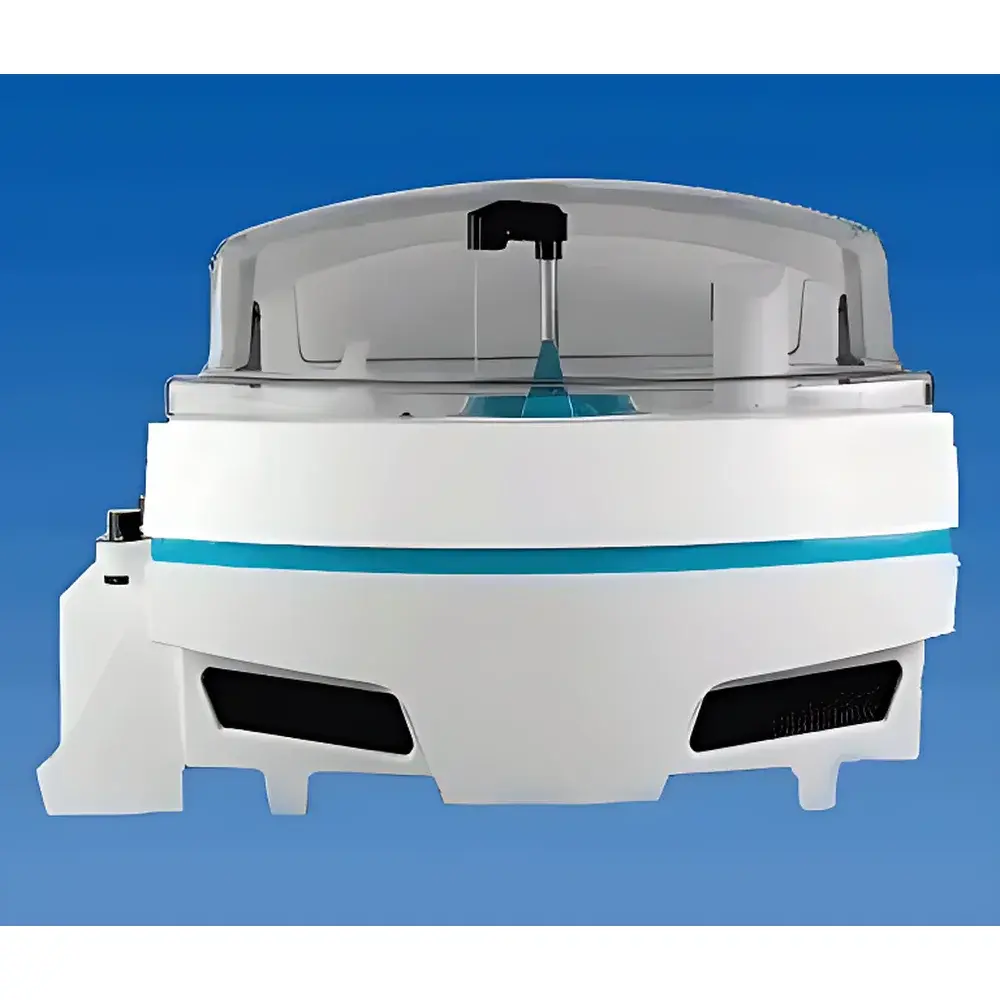
AMS Alliance Smartchem 450 Automated Discrete Analyzer
| Brand | AMS Alliance |
|---|---|
| Origin | Italy |
| Model | Smartchem 450 |
| Sample Throughput | Up to 450 samples/hour (colorimetric), 150 samples/hour (ISE) |
| Reaction Temperature Range | 30–50 °C (adjustable, ±0.1 °C accuracy) |
| Optical System | Dual-beam, dual-wavelength photometer with 12 filters (340–880 nm), 10 mm pathlength cuvettes |
| Absorbance Linearity | 0.001–4.200 Abs |
| Resolution | 0.0001 Abs |
| Minimum Reaction Volume | 180 μL |
| Sample Capacity | 100 positions (5 rotating racks) |
| Reagent Capacity | 72 positions (refrigerated at 10 °C) |
| Dispensing Precision | 0.1 μL (1.0–900 μL sample |
| Dilution Ratio | Up to 100× |
| Cuvette Disk | 80 reusable quartz/glass cuvettes |
| Compliance | US EPA Method 353.2 (with Cd-column module), ISO/IEC 17025-compatible operation |
Overview
The AMS Alliance Smartchem 450 Automated Discrete Analyzer is a high-precision, laboratory-grade discrete chemistry analyzer engineered for routine and regulatory-compliant clinical, environmental, food, and industrial testing. Unlike continuous-flow or segmented-flow analyzers, the Smartchem 450 employs true discrete analysis—each sample reacts independently in a dedicated, temperature-controlled cuvette under precisely defined reagent stoichiometry and incubation conditions. This architecture eliminates cross-contamination, ensures full reaction control, and delivers metrologically traceable results aligned with ISO 8655 (volumetric delivery), CLSI EP15-A3 (precision verification), and US EPA Method 353.2 for nitrate/nitrite determination (when equipped with the optional cadmium column reduction module). The system integrates second-generation direct-read optical detection: a stabilized halogen light source (6 V / 10 W), dual-beam dual-wavelength photometry, and automated filter selection across 12 fixed wavelengths (340–880 nm), enabling simultaneous reference and measurement channel acquisition per assay cycle.
Key Features
- Modular three-zone carousel architecture: independent rotating sample, reagent, and reaction disks minimize robotic arm travel distance—enhancing mechanical reproducibility and reducing cycle time.
- High-fidelity optical detection: dual-beam design compensates for lamp drift and cuvette imperfections; linear absorbance range of 0.001–4.200 Abs (0.0001 Abs resolution) supports undiluted analysis of high-concentration matrices without manual rerun.
- Temperature-stabilized reaction environment: Peltier-controlled reaction disk maintains 30–50 °C within ±0.1 °C; default operational setpoint is 37.2 °C—optimized for enzymatic and kinetic assays requiring physiological thermal fidelity.
- Microfluidic precision dispensing: capacitive liquid level sensing enables adaptive probe immersion depth control; sample/reagent volumes programmable from 1.0 to 900 μL (sample) and 1.0 to 450 μL (reagent) at 0.1 μL resolution.
- Reusable cuvette management: 80-position cuvette disk with automatic optical quality verification prior to each measurement; integrated wash station performs multi-step cleaning (acid, detergent, deionized water, air-dry) between uses.
- Refrigerated reagent handling: 72-position reagent carousel maintained at 10 °C; compatible with 10 mL, 25 mL, and 50 mL bottle formats; barcode reader option enables audit-ready reagent lot tracking.
Sample Compatibility & Compliance
The Smartchem 450 accepts standard 10–13 mm diameter × 100 mm height sample tubes and accommodates heterogeneous sample types—including serum, plasma, urine, wastewater, soil extracts, beverage filtrates, and dairy homogenates—without prefiltration in most applications. Its discrete format inherently supports mixed-sample batches (standards, controls, unknowns, calibrators) loaded dynamically during run execution. Regulatory alignment includes full support for US EPA Method 353.2 (nitrate/nitrite via cadmium column reduction), ASTM D3223 (cyanide), ISO 6493 (phosphorus), and EN ISO 11843-7 (detection capability estimation). When configured with ISE modules (Na⁺, K⁺, Cl⁻, Li⁺), the platform meets CLIA and CAP requirements for electrolyte profiling. All critical parameters—including temperature logs, dispense volumes, absorbance traces, and cuvette ID—are timestamped and stored with immutable audit trails compliant with FDA 21 CFR Part 11 and EU Annex 11 data integrity principles.
Software & Data Management
The Smartchem Control Software (v5.x) provides GLP/GMP-aligned workflow management: method creation with nested calibration curves (linear, quadratic, log-log), QC rule application (Westgard rules, customizable limits), and real-time result flagging. It supports scheduled instrument startup/shutdown, dynamic retest initiation (including reflex testing based on primary result thresholds), and “add-on” sample insertion mid-run without process interruption. Measurement time budgeting allows predictive throughput modeling per assay panel. Raw spectral data, photometric traces, and diagnostic logs are exportable in CSV, XML, and PDF formats; LIMS integration is achieved via ASTM E1384-compliant HL7 v2.5.2 messaging or ODBC database connectors. All user actions—including method edits, result overrides, and maintenance events—are recorded with operator ID, timestamp, and reason code in a tamper-evident electronic log.
Applications
The Smartchem 450 serves as a core analytical platform across regulated and research laboratories. In clinical diagnostics, it quantifies creatinine (Jaffé and enzymatic), uric acid, glucose, cholesterol, HDL/LDL, AST/ALT, and CRP using standardized colorimetric and enzymatic protocols. Environmental labs deploy it for nutrient analysis (NO₃⁻, NO₂⁻, NH₄⁺, PO₄³⁻, SiO₂), heavy metals (via chelation), and cyanide (pyridine-barbituric acid). Food safety applications include sulfite, nitrite, phosphates, and preservative screening per AOAC and ISO standards. Industrial QA/QC leverages its robustness for raw material verification (e.g., chloride in caustic soda, iron in catalysts) and stability-indicating assays in pharmaceutical excipient release testing.
FAQ
What distinguishes discrete analysis from flow injection or segmented flow methods?
Discrete analysis isolates each sample-reagent reaction in a dedicated cuvette, eliminating carryover and enabling precise control over reaction time, temperature, and mixing—critical for kinetic assays and low-abundance analytes.
Can the Smartchem 450 perform both colorimetric and ion-selective electrode (ISE) measurements in a single run?
Yes—ISE modules operate in parallel with optical channels; the system automatically schedules ISE and photometric steps within the same batch, maintaining independent calibration and QC for each modality.
Is the 450 samples/hour throughput achievable across all assay types?
The 450/h rate applies to optimized colorimetric assays with short incubation times (e.g., total protein); ISE measurements are capped at 150/h due to electrode equilibration requirements.
How does the system ensure long-term photometric stability?
The dual-beam architecture continuously references the light source output against a dedicated blank channel; combined with daily automated dark-current and zero-absorbance calibration, drift remains below 0.002 Abs/24 h.
What validation documentation is provided for regulatory submissions?
AMS Alliance supplies IQ/OQ documentation templates, factory calibration certificates (NIST-traceable photometric and volumetric standards), and software validation packages supporting GxP compliance assessments.




