
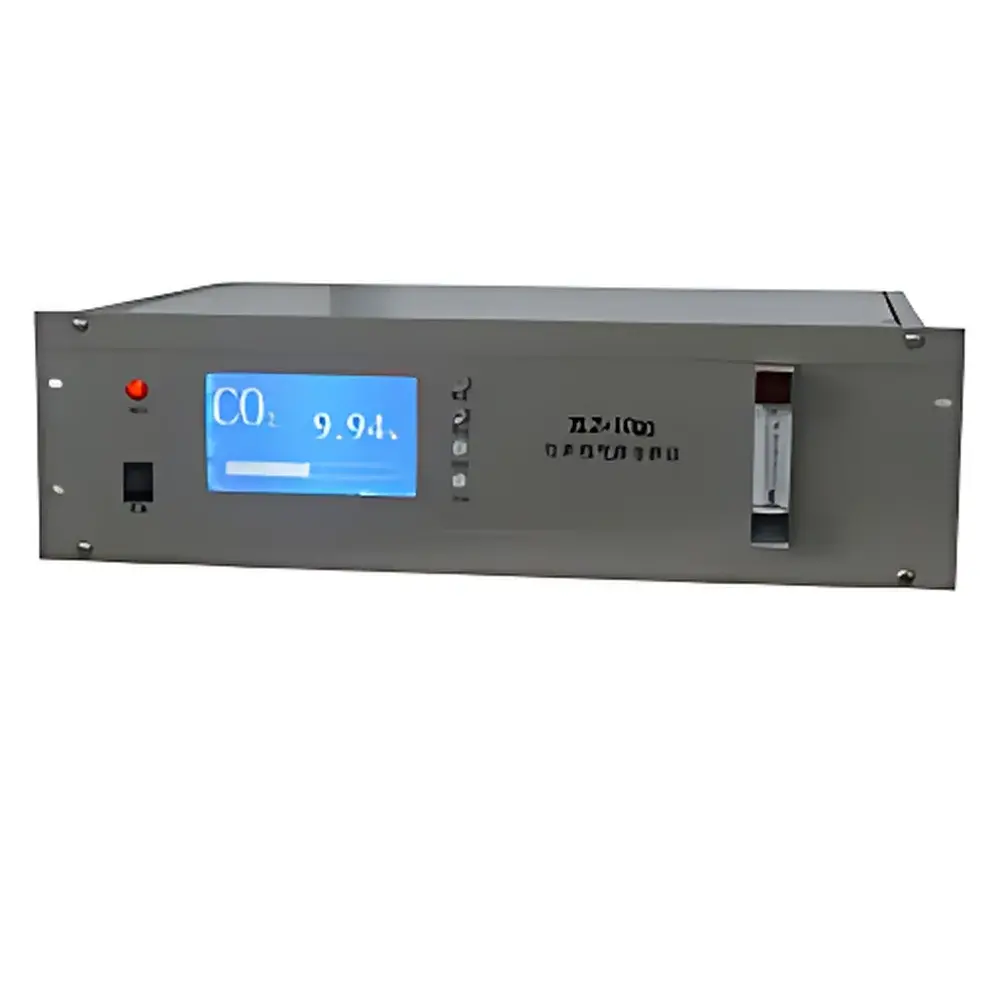
SIELINS XLZ-1090GXH Non-Dispersive Infrared (NDIR) Ammonia Analyzer
| Brand | SIELINS |
|---|---|
| Model | XLZ-1090GXH |
| Detection Principle | Non-Dispersive Infrared (NDIR) Absorption |
| Gas Measured | NH₃ (ammonia), with multi-gas capability (CO, CO₂, SO₂, CH₄) |
| Measurement Range | 0–50 ppm (standard) |
| Accuracy | ≤ 0.01% v/v (for high-concentration mode), 1 ppm (for trace-level NH₃) |
| Response Time | T₉₀ ≤ 15 s |
| Repeatability | ≤ 1% FS |
| Zero Drift | ≤ ±1% FS / 48 h |
| Span Drift | ≤ ±1% FS / 48 h |
| Linearity Error | ≤ ±1% FS |
| Sample Flow Rate | 0.5–3 L/min |
| Operating Temperature | 0–40 °C |
| Relative Humidity | ≤ 90% RH (non-condensing) |
| Power Supply | 220 V ±10%, 50 ±0.5 Hz, 150 W |
| Output Signals | 4–20 mA, 0–20 mA, 0–10 mV, 1–5 V (isolated, load ≤ 600 Ω) |
| Display | Digital LCD with real-time concentration readout |
| Enclosure Type | Wall-mounted online analyzer |
| Compliance | Designed for continuous ambient and stack emission monitoring per ISO 12039, ASTM D6348, and EN 15267-3 requirements |
Overview
The SIELINS XLZ-1090GXH is a fixed-installation, non-dispersive infrared (NDIR) ammonia analyzer engineered for continuous, real-time quantification of NH₃ in complex gas matrices. It operates on the fundamental spectroscopic principle that ammonia exhibits strong, characteristic absorption bands in the mid-infrared region—specifically near 10.4 µm—enabling selective detection without optical dispersion elements. Unlike tunable diode laser (TDLAS) or electrochemical systems, this NDIR platform employs a single broadband infrared source, a dual-compartment (half-cell) sample chamber, and a high-stability pyroelectric detector optimized for NH₃-specific spectral response. The optical path design minimizes cross-sensitivity to water vapor and CO₂ through differential referencing and advanced signal compensation algorithms. Its architecture supports unattended operation in demanding field environments, delivering stable baseline performance and high reproducibility over extended duty cycles—critical for regulatory-grade ambient air quality networks and industrial process safety applications.
Key Features
- True NDIR measurement principle with dedicated NH₃ spectral band targeting (10.4 µm), eliminating reliance on consumables or catalytic surfaces
- Dual-chamber single-beam optical configuration with internal reference channel for automatic zero compensation and drift correction
- High-speed response (T₉₀ ≤ 15 s) enabled by optimized gas flow dynamics and low thermal mass detector housing
- Digital signal processing engine with 24-bit ADC resolution, adaptive filtering, and temperature-compensated calibration coefficients stored in non-volatile memory
- Modular analog output interface supporting 4–20 mA (HART-compatible), 0–10 V, and RS-485 Modbus RTU for seamless integration into SCADA, DCS, and EMS platforms
- IP54-rated enclosure with corrosion-resistant aluminum alloy chassis, suitable for indoor control rooms and sheltered outdoor installations
- Onboard data logging (up to 30 days at 1-min intervals) with timestamped events, alarm history, and diagnostic status flags
Sample Compatibility & Compliance
The XLZ-1090GXH is validated for direct analysis of NH₃ in humid, particulate-laden, and chemically aggressive sample streams typical of flue gas, biogas, agricultural ventilation exhaust, and urban ambient air. Integrated heated sampling line interface (optional) prevents condensation-induced measurement artifacts. It meets functional requirements aligned with ISO 12039 (stationary source emissions — determination of ammonia), ASTM D6348 (standard test method for determining gaseous compounds by gas chromatography), and EN 15267-3 (performance certification of automated measuring systems). While not CE-marked for intrinsic safety, it complies with IEC 61000-6-2/6-3 for electromagnetic compatibility and operates within Class II pollution degree per IEC 60664-1. Calibration traceability follows NIST-traceable standards; factory calibration certificates include uncertainty budgets per ISO/IEC 17025 guidelines.
Software & Data Management
The analyzer includes embedded firmware with configurable alarm thresholds (high/low, rate-of-change), relay-controlled external valve actuation, and user-defined averaging periods (1–300 s). Local configuration is performed via intuitive menu-driven LCD interface with multilingual support (English, Spanish, German). Remote diagnostics and parameter adjustment are supported via Modbus RTU over RS-485 or optional Ethernet/WiFi module. Data export supports CSV format via USB port or serial dump. All calibration events, zero/span checks, and fault logs are time-stamped and retained with audit trail integrity—satisfying basic GLP documentation needs. For regulated environments requiring full 21 CFR Part 11 compliance, optional software add-ons provide electronic signatures, role-based access control, and encrypted database archiving.
Applications
- Ambient air quality monitoring networks tracking NH₃ contributions to PM₂.₅ formation and eutrophication in sensitive ecological zones
- Continuous emission monitoring systems (CEMS) for waste incinerators, fertilizer plants, and animal feeding operations subject to EU BREF or US EPA Method 320 compliance
- Process control in SCR (selective catalytic reduction) de-NOₓ systems where NH₃ slip must be maintained below 2–5 ppm to prevent catalyst fouling and secondary aerosol generation
- Indoor air quality assessment in livestock barns, poultry houses, and wastewater treatment facilities for occupational health compliance (OSHA PEL: 50 ppm TWA)
- Research-grade validation of open-path DOAS or cavity ring-down spectrometers in field intercomparison studies
- Calibration verification of portable electrochemical NH₃ sensors used in leak detection surveys
FAQ
What gases can the XLZ-1090GXH measure simultaneously?
It measures one target gas at a time—NH₃ is the primary calibrated species. Optional factory configurations support CO, CO₂, SO₂, or CH₄, but reconfiguration requires hardware recalibration and cannot be performed in-field.
Is sample conditioning required for stack gas applications?
Yes. For hot, wet, or high-dust flue gas, a certified sample probe with thermoelectric cooler, particulate filter, and moisture trap (e.g., Nafion dryer) is mandatory to protect optics and ensure accuracy.
Does the analyzer support automatic zero and span calibration?
Manual zero and span functions are provided via front-panel interface. Fully automated calibration requires external solenoid valves and certified span gas cylinders—available as an optional integrated calibration module (XLZ-CALM-200).
Can the device operate in explosive atmospheres?
No. The XLZ-1090GXH is not ATEX, IECEx, or UL-classified for hazardous locations. It must be installed in Zone 2/Class I, Division 2 areas only, or housed in a pressurized purge cabinet if deployed near potential ignition sources.
What maintenance schedule is recommended?
Optical window cleaning every 3 months under normal ambient conditions; annual verification of detector responsivity and span calibration using certified NH₃ standard gas (±2% uncertainty); filter replacement every 6 months in dusty environments.
Related Products







