
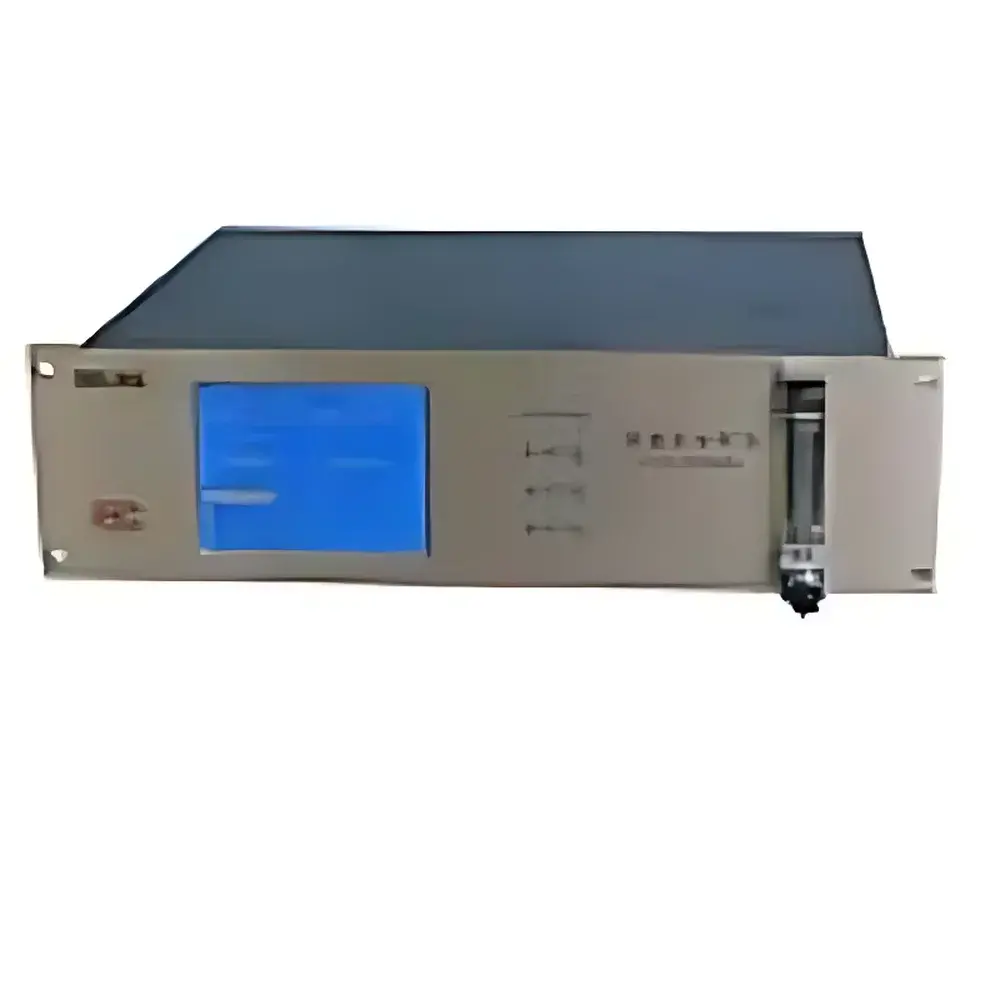
SIELINS XLZ-1090GXH Online Non-Dispersive Infrared (NDIR) Sulfur Dioxide Analyzer
| Brand | SIELINS |
|---|---|
| Model | XLZ-1090GXH |
| Type | Online NDIR Gas Analyzer |
| Detection Principle | Non-Dispersive Infrared Absorption |
| Measurement Target | SO₂ (Single-Component) |
| Range | 0–50 ppm (standard), up to 0–100% vol (configurable) |
| Repeatability | ≤1% FS |
| Resolution | 0.1 ppm |
| Response Time (T₉₀) | ≤20 s |
| Zero Drift | ≤±1% FS / 48 h (high-concentration mode) |
| Span Drift | ≤±1% FS / 48 h (high-concentration mode) |
| Linearity Error | ≤±2% FS |
| Output Signals | Isolated 4–20 mA (default), 0–5 V (default), RS232 digital interface |
| Enclosure | 19″ rack-mount chassis (483 × 290 × 177 mm) |
| Compliance | Designed for continuous emission monitoring (CEMS) and industrial process control per ISO 12039, ASTM D6216, and EPA Method 6C requirements |
Overview
The SIELINS XLZ-1090GXH is a dedicated online non-dispersive infrared (NDIR) sulfur dioxide (SO₂) analyzer engineered for continuous, real-time measurement of SO₂ concentration in industrial flue gases, ambient air, and process streams. It operates on the fundamental principle of selective infrared absorption: SO₂ exhibits strong, characteristic absorption bands near 7.3 µm, enabling highly specific detection without optical filters or dispersive elements. The instrument employs a single broadband IR source, a dual-compartment (half-cell) sample chamber with reference and measurement paths, and a thermopile or pyroelectric detector optimized for the SO₂ absorption band. This robust optical architecture—combined with advanced digital signal processing, temperature-stabilized electronics, and passive drift compensation algorithms—ensures long-term stability and metrological reliability under demanding field conditions. Designed for integration into CEMS (Continuous Emission Monitoring Systems), it meets the foundational performance expectations for regulatory-grade gas analysis in stationary source monitoring.
Key Features
- True online operation with uninterrupted sampling, supporting 24/7 unattended monitoring in harsh industrial environments.
- High-selectivity NDIR optics with dual-path gas cell design minimizes cross-sensitivity to CO₂, H₂O vapor, NOₓ, and hydrocarbons—critical for stack gas applications where matrix interference is prevalent.
- Configurable measurement range from 0–50 ppm (for low-level ambient or scrubber outlet monitoring) up to 0–100% volume (for high-concentration furnace or Claus process streams), with automatic range switching capability.
- Full digital signal chain: analog-to-digital conversion at ≥16-bit resolution, real-time baseline correction, and adaptive zero/span tracking algorithms to maintain accuracy across thermal and pressure fluctuations.
- Standard 19″ rack-mount enclosure (483 × 290 × 177 mm) compliant with IEC 60297-3-100, enabling seamless integration into DCS cabinets, analyzer shelters, or modular CEMS skids.
- Dual isolated analog outputs (4–20 mA and 1–5 V default), RS232 serial interface for configuration, diagnostics, and data logging, and discrete relay outputs for alarm, fault, and calibration status reporting.
Sample Compatibility & Compliance
The XLZ-1090GXH is validated for use with dry or conditioned sample gas streams containing SO₂ in concentrations ranging from trace (ppm) to percent-level. It accommodates inlet pressures from 70–106 kPa and temperatures from 0–50 °C; optional heated sample lines and particulate filtration (e.g., sintered stainless steel, PTFE membrane) are recommended for wet, dusty, or corrosive flue gas applications. The analyzer complies with key international standards governing fixed-source emissions monitoring, including ISO 12039:2000 (determination of SO₂ in stationary source emissions), ASTM D6216-19 (standard test method for SO₂ by NDIR), and U.S. EPA Performance Specification 2 (PS-2) for SO₂ analyzers used in CEMS. Its firmware supports audit-trail logging and user-access level management, facilitating alignment with GLP/GMP documentation requirements and internal QA/QC protocols.
Software & Data Management
Configuration, calibration, and diagnostic functions are accessible via an intuitive on-device LCD interface with multilingual support (English default) and context-sensitive prompts. All operational parameters—including zero/span calibration history, drift logs, alarm thresholds, and output scaling—are stored in non-volatile memory with time-stamped records. The RS232 interface enables bidirectional communication with host SCADA systems or third-party data acquisition software using ASCII-based command sets. Optional Modbus RTU protocol support (via external converter) allows direct integration into PLC-based control architectures. Data export formats include CSV-compatible timestamped readings, enabling traceability for regulatory reporting (e.g., EPA Form 7520-1, EU MRV). Firmware updates are performed via USB or serial connection, with version rollback and checksum validation to ensure integrity.
Applications
- Regulatory compliance monitoring of SO₂ emissions from coal-fired power plants, waste incinerators, and cement kilns per national CEMS mandates.
- Process optimization and catalyst health assessment in sulfur recovery units (SRUs), Claus plants, and tail-gas treating systems.
- Ambient air quality networks measuring urban or industrial boundary SO₂ levels in accordance with WHO and EU Air Quality Directive (2008/50/EC) limit values.
- Real-time feedback control in flue gas desulfurization (FGD) scrubbers, where precise SO₂ inlet/outlet concentration data drives lime slurry dosing algorithms.
- Research-grade quantification of SO₂ in combustion studies, atmospheric chemistry simulations, and material corrosion testing chambers.
FAQ
What gas interferences affect SO₂ measurement accuracy?
Cross-sensitivity to water vapor and CO₂ is minimized through optical path differential referencing and spectral bandpass filtering; however, condensation or excessive moisture (>10% RH) requires sample conditioning. Calibration with certified SO₂/N₂ mixtures is recommended for critical applications.
Is the analyzer suitable for high-dust flue gas without pretreatment?
No. Particulate loading >5 mg/m³ requires upstream filtration (e.g., ceramic filter + heated line) to prevent optical window fouling and flow restriction. Optional integrated probe heaters and purge-air modules are available.
How often must zero and span calibration be performed?
Per EPA PS-2, daily automated zero checks and weekly span verification are recommended for CEMS compliance; the instrument supports scheduled auto-calibration routines triggered via digital input or timer.
Does the device support 21 CFR Part 11-compliant electronic records?
While the base unit provides audit-trail logging, full Part 11 compliance (electronic signatures, role-based access, system validation) requires integration with validated LIMS or CEMS data handling software—not inherent to the analyzer’s embedded firmware.
Can multiple XLZ-1090GXH units share one RS232 host connection?
Yes, using Modbus RTU over RS485 (with optional converter) and unique device addressing; RS232 supports point-to-point only.
Related Products







