
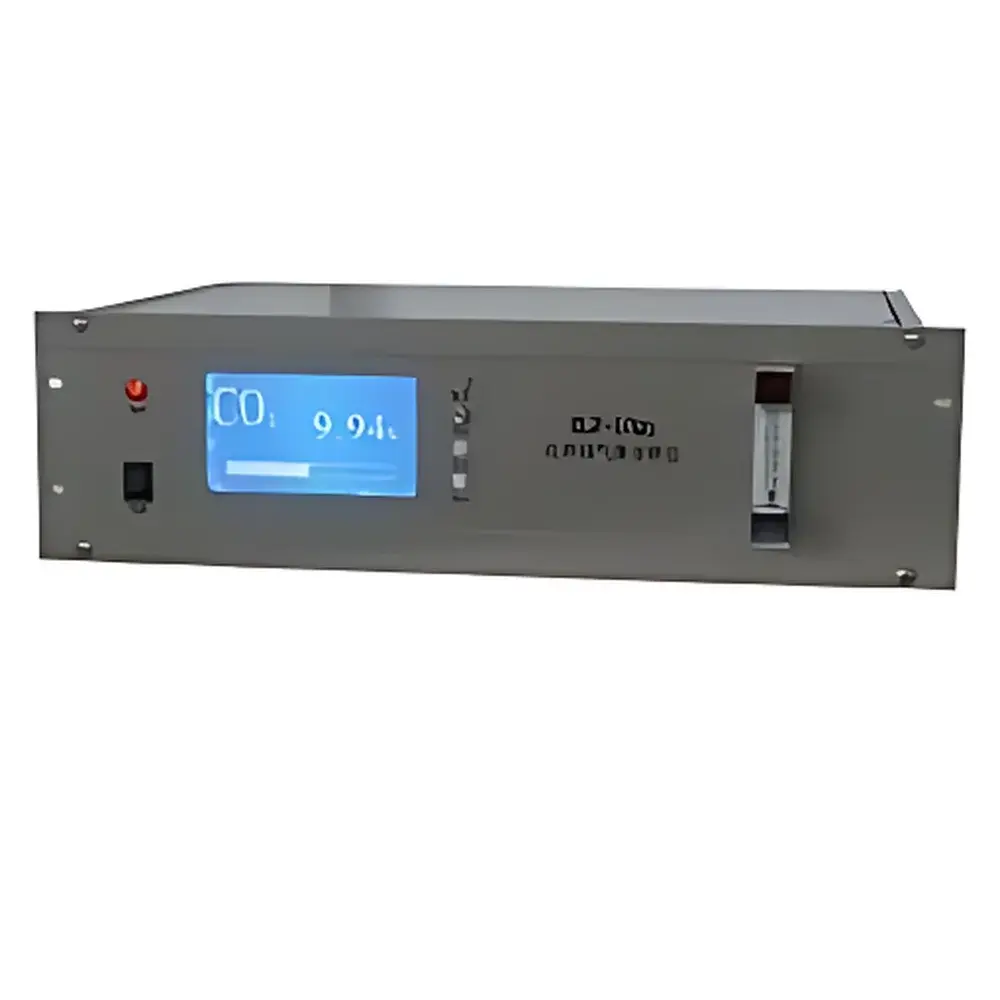
SIELINS XLZ-1090 Multicomponent Infrared Gas Analyzer
| Brand | SIELINS |
|---|---|
| Model | XLZ-1090 |
| Principle | Non-Dispersive Infrared (NDIR) Absorption |
| Configuration | Online Fixed-Mount Analyzer |
| Response Time | T90 ≤ 15 s |
| Repeatability | ≤ 1% FS |
| Stability | Drift ≤ ±1% FS / 15 days |
| Linearity Error | ≤ ±1% FS |
| Gas Flow Rate | 0.5–3 L/min |
| Operating Temperature | 0–40 °C |
| Relative Humidity | ≤ 90% RH |
| Power Supply | 220 V ±10%, 50 Hz ±0.5 Hz, 150 W |
| Simultaneous Measurement Channels | Up to 4 gases |
| Measured Gases | CO, CO₂, SO₂, CH₄, NH₃ (configurable per application) |
Overview
The SIELINS XLZ-1090 is a fixed-mount, online multicomponent gas analyzer engineered for continuous, real-time quantification of up to four infrared-active gases—including carbon monoxide (CO), carbon dioxide (CO₂), sulfur dioxide (SO₂), methane (CH₄), and ammonia (NH₃)—within complex gas matrices. It operates on the principle of non-dispersive infrared (NDIR) absorption spectroscopy: a broadband infrared source emits radiation through a dual-compartment measurement cell (single-beam, half-cell design), where target gas molecules absorb characteristic wavelengths. A high-stability pyroelectric or photonic detector captures the attenuated signal, and advanced digital signal processing—implemented via embedded microcontroller architecture—converts absorbance into concentration values using calibrated Beer–Lambert relationships. Unlike dispersive systems, the XLZ-1090 employs optical filtering and reference compensation to eliminate spectral interference, ensuring robust performance in industrial and environmental settings where dust, moisture, and pressure fluctuations are present. Its design prioritizes long-term baseline stability and minimal maintenance, making it suitable for unattended operation in continuous emission monitoring systems (CEMS) and process safety applications.
Key Features
- Simultaneous real-time analysis of up to four IR-absorbing gases from a single sample stream
- Optimized NDIR optical path with single-source, dual-chamber gas cell for enhanced signal-to-noise ratio and cross-sensitivity suppression
- Digital temperature and pressure compensation algorithms integrated into firmware to correct for ambient and flow-induced drift
- High-resolution graphical LCD interface with intuitive menu navigation, local data logging (up to 30 days at 1-min intervals), and configurable alarm thresholds
- Ruggedized aluminum housing rated IP65 for indoor/outdoor mounting; compliant with electromagnetic compatibility (EMC) standards IEC 61326-1 and IEC 61000-4 series
- Modular sensor configuration: factory-calibrated gas-specific filter/detector pairs enable field-replaceable channel upgrades without full system recalibration
Sample Compatibility & Compliance
The XLZ-1090 accepts conditioned sample gas streams within 0.5–3 L/min flow range and accommodates inlet pressures up to 150 kPa (gauge). It requires particulate filtration (≤5 µm) and optional moisture removal (e.g., Nafion dryer or chilled mirror condenser) for optimal accuracy in high-humidity environments. The analyzer meets key regulatory and industry requirements for stationary source monitoring, including alignment with ISO 12039 (CO/CO₂ in flue gas), ASTM D6522 (SO₂ by IR), and China’s HJ 75–2017 and HJ 76–2017 technical specifications for CEMS. While not intrinsically safe certified, it may be deployed in Zone 2 hazardous areas when installed with appropriate barrier systems and documented risk assessment per IEC 60079-10-1. All calibration records, zero/span logs, and diagnostic events are timestamped and stored locally to support GLP/GMP audit readiness.
Software & Data Management
Data output is provided via isolated 4–20 mA analog channels (one per measured gas), RS-485 Modbus RTU protocol, and optional Ethernet TCP/IP interface. The built-in data logger supports CSV export via USB flash drive for offline trend analysis. Optional PC-based configuration software (XLZ-Config Suite v3.x) enables remote parameter adjustment, multi-point calibration curve management, and generation of compliance reports aligned with EPA Method 205 and EU BREF reference documentation. Audit trails—including user login history, configuration changes, and calibration actions—are retained for ≥180 days and comply with basic FDA 21 CFR Part 11 principles (electronic signature capability available upon request with password-protected admin mode).
Applications
- Continuous emissions monitoring (CEMS) at coal-fired power plants, waste incinerators, and cement kilns for regulatory reporting under national air pollutant discharge standards
- In-process gas composition control in syngas production, biogas upgrading, and catalytic reforming units
- Ambient air quality stations measuring urban CO/CO₂ gradients and industrial fence-line SO₂/NH₃ leakage detection
- Combustion efficiency analysis in boiler optimization and R&D-scale furnace testing
- Indoor air quality (IAQ) surveillance in hospitals, laboratories, and livestock facilities requiring NH₃ or CH₄ monitoring
FAQ
What gases can the XLZ-1090 measure simultaneously?
Up to four gases from the standard set: CO, CO₂, SO₂, CH₄, and NH₃. Channel selection is configured at time of order based on application requirements.
Is field calibration possible without specialized equipment?
Yes—zero calibration uses certified nitrogen (N₂) or synthetic air; span calibration requires certified gas mixtures traceable to NIST or GBW standards. The instrument supports two-point calibration with automatic gain adjustment.
Does the analyzer require periodic optical cleaning or lamp replacement?
The infrared source has a typical lifetime exceeding 5 years under continuous operation. Optical windows are sealed and do not require routine cleaning unless exposed to heavy particulate loading; preventive maintenance is recommended every 6 months.
Can the XLZ-1090 integrate with existing SCADA or DCS platforms?
Yes—via Modbus RTU over RS-485 or 4–20 mA analog outputs. Engineering documentation includes register maps, loop diagrams, and DCS integration checklists.
What is the minimum detectable concentration for CO and SO₂?
Detection limits are application-dependent and defined by selected range (e.g., 0–100 ppm CO or 0–5000 ppm SO₂). Typical signal resolution is 0.1% of full scale, with noise-equivalent concentration (NEC) below 0.5% FS RMS.
Related Products







