
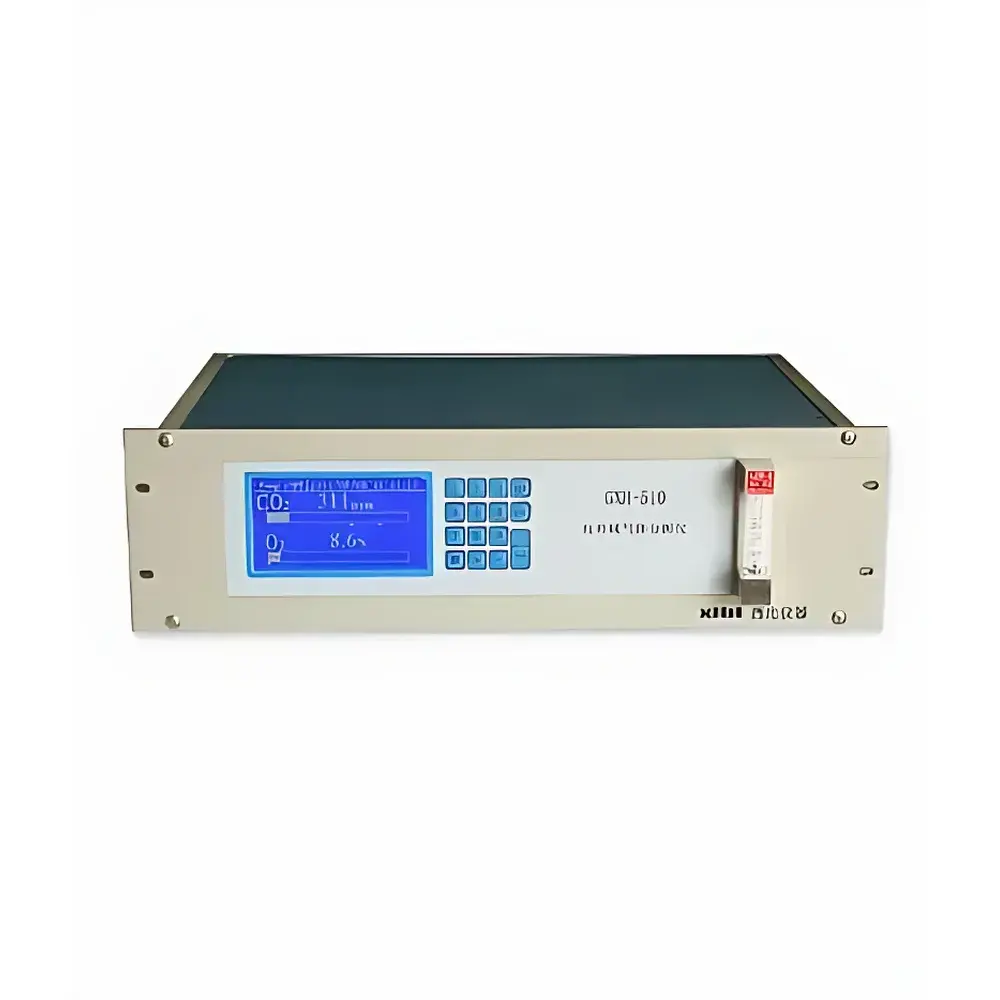
SIELINS XLZ-1090 NDIR Multi-Gas Analyzer
| Brand | SIELINS |
|---|---|
| Model | XLZ-1090 |
| Type | Online NDIR Gas Analyzer |
| Detection Principle | Non-Dispersive Infrared (NDIR) |
| Target Gases | CO, CO₂, SO₂, CH₄, NH₃ (single-gas measurement per configuration) |
| Measurement Range | 0–50 ppm (min) to 0–100% vol (max, configurable) |
| Repeatability | ≤1% of full scale |
| Resolution | 0.1 ppm (trace mode) / 0.01% v/v (percent mode) |
| Response Time (T₉₀) | ≤15 s |
| Zero Drift | ≤±1% FS / 48 h |
| Span Drift | ≤±1% FS / 48 h |
| Linearity Error | ≤±1% FS |
| Sample Flow Rate | 0.5–3 L/min |
| Operating Temperature | 0–40 °C |
| Relative Humidity | ≤90% RH (non-condensing) |
| Power Supply | 220 V ±10%, 50 ±0.5 Hz, 150 W |
| Analog Outputs | 0–20 mA, 4–20 mA, 0–10 mV, 1–5 V (load ≤600 Ω, isolated) |
| Display | Digital LCD with real-time concentration readout |
Overview
The SIELINS XLZ-1090 is a fixed-installation, single-channel non-dispersive infrared (NDIR) gas analyzer engineered for continuous, high-stability quantification of individual infrared-active gases—including carbon monoxide (CO), carbon dioxide (CO₂), sulfur dioxide (SO₂), methane (CH₄), and ammonia (NH₃)—within complex gas matrices. Unlike dispersive spectrometers, the XLZ-1090 employs a broadband IR source, a dual-compartment (reference/sample) single-beam optical cell, and a thermopile or pyroelectric detector optimized for target gas absorption bands. This architecture eliminates moving parts and spectral calibration drift, delivering robust performance in industrial and environmental monitoring applications where long-term unattended operation is required. The analyzer operates on Beer–Lambert law principles: gas concentration is derived from the attenuation of IR radiation at characteristic wavelengths (e.g., 4.26 µm for CO₂, 4.67 µm for CO), with electronic compensation for temperature, pressure, and humidity effects applied via embedded digital signal processing.
Key Features
- Single-source, dual-compartment NDIR optical design ensures inherent stability and minimizes cross-sensitivity between gases
- Digital signal processing engine with real-time baseline correction and auto-zero referencing over 48-hour intervals
- High-resolution display (0.1 ppm for trace ranges; 0.01% v/v for percent-level measurements) with configurable units and alarm thresholds
- Fast T₉₀ response ≤15 seconds—optimized for dynamic process streams and emission stack monitoring
- Low-drift architecture: zero drift ≤±1% FS/48 h and span drift ≤±1% FS/48 h support extended calibration intervals per ISO 14064-3 and EPA Method 205 verification protocols
- Industrial-grade analog outputs (4–20 mA standard, plus optional 0–20 mA, 1–5 V, or 0–10 mV) with galvanic isolation and load-insensitive delivery up to 600 Ω
- Wide operating envelope: functional across 0–40 °C ambient temperature and ≤90% RH (non-condensing), suitable for indoor control rooms and outdoor sheltered enclosures
Sample Compatibility & Compliance
The XLZ-1090 is designed for clean, dry, particulate-free sample gas streams. It requires external conditioning (e.g., heated sampling line, condensate trap, particulate filter) when deployed in high-moisture or high-dust environments such as flue gas ducts or biogas pipelines. While not intrinsically safe, it complies with IEC 61000-6-2 (immunity) and IEC 61000-6-4 (emissions) for industrial electromagnetic environments. Its measurement accuracy and repeatability meet the technical requirements of ISO 4223-1 (CO analyzers), ISO 8573-1 (compressed air purity), and EN 15267-3 (QAL1 certification framework for automated measuring systems). For regulatory reporting under EU Industrial Emissions Directive (IED) or U.S. EPA subpart GG, users must validate system performance via periodic span/zero checks and document maintenance per GLP-aligned procedures.
Software & Data Management
The XLZ-1090 operates autonomously without host software but supports integration into centralized SCADA, DCS, or EMS platforms via its analog outputs. Optional RS-485 Modbus RTU interface (available upon request) enables remote parameter readout (current concentration, status flags, fault codes) and basic configuration changes. All analog output signals include built-in linearization and temperature-compensated scaling. Internal event logging captures power cycles, alarm activations, and output saturation events—accessible via front-panel navigation. For audit-trail compliance in regulated environments (e.g., pharmaceutical cleanroom air monitoring per ISO 14644-2), data acquisition systems must be validated separately to satisfy FDA 21 CFR Part 11 requirements for electronic records and signatures.
Applications
- Continuous emissions monitoring (CEM) of CO and CO₂ from combustion sources (boilers, incinerators, cement kilns) per EN 14181 QAL2/QAL3
- In-process gas composition control in petrochemical reformers, syngas purification units, and fertilizer synthesis loops (NH₃, CH₄)
- Ambient air quality stations measuring urban CO and background CO₂ levels in accordance with WHO Air Quality Guidelines
- Indoor air quality (IAQ) surveillance in hospitals, schools, and commercial buildings—compliant with ASHRAE Standard 62.1 ventilation rate procedures
- Research-grade combustion analysis in university laboratories, supporting ASTM D5845 (CO in exhaust gas) and ISO 8178-4 (engine emission testing)
- Biogas upgrading facilities monitoring CH₄ purity and H₂S surrogate (via SO₂ channel with conversion factor)
FAQ
Can the XLZ-1090 measure multiple gases simultaneously?
No. It is a single-channel NDIR analyzer configured at time of manufacture for one specific gas. Multi-gas capability requires parallel installation of separate XLZ-1090 units or integration into a multi-analyzer rack system.
What sample gas conditioning is required for flue gas applications?
A heated sampling probe (≥180 °C), PTFE-lined sample line, thermoelectric chiller (to maintain dew point <5 °C), and 1-µm particulate filter are mandatory to prevent condensation, corrosion, and optical fouling.
Does the instrument support automatic calibration?
It does not include an internal calibration gas manifold. Automatic zero/span calibration requires external solenoid valves and certified calibration gases—typically implemented via third-party CEMS controllers.
Is the 4–20 mA output intrinsically safe?
No. The analog outputs are non-isolated from mains power and require external barriers (e.g., Pepperl+Fuchs KFD2-STC4-Ex1) for use in Zone 1/2 hazardous areas.
How often should zero and span checks be performed?
Per ISO 14064-3 and EN 15267-3, daily zero checks and weekly span verification are recommended for regulatory compliance; quarterly full calibration with traceable standards is advised for QA/QC documentation.







