
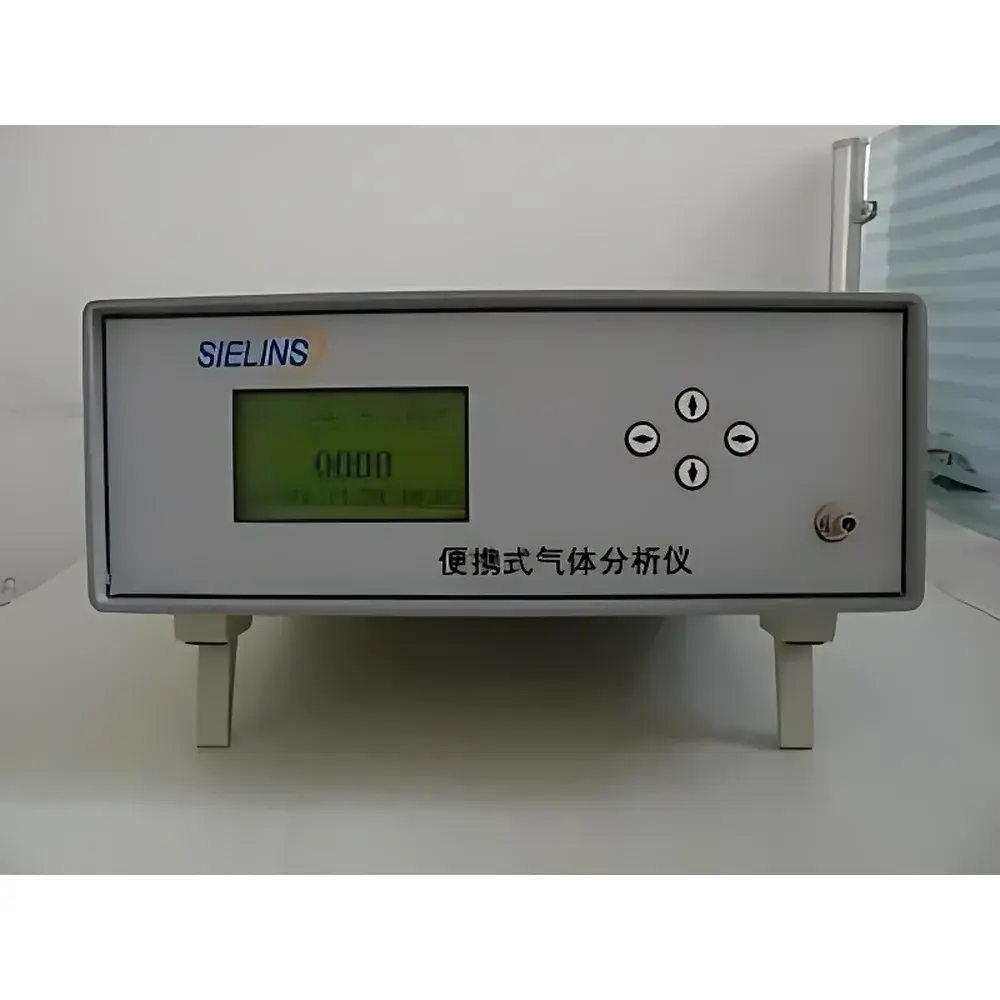
SIELINS XLZ-3091GXH Portable NDIR Carbon Dioxide Analyzer
| Brand | SIELINS |
|---|---|
| Origin | Beijing, China |
| Model | XLZ-3091GXH |
| Instrument Type | Portable |
| Detection Principle | Non-Dispersive Infrared (NDIR) |
| Measuring Range | 0–0.5% or 0–1% CO₂ (selectable) |
| Resolution | 0.001 ppm |
| Repeatability | ≤0.5% |
| Zero Drift | ≤±1% F.S. |
| Span Drift | ≤±1% F.S. |
| Linearity Error | ±2% F.S. |
| Response Time | ≤60 s |
| Power Supply | AC 220 V / Internal Rechargeable Battery |
| Weight | ≤3 kg |
| Dimensions | 245 × 190 × 85 mm |
| Interface | RS232 |
| Calibration | Field-calibratable with certified standard gas |
| Filter | Integrated particulate filter with 6-port valve sampling system |
Overview
The SIELINS XLZ-3091GXH Portable NDIR Carbon Dioxide Analyzer is a field-deployable, single-component gas measurement instrument engineered for high-fidelity, real-time quantification of carbon dioxide (CO₂) concentration in ambient air and indoor environments. It operates on the principle of non-dispersive infrared (NDIR) spectroscopy — a well-established, interference-resistant optical detection method grounded in the Beer-Lambert law. CO₂ molecules exhibit strong, characteristic absorption bands near 4.26 µm; the analyzer employs a thermopile detector and dual-wavelength reference architecture to isolate this spectral signature while compensating for humidity, temperature, and optical path variability. Designed for environmental monitoring, indoor air quality (IAQ) assessment, HVAC commissioning, and occupational safety applications, the device delivers laboratory-grade stability in a compact, battery-powered enclosure weighing under 3 kg. Its integrated sampling pump enables continuous draw-through operation, supporting both spot checks and time-series profiling without external vacuum sources.
Key Features
- True portable architecture: Self-contained power (AC 220 V or internal rechargeable battery), lightweight design (≤3 kg), and ergonomic dimensions (245 × 190 × 85 mm) optimized for handheld or tripod-mounted deployment.
- NDIR optical engine with dual-wavelength compensation: Minimizes cross-sensitivity to water vapor and other common atmospheric interferents, ensuring robust performance across variable humidity conditions (10–90% RH, non-condensing).
- High-resolution detection: 0.001 ppm resolution over selectable full-scale ranges (0–0.5% or 0–1% CO₂), enabling precise low-concentration tracking relevant to IAQ standards (e.g., ASHRAE 62.1, WHO guidelines).
- Stability-critical calibration architecture: Supports field calibration using traceable certified standard gases; zero and span adjustments are software-accessible via intuitive menu navigation.
- Integrated particulate management: Built-in particulate filter combined with a 6-port solenoid valve manifold ensures consistent sample conditioning and extends optical cell service life.
- Real-time data handling: RS232 serial interface enables direct connection to laptops, data loggers, or SCADA systems for live streaming, timestamped storage, and remote configuration.
Sample Compatibility & Compliance
The XLZ-3091GXH is validated for gaseous samples within ambient temperature (0–40 °C) and relative humidity (10–90% RH, non-condensing) ranges. It is intended for clean, dry, non-corrosive air matrices — typical of indoor offices, classrooms, greenhouses, and outdoor urban monitoring sites. While not intrinsically safe or ATEX-certified, it complies with general EMC Directive 2014/30/EU and Low Voltage Directive 2014/35/EU. Data acquisition workflows support GLP-aligned documentation when used with validated third-party logging software. The instrument’s linearity (±2% F.S.), repeatability (≤0.5%), and drift specifications (≤±1% F.S. for zero and span over 24 h) align with ISO 12039:2000 (stationary source emissions — determination of CO₂ mass concentration) and ASTM D6216-22 (standard practice for calibration of portable gas analyzers).
Software & Data Management
The analyzer features an embedded firmware platform with LCD-based human-machine interface (HMI), supporting full-menu navigation, auto-zero, endpoint adjustment, and linearization of analog output. Optional data acquisition software — distributed separately — provides Windows-compatible serial communication drivers, configurable sampling intervals (1 s to 60 min), CSV export, trend graphing, and audit-trail-enabled calibration logs. All stored datasets include UTC timestamps, instrument ID, range selection, and calibration status flags. While native firmware does not implement FDA 21 CFR Part 11 electronic signature controls, the system supports external validation protocols for regulated environments where raw data integrity and operator accountability are required.
Applications
- Indoor Air Quality (IAQ) auditing per ASHRAE Standard 62.1 and EN 13779, including CO₂ demand-controlled ventilation (DCV) verification.
- Greenhouse climate monitoring for precision agriculture and horticultural research.
- Environmental baseline surveys in urban, suburban, and peri-urban zones — compliant with national ambient air quality monitoring network (NAAQMN) supplementary protocols.
- Post-occupancy evaluation (POE) studies in LEED- or BREEAM-certified buildings.
- Educational laboratory use for teaching gas sensing principles, infrared spectroscopy, and environmental instrumentation fundamentals.
- Field validation of fixed-site CO₂ monitors and sensor networks.
FAQ
What detection principle does the XLZ-3091GXH employ?
It uses non-dispersive infrared (NDIR) absorption spectroscopy at 4.26 µm, leveraging the Beer-Lambert law for quantitative CO₂ measurement.
Can the instrument measure gases other than CO₂?
No — it is a single-component analyzer optimized exclusively for CO₂. Cross-sensitivity to CO, CH₄, or NO₂ is minimized through optical filtering and signal processing but not eliminated; co-detection is not supported.
Is field calibration possible without returning the unit to a service center?
Yes — users may perform zero and span calibration on-site using certified CO₂ standard gases (e.g., 500 ppm or 1000 ppm in N₂), following the built-in calibration wizard.
Does the device meet international metrological traceability requirements?
The analyzer itself is not NIST-traceable out-of-box; however, its calibration protocol accepts NIST-traceable standard gases, enabling users to establish and document traceability within their QA/QC framework.
What is the expected service interval for the optical cell and pump?
Under normal use (≤8 h/day, filtered air), the NDIR cell requires no routine maintenance; the diaphragm pump is rated for ≥10,000 hours. Annual functional verification against reference gas is recommended.







