
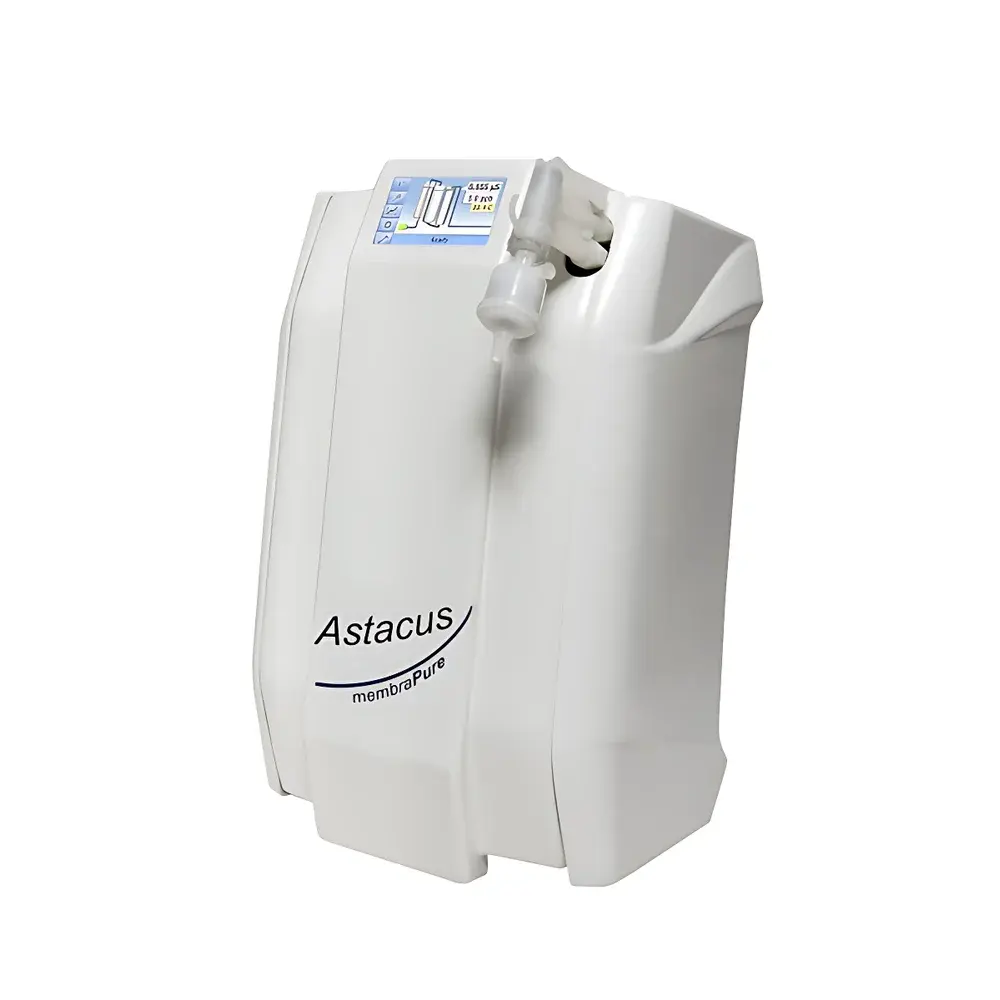
Astacus Mini Ultra-Pure Water System
| Origin | Germany |
|---|---|
| Manufacturer Type | Authorized Distributor |
| Origin Category | Imported |
| Model | Astacus |
| Price Range | USD 4,200–7,000 (FOB) |
| Purification Grade | ASTM Type I Reagent Water |
| Resistivity | 18.2 MΩ·cm at 25 °C |
| Heavy Metals & Soluble Silica | < 0.1 ppb |
| Total Organic Carbon (TOC) | < 3 ppb |
| Microbial Count | < 0.1 CFU/mL |
| Endotoxins | < 0.001 EU/mL |
| Particles (>0.1 µm) | < 1 particle/mL |
| Daily Output | 20 L/day |
| Feed Water Requirements | Deionized (DI), Reverse Osmosis (RO), or EDI water |
| Flow Rate (Standard/Analytical/Life Science Configurations) | 2.0 / 2.0 / 1.8 L/min |
| Optional Modules | UV Oxidation (185/254 nm), Ultrafiltration (UF) Membrane, MemPak™ Final Polishing Cartridge |
Overview
The Astacus Mini Ultra-Pure Water System is a compact, benchtop- or wall-mountable point-of-use purification platform engineered for laboratories requiring continuous, on-demand production of ASTM Type I reagent-grade water. Designed and manufactured in Germany, the system employs a multi-stage purification architecture—comprising dual-stage ion exchange, integrated 185/254 nm UV photooxidation, and a final ultra-low adsorption MemPak™ polishing cartridge—to achieve consistent resistivity of 18.2 MΩ·cm at 25 °C. Its core operational principle relies on electrochemical deionization combined with advanced photolytic TOC reduction and sterile filtration, ensuring compliance with ISO 3696:1987, CLSI EP22-A, and USP specifications for purified water used in analytical chemistry, cell culture, molecular biology, and trace metal analysis.
Key Features
- Compact footprint (W × D × H: 320 × 420 × 540 mm) optimized for limited bench space or under-sink/wall-mounted installation
- Real-time μS-controller monitoring feed water conductivity to prevent premature cartridge exhaustion and ensure stable outlet quality
- Three configurable variants: Standard (for general HPLC and buffer preparation), Analytical (enhanced TOC control <3 ppb), and Life Science (endotoxin-free output <0.001 EU/mL with integrated UF membrane)
- Non-metallic fluid path constructed entirely from pharmaceutical-grade PTFE, PEEK, and fused silica to eliminate leachables and metallic contamination
- Integrated 185/254 nm dual-wavelength UV lamp achieving >90% TOC degradation efficiency and microbial inactivation without chemical residuals
- Automatic system self-sanitization cycle with programmable scheduling to maintain microbiological integrity during idle periods
Sample Compatibility & Compliance
The Astacus Mini is validated for use with feed water meeting ASTM D1193 Type II or ISO 3696 Grade 2 specifications—including RO permeate, EDI effluent, or mixed-bed deionized water. All configurations comply with ISO/IEC 17025:2017 requirements for calibration traceability and are compatible with GLP/GMP environments requiring audit-ready documentation. The Life Science variant satisfies USP pyrogen testing criteria and FDA 21 CFR Part 11–compliant data logging when paired with optional Ethernet-enabled controller firmware. Certificates of Conformance, material biocompatibility reports (USP Class VI), and heavy metal extractables test data are supplied with each unit.
Software & Data Management
Equipped with an embedded microprocessor-based control interface, the system logs all critical operational parameters—including inlet conductivity, outlet resistivity, UV lamp hours, cartridge service life, and daily volume dispensed—in non-volatile memory. Data export via USB or RS-232 supports CSV formatting for integration into LIMS or ELN platforms. Optional firmware upgrade enables remote diagnostics, alarm notifications via email/SMS, and electronic signature-capable audit trails aligned with 21 CFR Part 11 Annex 11 requirements. Calibration events and maintenance records are timestamped and user-annotated to support regulatory inspections.
Applications
- HPLC, UHPLC, and LC-MS mobile phase and blank preparation where low TOC and ionic background are critical
- Preparation of electrophysiology buffers, patch-clamp solutions, and stem cell media requiring endotoxin-free water
- ICP-MS and GF-AAS trace elemental analysis demanding sub-ppt metal contamination limits
- QPCR master mix preparation and NGS library construction sensitive to nuclease or RNase activity
- Calibration of conductivity meters, pH electrodes, and TOC analyzers per ISO 17025 method validation protocols
FAQ
What feed water quality is required to operate the Astacus Mini?
Deionized water with conductivity ≤1 µS/cm (equivalent to ASTM Type II or ISO Grade 2) is mandatory; RO or EDI pretreatment is strongly recommended to extend cartridge lifetime and ensure stable 18.2 MΩ·cm output.
Can the system be integrated into a centralized lab water network?
No—the Astacus Mini is designed exclusively as a standalone point-of-use system; it lacks pressure-rated distribution manifolds or loop circulation capability.
How often must the MemPak™ cartridge be replaced?
Under typical usage (20 L/day), replacement intervals range from 6 to 12 months depending on feed water quality and configuration; the system provides real-time remaining capacity estimation via the μS-controller interface.
Is third-party certification available for pharmaceutical applications?
Yes—optional IQ/OQ/PQ documentation packages, including factory acceptance testing (FAT) reports and installation qualification templates, are available upon request for GMP-compliant deployment.
Does the UV lamp require periodic recalibration?
No—dual-wavelength UV intensity is monitored continuously via built-in photodiodes; lamp replacement is triggered automatically after 9,000 operating hours or detected intensity decay >15%.



