
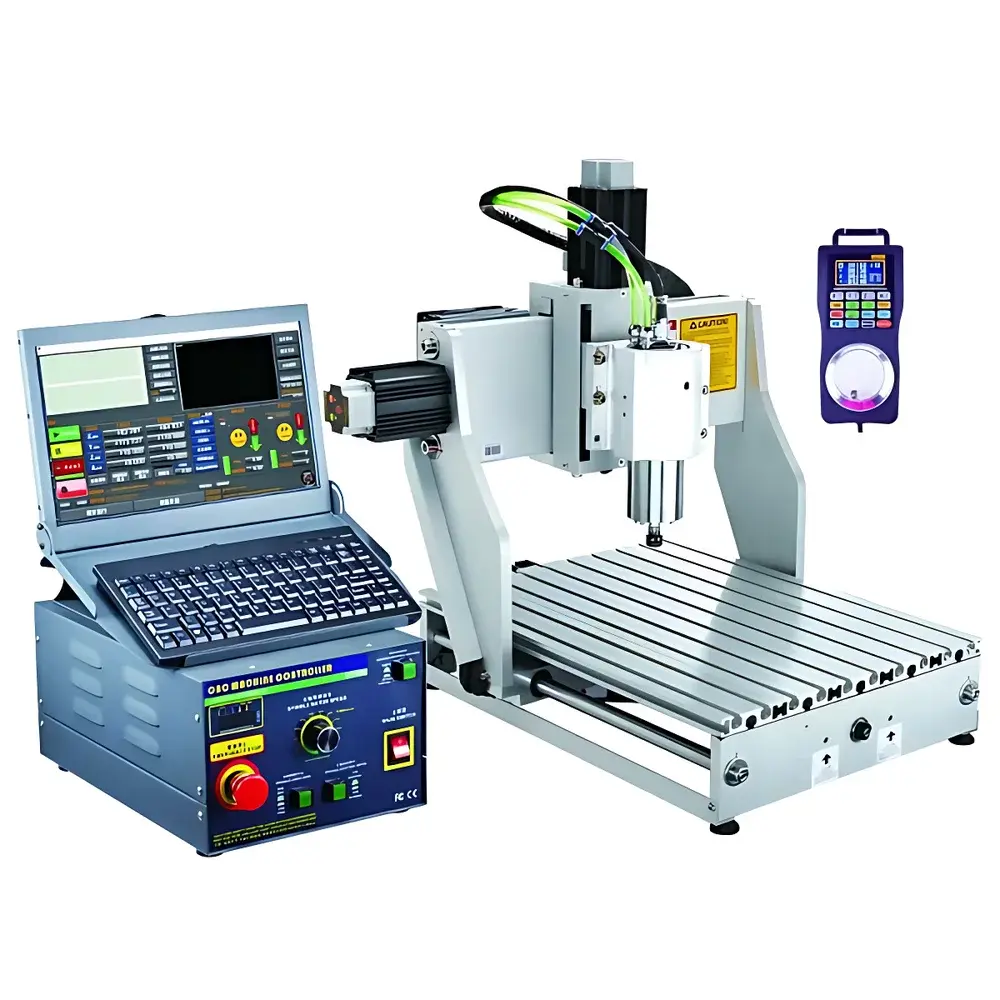
Hengyi HY(DK) Computer-Controlled Universal Specimen Preparation Machine
| Brand | Hengyi |
|---|---|
| Origin | Shanghai, China |
| Manufacturer Type | Direct Manufacturer |
| Country of Origin | Domestic (China) |
| Model | HY(DK)YUJN |
| Price | Upon Request |
| Spindle Speed | 24,000 rpm |
| Feed Rate | 0–500 mm/min |
| Cutting Depth | 2–20 mm |
| Compatible Pipe Diameter | 50–250 mm |
| Max. Workpiece Length (Pipe/Sheet) | 260 mm |
| X-Axis Travel | 280 mm |
| Y-Axis Travel | 310 mm |
| Z-Axis Travel | 70 mm |
| Frame Material | Aluminum Alloy |
| Stepper Motor & Driver Sets | 3 |
| High-Speed Variable-Frequency Spindle Motor | 1 |
| Precision Linear Guide Rods | 6 |
| Precision Ball Screws | 3 |
| Standard Vise | 1 set |
| Specimen Dimensional Accuracy | Compliant with GB/T 1043, GB/T 1843, GB/T 1040, GB/T 8804.2, ISO 8004.2, and ISO 179 |
| Tooling Options | Cylindrical end mills, 20° flat-bottom cutters, slitting knives, 45° chamfering cutters |
| Tool Diameters | Φ3 mm, Φ4 mm, Φ6 mm |
| Max. Machining Envelope | 300 × 150 × 100 mm |
| Power Supply | AC 220 V |
| Total Power Consumption | 1500 W |
| Net Weight | 45 kg |
Overview
The Hengyi HY(DK) Computer-Controlled Universal Specimen Preparation Machine is an industrial-grade CNC machining system engineered specifically for the precise, repeatable preparation of standardized test specimens from thermoplastics, thermosets, composites, acrylics, fiberglass, and other non-metallic materials. Unlike general-purpose milling equipment, the HY(DK) integrates motion control, toolpath optimization, and metrological traceability to meet the stringent dimensional tolerances required by international mechanical testing standards. Its operational principle relies on synchronized three-axis (X/Y/Z) servo-controlled positioning combined with high-speed rotary cutting—enabling deterministic material removal at controlled feed rates and depths of cut. This architecture ensures sub-millimeter geometric fidelity across specimen types including Izod/Charpy impact notched bars (per ISO 179 and GB/T 1843), tensile dumbbells (per ISO 527 and GB/T 1040), flexural test beams (per ISO 178), and pipe-section coupons (per ISO 8004.2 and GB/T 8804.2). Designed for integration into QC laboratories, R&D centers, and third-party certification facilities, the system bridges the gap between raw material processing and accredited mechanical property evaluation.
Key Features
- Three-axis CNC architecture with aluminum alloy frame for thermal stability and vibration damping during high-speed machining (24,000 rpm spindle)
- Independent stepper motor-driven axes (X: 280 mm, Y: 310 mm, Z: 70 mm) supported by six precision linear guide rods and three ground ball screws for positional repeatability ≤ ±0.02 mm
- Dedicated tooling suite—including Φ3 mm, Φ4 mm, and Φ6 mm cylindrical end mills, 20° flat-bottom cutters, slitting knives, and 45° chamfering tools—pre-configured for standard specimen geometries
- Programmable feed rate (0–500 mm/min) and adjustable cutting depth (2–20 mm) to accommodate varying material hardness and surface finish requirements
- Integrated vise system with parallel jaw alignment and clamping force calibration, ensuring workpiece rigidity across pipe diameters (50–250 mm) and sheet dimensions up to 260 mm in length
- Compliance-ready firmware with parameter locking, operation logging, and user-accessible machining protocols aligned with GLP documentation practices
Sample Compatibility & Compliance
The HY(DK) accommodates a broad spectrum of polymeric and composite substrates, including but not limited to PVC, PE, PP, ABS, PC, PMMA (organic glass), FRP laminates, and fiber-reinforced thermosets. It supports both tubular and planar stock forms—processing pipe sections with wall thicknesses up to 20 mm and sheet stock up to 100 mm in height. All specimen geometries conform to the dimensional definitions and tolerance bands specified in GB/T 1043 (notched impact bars), GB/T 1843 (Izod impact), GB/T 1040 (tensile testing), GB/T 8804.2 (polyethylene pipe tensile properties), ISO 179 (determining Charpy impact strength), and ISO 8004.2 (plastic piping systems — test methods for impact resistance). The machine’s mechanical accuracy and process consistency support audit readiness under ISO/IEC 17025-accredited testing environments.
Software & Data Management
The HY(DK) operates via an embedded Windows-based control interface with preloaded machining templates for common specimen types (e.g., ISO 179 Type 1A notch, ASTM D638 Type I dumbbell, ISO 178 flexural bar). Each template includes validated G-code sequences, tool offset compensation, and safety interlocks for spindle engagement and axis homing. All executed jobs are timestamped and logged with operator ID, tool ID, feed/spindle parameters, and final dimensional verification notes. Export formats include CSV and XML for traceability integration into LIMS platforms. While the system does not implement FDA 21 CFR Part 11 electronic signature functionality natively, its audit trail structure satisfies baseline GLP data integrity requirements when deployed with supplementary procedural controls.
Applications
- Preparation of notched specimens for standardized impact testing in polymer manufacturing QA labs
- Production of tensile and flexural test coupons from extruded pipes and injection-molded plaques in building material certification workflows
- Generation of representative samples for accelerated aging studies, creep testing, or environmental stress cracking evaluations
- Specimen conditioning prior to ISO 62 (water absorption), ISO 527 (tensile modulus), or ISO 1133 (MFR) analyses
- Supporting round-robin interlaboratory studies requiring cross-site specimen geometry harmonization
FAQ
What standards does the HY(DK) directly support for specimen geometry?
It meets dimensional specifications defined in GB/T 1043, GB/T 1843, GB/T 1040, GB/T 8804.2, ISO 179, and ISO 8004.2 for notched impact, tensile, flexural, and pipe-specific test specimens.
Can the machine process metallic materials?
No—the HY(DK) is calibrated and validated exclusively for non-metallic polymers and composites; its tooling, spindle dynamics, and feed logic are not rated for ferrous or non-ferrous metal machining.
Is remote monitoring or network connectivity available?
The system features USB and RS-232 interfaces for local data export; Ethernet or Wi-Fi connectivity is not included in the base configuration but may be added via optional industrial gateway modules.
What maintenance intervals are recommended for the spindle and drive components?
Hengyi recommends spindle bearing inspection every 2,000 operational hours and periodic recalibration of axis encoders and tool offsets every 6 months under continuous lab use.
Are replacement cutters and tool holders supplied with OEM traceability?
Yes—Hengyi provides certified tooling kits with batch-numbered cutters, dimensional certificates, and compatibility documentation for each tool diameter (Φ3/Φ4/Φ6 mm).



