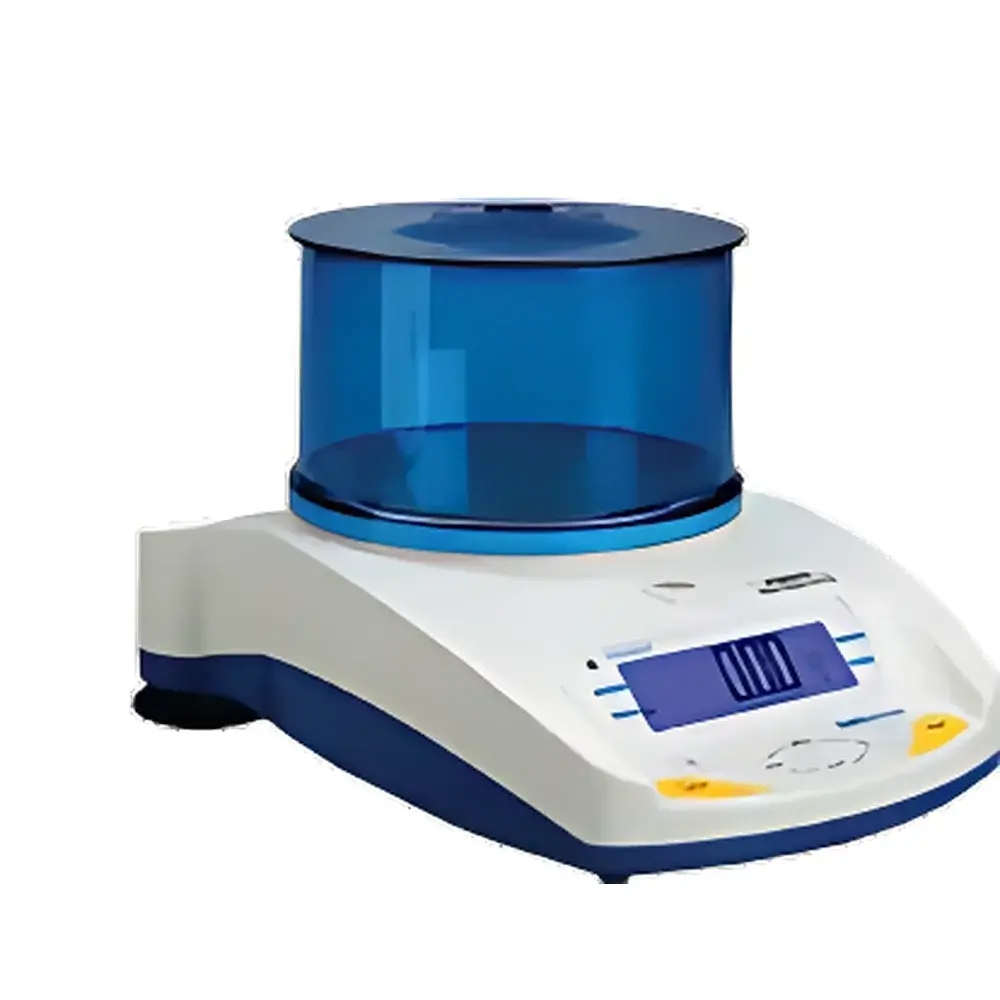
Adam CQT-2601 Portable Precision Balance
| Brand | Adam |
|---|---|
| Origin | United Kingdom |
| Manufacturer Type | Original Equipment Manufacturer (OEM) |
| Product Origin | Imported |
| Model | CQT-2601 |
| Instrument Type | Precision Balance |
| Maximum Capacity | 2600 g |
| Readability | 0.1 g |
| Repeatability | ±0.1 g |
| Linearity Error | ±0.2 g |
| Calibration Method | External Calibration |
| Calibration Weight Required | 2000 g |
| Display | 6-digit, 15 mm high backlit LCD |
| Stabilization Time | 3 s |
| Operating Temperature Range | 0–40 °C |
| Power Supply | 12 V AC @ 150 mA adapter or 6 × AA batteries (optional) |
| Weighing Units | kg, g, lb, oz, ct, dr, GN |
| Pan Diameter | 145 mm |
| Draft Shield Dimensions (L×W×H) | 180 × 158 × 82 mm |
| Housing Material | Matte-finish ABS |
| Overall Dimensions (L×W×H) | 195 × 240 × 70 mm |
| Shock Protection | ShockProtect™ technology (withstands up to 180 kg overload) |
| Security | Bottom-mounted Kensington lock slot |
| Protection Class | IP42-rated enclosure (dust and splash resistant) |
Overview
The Adam CQT-2601 Portable Precision Balance is a rugged, field-ready weighing instrument engineered for reliable mass measurement in dynamic environments—from quality control checkpoints on manufacturing floors to field laboratories, educational settings, and mobile calibration services. Built upon Adam Equipment’s Core series platform, the CQT-2601 employs electromagnetic force restoration (EMFR) load cell technology to deliver stable, temperature-compensated readings with high reproducibility. Its 2600 g maximum capacity and 0.1 g readability meet ISO/IEC 17025-compliant requirements for routine weighing tasks where moderate precision—rather than analytical-grade resolution—is sufficient. Unlike laboratory-grade analytical balances, the CQT-2601 prioritizes mechanical robustness, rapid stabilization (<3 s), and operational flexibility over sub-milligram sensitivity, making it ideal for applications requiring portability without sacrificing metrological integrity.
Key Features
- ShockProtect™ overload protection system—certified to withstand accidental impacts up to 180 kg without sensor damage or recalibration requirement.
- Matte-finish ABS housing—resistant to abrasion, chemical splashes, and mechanical stress; fully cleanable and compliant with ISO 14644-1 Class 8 cleanroom-compatible surface standards.
- Detachable draft shield—designed for rapid setup and transport; accommodates samples up to 145 mm in diameter and ensures measurement stability under ambient airflow conditions.
- Dual-power architecture—supports continuous operation via included 12 V AC adapter or optional 6 × AA alkaline battery pack (up to 72 hours runtime at typical usage).
- Kensington security slot—enables physical anchoring using standard lock cables, supporting asset tracking and theft deterrence in shared or unsecured workspaces.
- IP42 ingress protection rating—provides resistance against solid objects >1 mm and vertically falling water droplets, suitable for non-harsh industrial or outdoor transitional environments.
Sample Compatibility & Compliance
The CQT-2601 accepts a wide range of sample types—including powders, granules, packaged goods, tools, and small components—within its 145 mm diameter stainless-steel pan. Its 1:26,000 division ratio (2600 g ÷ 0.1 g) satisfies minimum weight determination criteria per USP <41> for non-critical pharmaceutical checks and ASTM E122-22 sampling guidelines. The balance complies with OIML R76-1 (2021) Class III accuracy requirements for general-purpose weighing instruments and supports traceable calibration through external 2000 g Class M2 reference weights. While not FDA 21 CFR Part 11–compliant out-of-the-box (lacking electronic audit trail functionality), it supports GLP/GMP documentation workflows when paired with external data logging software and manual calibration records.
Software & Data Management
The CQT-2601 features an RS-232 serial interface (standard) for direct connection to PCs, label printers, or LIMS systems. It outputs ASCII-formatted weight data with configurable prefixes, suffixes, and transmission intervals—enabling seamless integration into Excel-based QA templates or custom Python/Node.js acquisition scripts. No proprietary software is required; raw output includes unit identifiers (e.g., “2450.3 g”) and real-time stability flags. Optional USB-to-serial adapters allow compatibility with modern Windows/macOS/Linux hosts. Firmware updates are performed via terminal emulation only; no cloud dependency or vendor-hosted platforms are involved.
Applications
- Field-based inventory reconciliation and parcel verification in logistics hubs.
- Raw material batch sampling during incoming inspection in food, chemical, and polymer production lines.
- Student laboratory exercises in physics, chemistry, and engineering curricula requiring portable, intuitive mass measurement.
- On-site calibration verification of lower-capacity benchtop balances using certified check weights.
- Mobile veterinary clinics weighing small animals, feed portions, or pharmaceutical doses.
- Workshop tool crib management and consumables tracking across maintenance departments.
FAQ
Is the CQT-2601 suitable for use in regulated pharmaceutical environments?
It meets basic accuracy and repeatability requirements for non-sterile, non-potent material handling—but lacks built-in audit trail, user authentication, or electronic signature capabilities required for full 21 CFR Part 11 compliance.
What is the recommended calibration frequency?
Per ISO/IEC 17025:2017 Clause 7.8.2, external calibration should be performed before first use, after relocation, following any impact event, and at intervals validated by risk assessment—typically daily or per-shift for critical processes.
Can the draft shield be omitted during weighing?
Yes, though removal increases susceptibility to air currents and thermal drafts; stability time may extend beyond 3 seconds, and repeatability may degrade marginally in non-laminar airflow environments.
Does the balance support auto-zero tracking?
No—the CQT-2601 uses manual zero reset only, consistent with its design focus on simplicity, low power consumption, and deterministic behavior in variable ambient conditions.
Is the ABS housing resistant to common laboratory solvents?
It demonstrates resistance to diluted ethanol, isopropanol, and 10% sodium hypochlorite solutions; prolonged exposure to acetone, chloroform, or concentrated acids is not recommended.