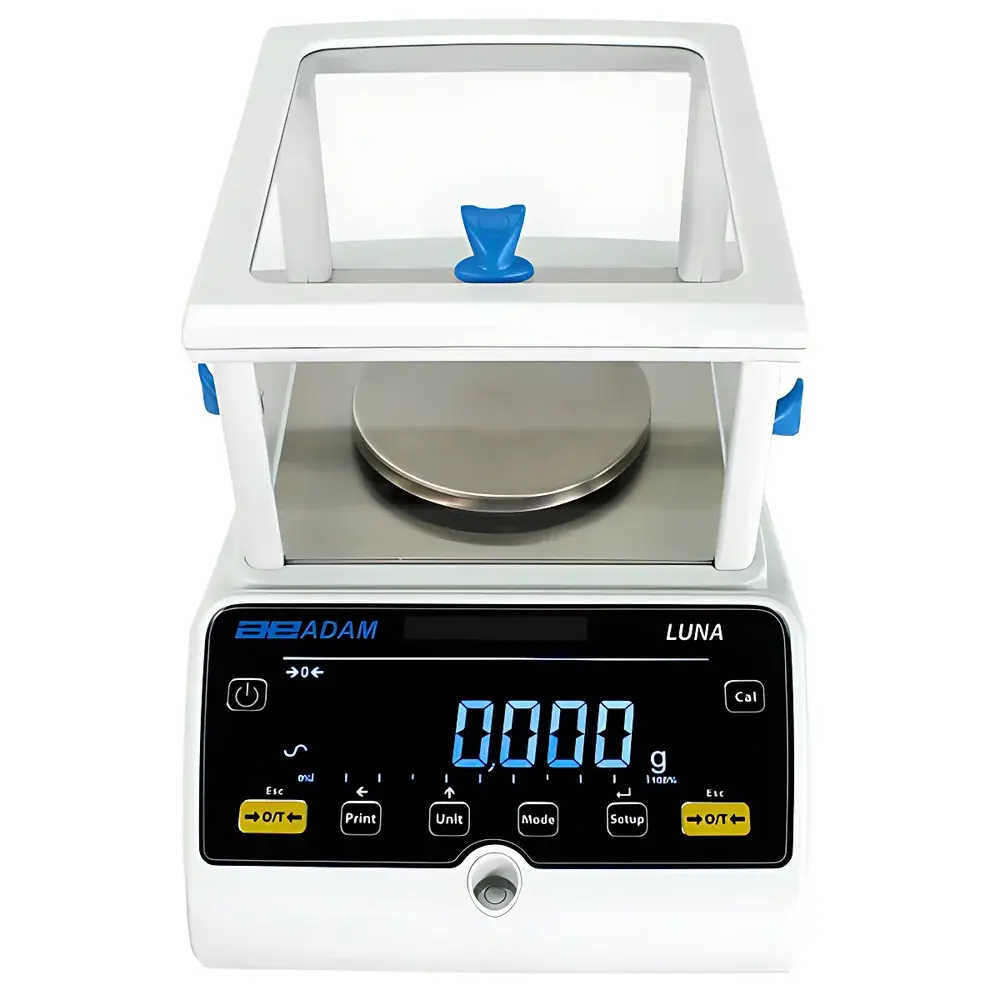
Adam Luna LPB Series Precision Balance
| Brand | Adam |
|---|---|
| Origin | United Kingdom |
| Manufacturer Type | Manufacturer |
| Origin Category | Imported |
| Model | LPB |
| Instrument Type | Precision Balance |
| Capacity Range | 500–1000 g |
| Readability | 0.001 g |
| Calibration | Internal or External |
| Maximum Capacity | 820 g |
| Measurement Accuracy | 0.001 g |
| Repeatability | 0.002 g |
Overview
The Adam Luna LPB Series Precision Balance is an engineered solution for laboratories requiring high-resolution mass measurement with robust repeatability and operational reliability. Built on a proven gravimetric principle—utilizing electromagnetic force compensation (EMFC) transduction—the LPB series delivers stable, drift-compensated readings across dynamic environmental conditions typical of QC, R&D, and academic labs. With capacities up to 820 g and readability of 0.001 g, the LPB balances meet the metrological demands of ISO/IEC 17025-compliant workflows and support traceable calibration against certified reference masses. Designed and manufactured in the UK, each unit undergoes factory verification per OIML R76-1 and conforms to EN 45501 standards for non-automatic weighing instruments. The balance’s structural integrity is reinforced by a 304 stainless steel weighing pan and an impact-resistant ABS housing—engineered for long-term stability under repeated mechanical stress and routine chemical exposure.
Key Features
- Backlit LCD display with 24 mm high white digits on black background—optimized for visibility under variable ambient lighting, including low-light or UV-lit environments.
- Color-coded tactile keys for intuitive access to frequently used functions: tare, print, unit toggle, and mode selection.
- Integrated bubble level and adjustable leveling feet ensure precise horizontal alignment—critical for minimizing gravitational vector error and achieving maximum accuracy.
- Underneath-mounted Kensington lock slot provides physical security against unauthorized relocation or theft in shared lab spaces.
- Fully sealed membrane keypad resists ingress of particulates, liquid splashes, and corrosive vapors—supporting compliance with IP42-rated operational durability.
- Dual communication interfaces: RS-232 (legacy printer compatibility) and USB (virtual COM port support) enable seamless integration with LIMS, ELN, and statistical process control software.
- Configurable digital filtering algorithms mitigate vibration-induced noise during dynamic weighing (e.g., animal or powder dispensing), enhancing result reliability without compromising response time.
- Auto-power-off function with user-selectable delay (1–60 min) extends battery life when used with optional rechargeable packs; AC adapter included as standard.
Sample Compatibility & Compliance
The Luna LPB accommodates diverse sample geometries via its 120 mm diameter stainless steel pan and optional square glass draft shield (192 × 195 × 115 mm W×D×H). Its design supports weighing of powders, granules, liquids in containers, small components, and biological specimens—including live animals in dynamic mode. All models comply with GLP requirements through timestamped data output, operator ID tagging (via optional software), and audit-trail-capable firmware. While not inherently 21 CFR Part 11 compliant, the balance supports electronic record integrity when paired with validated third-party data capture systems adhering to ALCOA+ principles. Calibration traceability is maintained via internal self-calibration (‘i’ models) or external weight-based procedures using Class E2 or better standards per ISO 9001 and ISO/IEC 17025 Annex A.5.
Software & Data Management
Data export is supported natively via ASCII protocol over RS-232 or USB CDC interface, enabling direct ingestion into Excel, LabVIEW, or custom Python scripts using standard serial libraries. Optional Adam Connect software provides enhanced functionality—including customizable report templates, batch logging, statistical analysis (mean, SD, CV%), and automated calibration scheduling. All printed outputs include date/time stamps, gross/net/tare values, unit identifiers, and operator-defined headers—fulfilling documentation requirements for ISO 17025 clause 7.7 and USP . Firmware supports 12 language options (English, French, German, Spanish, Chinese, Japanese, Korean, Portuguese, Italian, Dutch, Polish, Russian), facilitating multinational deployment without UI reconfiguration.
Applications
The LPB series serves critical roles across pharmaceutical quality control (e.g., active ingredient assay, tablet weight variation per USP ), chemical formulation (catalyst dosing, stoichiometric ratio verification), materials science (density determination via Archimedes’ principle), and food testing (moisture content pre/post-drying). Its parts counting mode enables rapid inventory reconciliation with configurable sample unit weight (SUW) validation. In teaching labs, the balance supports foundational experiments in uncertainty propagation, buoyancy correction, and calibration hierarchy traceability. Dynamic weighing mode satisfies veterinary and zoological applications where subject movement necessitates real-time averaging.
FAQ
What calibration standards are recommended for external calibration of LPB ‘e’ models?
Class E2 stainless steel weights per ISO 9001 Annex B or ASTM E617 are recommended. Calibration should be performed at 20 ± 2 °C and 50 ± 10 % RH, with stabilization time ≥30 minutes prior to verification.
Does the LPB support automatic temperature compensation?
Yes—integrated temperature sensors feed real-time data to the EMFC control loop, minimizing thermal drift across the specified operating range (15–35 °C).
Can the balance be integrated into a GMP-regulated manufacturing environment?
While the hardware itself does not provide electronic signature or audit trail capabilities, it is compatible with validated middleware solutions that enforce 21 CFR Part 11 controls for data integrity and user accountability.
Is the draft shield removable for cleaning or large-sample placement?
Yes—the glass draft shield is tool-free detachable and autoclavable up to 121 °C for sterility-critical applications.
How is minimum weight determined for GLP-compliant use?
Minimum weight is calculated as 2 × repeatability / required accuracy (per EURACHEM/CITAC Guide). For 0.002 g repeatability and ±0.1 % tolerance, minimum weight = 2 g—consistent with stated specification.