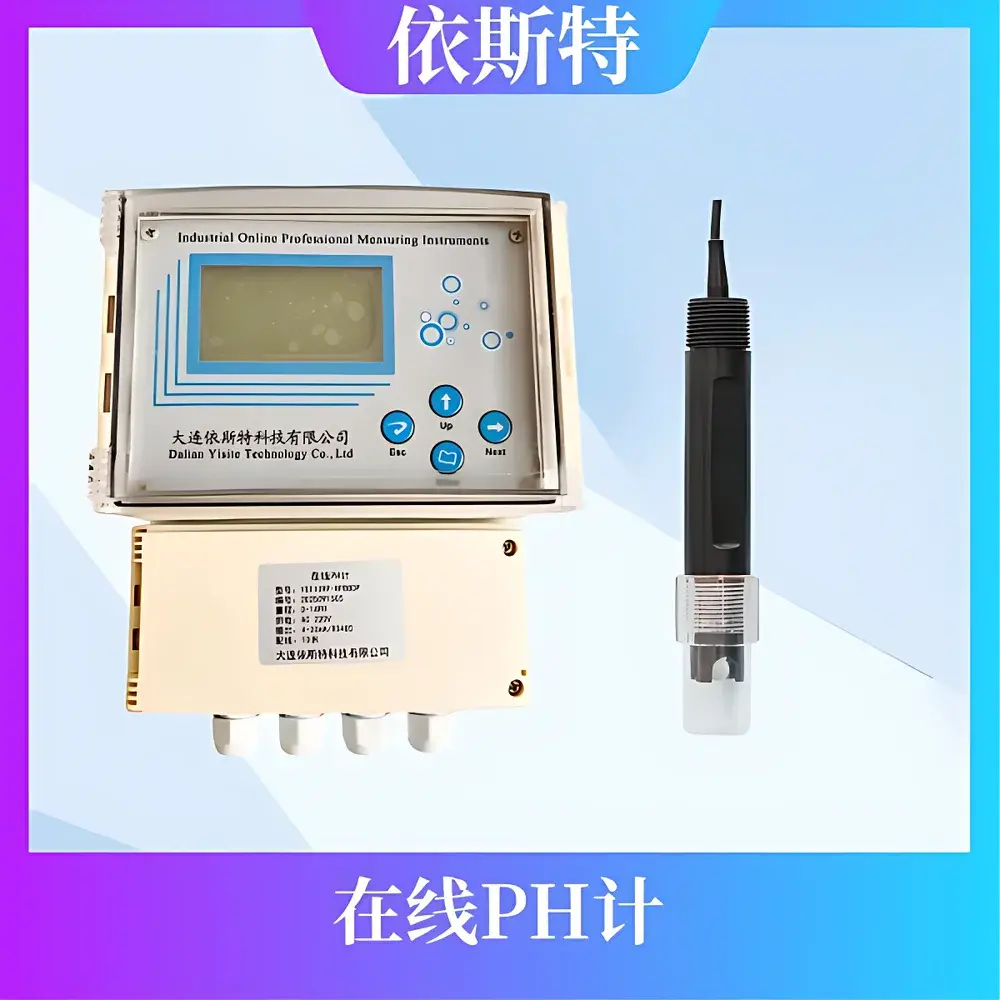
CLEAN CS1753 Industrial-Grade Online pH Electrode with Integrated Temperature Compensation and Grounding
| Brand | CLEAN Instruments |
|---|---|
| Origin | Taiwan |
| Model | CS1753 |
| Construction | Rugged PPS Body with SNEX Solid-State Junction |
| Pressure Rating | Up to 20 bar (CS1768-hp variant) |
| Temperature Compensation | Built-in Pt1000 RTD |
| Electrolyte System | Dual-ceramic porous junction + red SNEX solid-state liquid junction |
| Compatible Media | Wastewater, seawater, brine, caustic solutions (NaOH/KOH), crude oil emulsions, desulfurization slurry, low-conductivity water (<50 µS/cm), HF-containing streams (<1000 ppm), sulfide-rich environments |
| Output Signal | Analog mV (pH/ORP) + PT1000 resistance |
| Electrical Grounding | Integrated shielded grounding terminal |
| Compliance | Designed for continuous operation in ISO/IEC 17025-aligned QC labs and EPA-compliant wastewater treatment plants |
| Certifications | RoHS, CE (EMC Directive 2014/30/EU) |
Overview
The CLEAN CS1753 is an industrial-grade online pH electrode engineered for long-term stability and measurement integrity in chemically aggressive, high-pressure, particulate-laden, or low-conductivity process streams. Unlike conventional glass-body pH sensors relying on fragile liquid-junction reference systems, the CS1753 integrates a proprietary red SNEX solid-state junction — a chemically inert, ion-permeable ceramic-polymer composite developed by CLEAN Instruments for sustained electrolyte release without clogging, leakage, or chemical ingress. Its measurement principle follows the Nernst equation, where the potential difference between the pH-sensitive glass membrane and the stable reference system is converted to a calibrated pH value. The electrode employs a full-range borosilicate glass sensing bulb optimized for both acidic and alkaline extremes (pH 0–14), paired with a built-in Pt1000 RTD for automatic temperature compensation per IEC 60751 Class B tolerance. Designed for direct insertion into pressurized pipelines, open tanks, or agitated reactors, the CS1753 delivers reproducible readings under dynamic flow conditions while resisting mechanical abrasion, fouling, and electrochemical drift.
Key Features
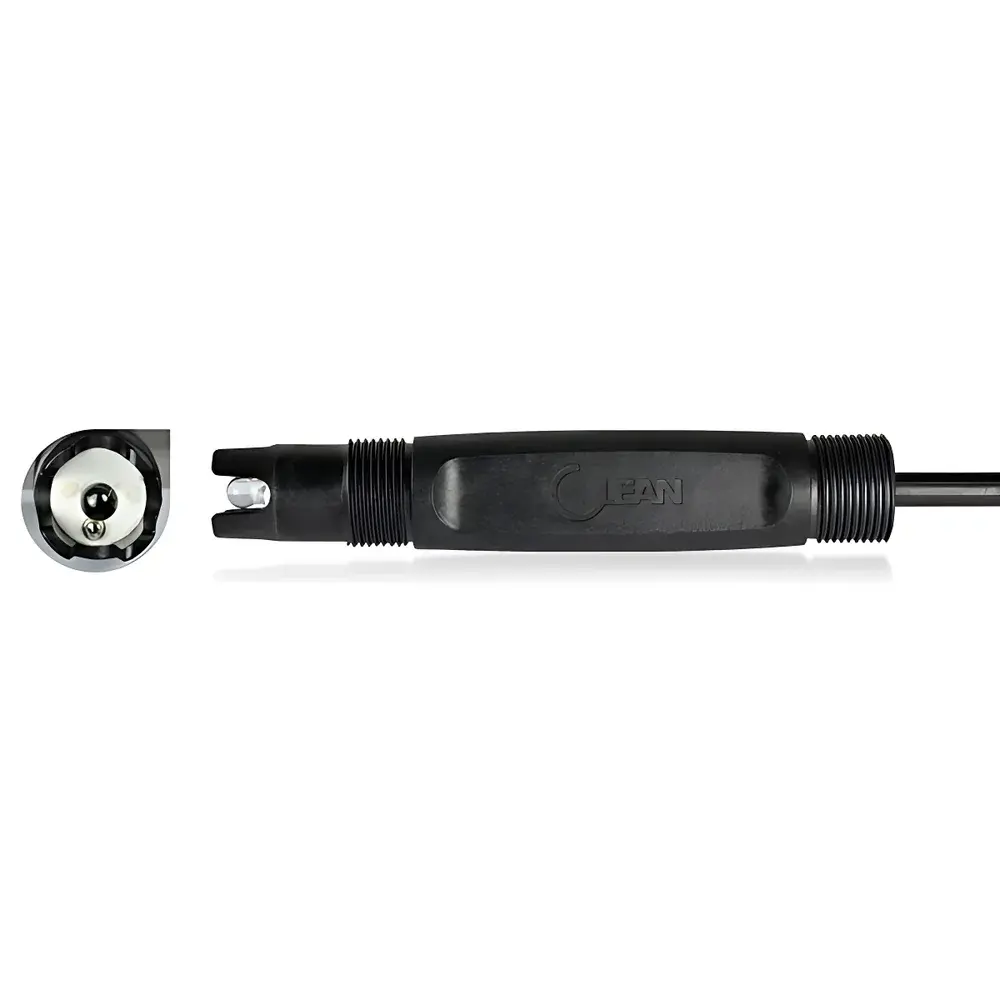
- Rugged PPS (polyphenylsulfone) housing rated for continuous operation up to 20 bar (validated per EN 13480-3 hydrostatic pressure testing)
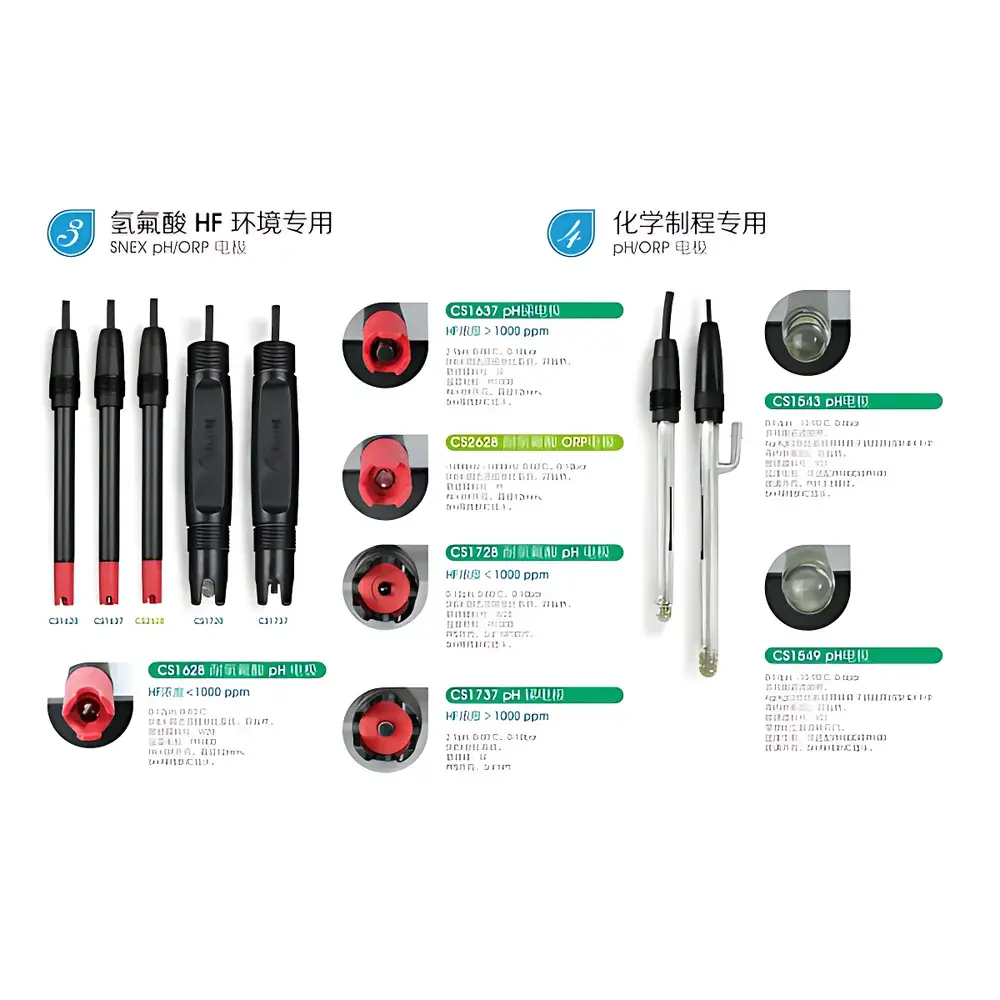
- Red SNEX solid-state liquid junction with dual ceramic permeation ports — ensures continuous K⁺/Cl⁻ ion flux for stable salt bridge formation, even under high backpressure or viscous media
- Integrated Pt1000 RTD sensor compliant with IEC 60751 Class B (±0.3 °C at 0 °C), enabling real-time temperature compensation without external modules
- Electrically grounded design with shielded coaxial cable termination and dedicated grounding terminal — eliminates stray current interference in electrically noisy plant environments
- Chemically resistant glass formulation resistant to HF (≤1000 ppm), sulfides, chromium salts, cyanides, and strong alkalis (up to 50% w/w NaOH/KOH)
- No moving parts or refillable electrolyte chambers — eliminates maintenance downtime associated with gel refills or junction cleaning
Sample Compatibility & Compliance
The CS1753 demonstrates validated performance across heterogeneous industrial matrices including flue gas desulfurization (FGD) gypsum slurries (ASTM D5119-22), municipal and industrial wastewater (EPA Method 150.1), seawater and brine (ISO 10523:2022), low-ionic-strength ultrapure water (ASTM D1125-21), and HF-containing etchant streams (SEMI F57-0301). Its construction adheres to IP68 ingress protection (IEC 60529) and meets electromagnetic compatibility requirements per EN 61326-1:2013 for industrial environments. While not intrinsically safe certified, it is compatible with hazardous area barriers (e.g., Pepperl+Fuchs KFD2-STC4-Ex1) when installed per IEC 60079-14. The electrode supports GLP/GMP data integrity workflows through traceable calibration logs and is suitable for use in FDA 21 CFR Part 11–compliant systems when integrated with validated SCADA or DCS platforms.
Software & Data Management
The CS1753 operates as a passive analog sensor, outputting mV signals proportional to pH (−59.16 mV/pH unit at 25 °C) and resistance values from its integrated Pt1000 RTD. It requires no firmware, drivers, or proprietary software — interfacing seamlessly with standard 4–20 mA transmitters (e.g., CLEAN PH3000 controller), PLC analog input modules (16-bit resolution minimum), or laboratory DAQ systems. Calibration data (two-point or three-point) is stored externally in the connected transmitter or historian system. For auditability, users are advised to record calibration timestamps, buffer lot numbers (NIST-traceable pH 4.01/7.00/10.01), and electrode impedance checks (>100 MΩ recommended pre-calibration) in accordance with ISO/IEC 17025 clause 7.7.
Applications
- Continuous pH monitoring in FGD absorber towers and gypsum dewatering circuits
- In-line control of caustic scrubbers and neutralization basins in chemical manufacturing
- Real-time pH surveillance in semiconductor wet benches containing dilute HF/HNO₃ mixtures
- Process analytics in food & beverage production (sugar refining, dairy processing, brewing)
- Environmental compliance monitoring at NPDES discharge points and landfill leachate collection systems
- Oil & gas produced water treatment, especially in high-TDS, H₂S-laden streams
FAQ
What distinguishes the CS1753 from standard pH electrodes?
It replaces conventional liquid-junction reference systems with a red SNEX solid-state junction, eliminating clogging, electrolyte depletion, and chemical contamination of the reference compartment.
Can the CS1753 be used in pressurized pipelines?
Yes — when configured as the CS1768-hp variant, it withstands static pressures up to 20 bar; standard CS1753 units are rated for ≤6 bar continuous service.
Is temperature compensation mandatory for accurate pH measurement?
Yes — the built-in Pt1000 RTD enables automatic compensation per the Nernst equation; omission introduces errors of ±0.1 pH per 5 °C deviation from calibration temperature.
How often should the CS1753 be calibrated?
Calibration frequency depends on process severity: daily for FGD slurry applications, weekly for municipal wastewater, and monthly for stable low-conductivity water systems — always verified against fresh NIST-traceable buffers.
Does the electrode require special cleaning procedures?
No routine cleaning is needed; if fouling occurs, soak in 0.1 M HCl for 10 minutes followed by deionized water rinse — avoid abrasive pads or ultrasonic cleaners.