
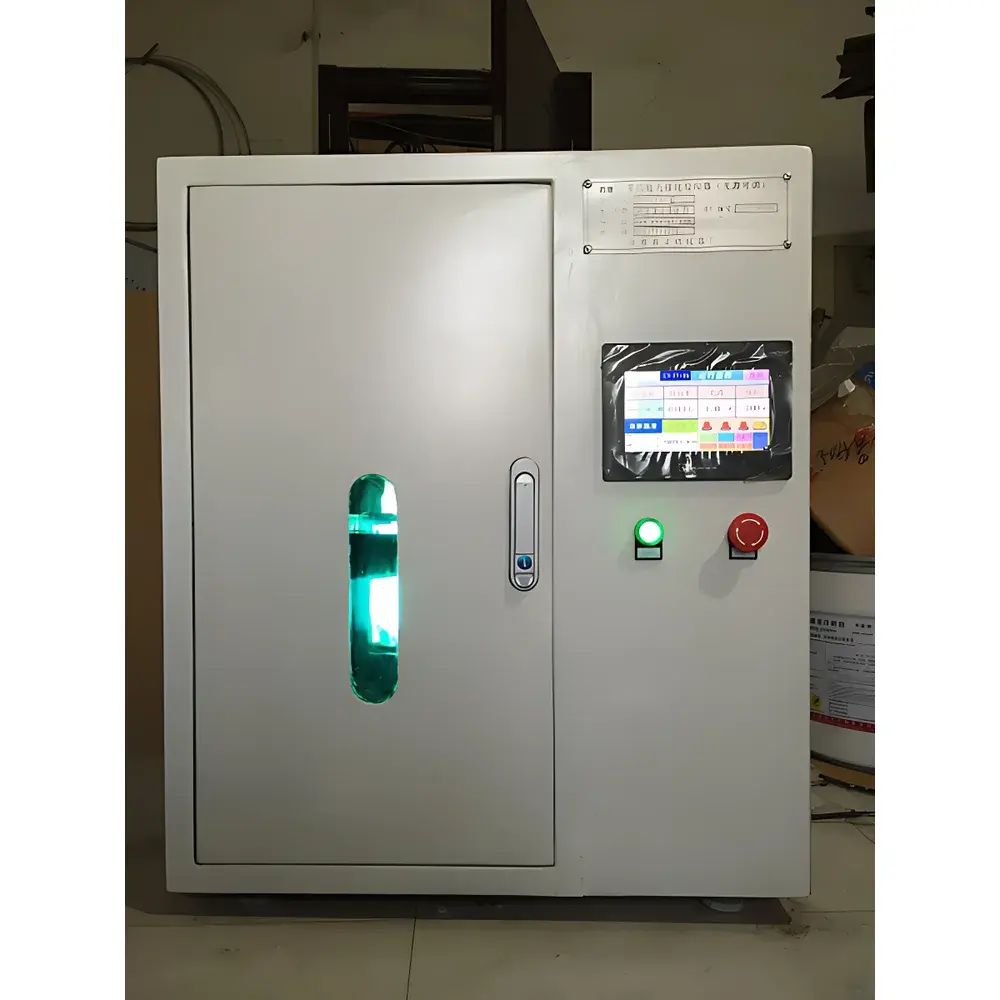
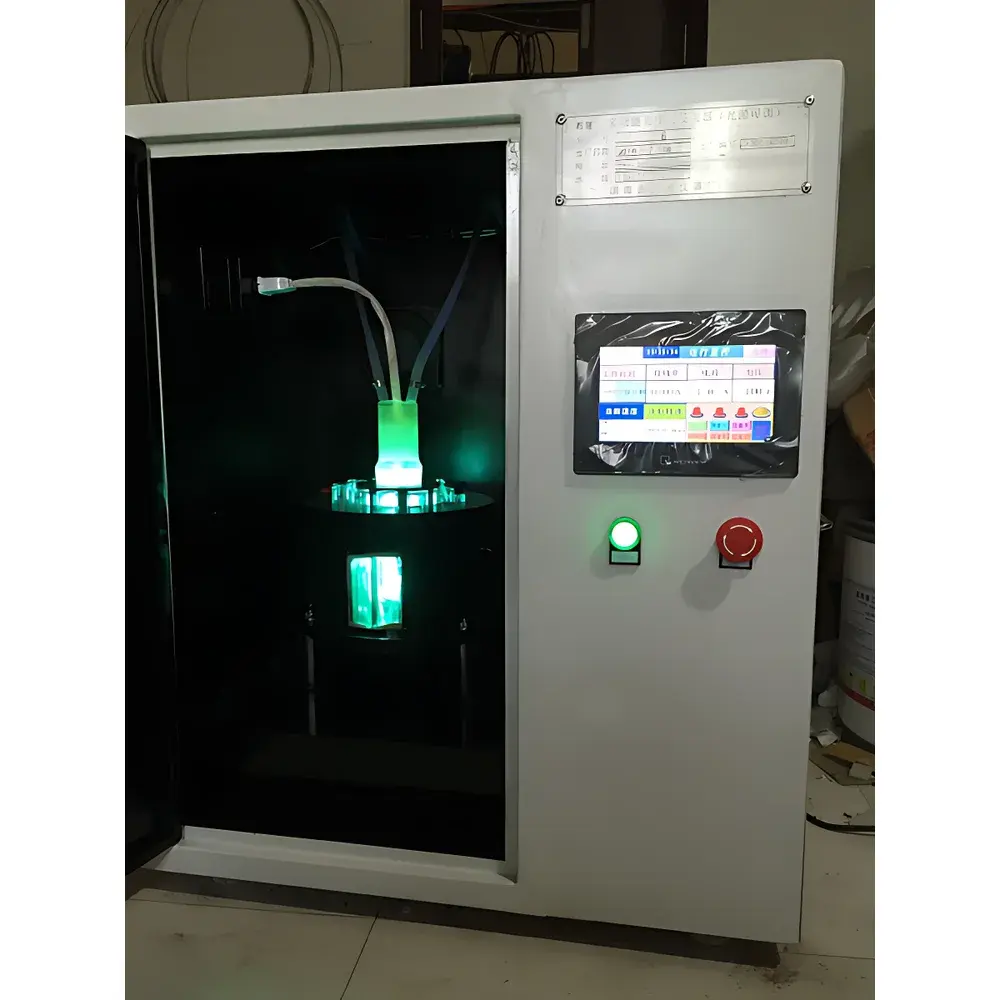
ZXF-LC Photocatalytic Reactor System by Zhengxin Instrument Factory
| Brand | Zhengxin Instrument Factory (ZXYIQI) |
|---|---|
| Origin | Jiangsu, China |
| Manufacturer Type | Authorized Distributor |
| Origin Category | Domestic (China-made) |
| Model | ZXF-LC |
| Price | USD 5,800 (FOB Jiangsu) |
| Reaction Volume | Micro-to-Milliliter Scale (3–100 mL per tube |
| Construction Material | 316L Stainless Steel Body with Quartz Optical Components |
| Operating Pressure | Low-Pressure / Ambient to Slightly Positive or Vacuum-Compatible (≤ −0.095 MPa) |
| Vacuum Capability | Up to −0.095 MPa (with integrated vacuum interface and sealing system) |
| Light Sources | Dual-Channel UV (250 W or 500 W Hg lamp) + Simulated Solar (300 W or 500 W Xe lamp) |
| Tube Configuration | 12× standard quartz test tubes (30 mL / 50 mL), each with vacuum-tight PTFE-sealed caps |
| Illumination Uniformity | Rotating sample carousel + coaxial magnetic stirring (0–1200 rpm, adjustable) |
| Control System | Industrial PLC with 7″ TFT touchscreen HMI |
| Safety Protections | Overtemperature cutoff (max. 80 °C), over-time shutdown, real-time fault logging, audible alarm, automatic system halt on parameter violation |
| Cooling | Integrated quartz cold trap (water-cooled) for thermal management of high-power lamps |
Overview
The ZXF-LC Photocatalytic Reactor System is an engineered platform designed for controlled, reproducible photocatalytic experimentation under laboratory conditions. It operates on the principle of heterogeneous photoactivation—where semiconductor catalysts (e.g., TiO₂, g-C₃N₄, or MOFs) absorb incident photons to generate electron–hole pairs that drive redox reactions in liquid-phase or gas-saturated solutions. Unlike batch photoreactors relying on static illumination, the ZXF-LC integrates dynamic irradiation geometry (rotating sample carousel), active mixing (magnetic stirring within each tube), and multi-spectral light delivery—enabling rigorous kinetic studies, quantum yield determination, and catalyst screening under standardized irradiance profiles. Its stainless steel chassis and quartz optical train ensure chemical inertness, UV transparency (>190 nm), and long-term stability during prolonged exposure to reactive oxygen species and acidic/alkaline media.
Key Features
- Modular three-unit architecture: Independent light source controller, magnetic stirrer module, and light-shielded reaction chamber—facilitating maintenance, calibration, and source swapping without system disassembly.
- Programmable PLC-based control with 7″ resistive touchscreen HMI: Supports time-segmented operation (total runtime, multi-stage intervals down to 1-second resolution), temperature setpoint monitoring (PT100 sensor embedded in reactor base), and real-time deviation alerts.
- Uniform photon flux distribution: 12-position rotating carousel ensures all quartz tubes receive circumferential irradiation—eliminating shadowing effects and improving inter-sample comparability (critical for structure–activity correlation studies).
- Dual-wavelength light engine: Interchangeable 250 W / 500 W mercury vapor lamps (254 nm, 365 nm primary lines) and 300 W / 500 W xenon arc lamps (full-spectrum 200–1100 nm, AM1.5G-filtered option available) enable wavelength-dependent reaction profiling per ASTM E2612 and ISO 10677 protocols.
- Vacuum- and gas-compatible quartz reaction vessels: Standard 12× 30/50 mL tubes include PTFE-faced silicone caps with dual-port gas inlet/outlet and vacuum coupling; optional 500 mL / 1000 mL quartz bottles support scalable gas-phase photocatalysis (e.g., CO₂ reduction, N₂ fixation).
- Active thermal management: Water-cooled quartz cold trap positioned between lamp and sample zone maintains <40 °C bulk solution temperature during 1000 W operation—preserving catalyst integrity and minimizing solvent evaporation artifacts.
Sample Compatibility & Compliance
The ZXF-LC accommodates aqueous, organic, and biphasic reaction media across pH 1–13. Quartz components comply with USP and ISO 8536-1 for optical clarity and low metal leaching. All electrical subsystems meet IEC 61010-1:2010 safety standards for laboratory equipment. Vacuum interfaces conform to ISO-KF25 specifications. When operated with traceable NIST-traceable radiometers (e.g., International Light ILT950), irradiance data satisfies GLP documentation requirements for regulatory submissions (e.g., EPA OPPTS 850.4400, OECD TG 121). The system supports audit-ready event logging—including timestamped parameter changes, alarm triggers, and manual overrides—for 21 CFR Part 11–aligned workflows.
Software & Data Management
No proprietary software installation is required: all operational parameters are configured and monitored via the onboard HMI. Event logs (start/stop times, temperature excursions, lamp-on duration, error codes) are exportable as CSV files via USB port. For integration into LIMS or ELN environments, Modbus RTU (RS-485) protocol support enables read-only access to real-time status registers—including lamp voltage/current, stir speed, chamber temperature, and vacuum level—using third-party SCADA platforms. Firmware updates are performed offline via SD card, ensuring cybersecurity compliance in regulated labs.
Applications
- Photocatalytic degradation kinetics of pharmaceuticals, dyes, and endocrine disruptors in wastewater matrices.
- Quantum efficiency mapping of novel photocatalysts under monochromatic or polychromatic excitation.
- Gas-phase photocatalytic CO₂ reduction to CH₄/CO/C₂H₄ using Ru/TiO₂ or Cu/ZnO systems under controlled humidity and CO₂/N₂ mixtures.
- Photoelectrochemical cell precursor synthesis (e.g., NiFe LDH, BiVO₄) via light-assisted hydrothermal deposition.
- UV-mediated polymerization initiation and crosslinking studies requiring precise dose control (J/cm²).
- Standardized photocatalyst performance benchmarking per ISO 22197-1 (NO removal) and ISO 22197-2 (acetaldehyde decomposition).
FAQ
Is the ZXF-LC compatible with inert atmosphere operation?
Yes—quartz tubes and bottles feature dual-gas-inlet ports and vacuum-rated seals, supporting continuous N₂/Ar purging or pressurized O₂/CO₂ environments up to 0.3 MPa gauge pressure (with optional pressure regulator kit).
What safety certifications does the system carry?
It conforms to IEC 61010-1:2010 (Safety Requirements for Electrical Equipment for Measurement, Control, and Laboratory Use) and includes redundant thermal fusing, grounded lamp housings, and interlocked dark chamber access.
Can irradiance be measured and validated per ISO standards?
Yes—integrated mounting points accept handheld spectroradiometers (e.g., Ocean Insight HDX) or broadband radiometers (e.g., Gigahertz-Optik X1). Calibration certificates for reference lamps are provided upon request.
Is remote monitoring supported?
Modbus RTU output allows integration with building management systems or lab-wide IoT dashboards for centralized status tracking—no cloud dependency or vendor lock-in.
What maintenance is required for long-term reliability?
Quartz components should be inspected quarterly for haze or etching; lamp electrodes require cleaning every 200 hours; PLC firmware updates are recommended annually to maintain alarm logic integrity.



