
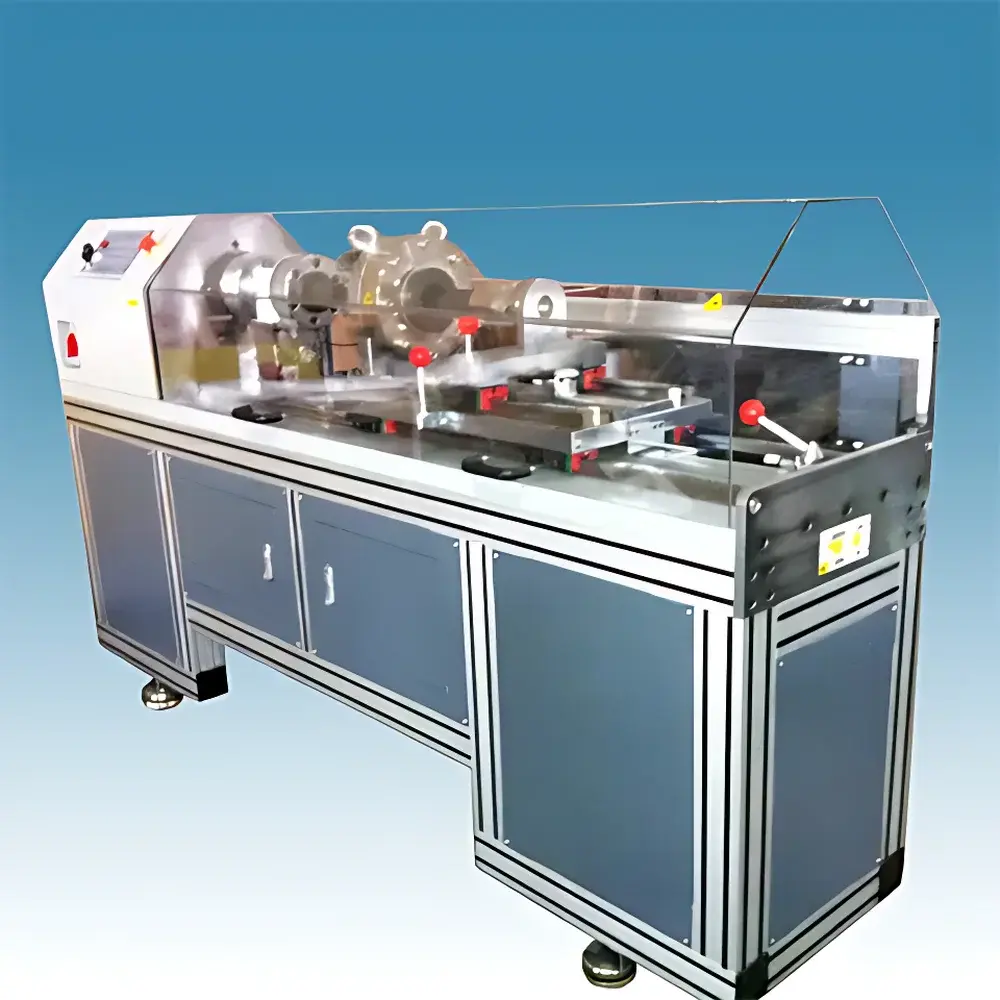
Hengyi HY-2000NM Wind Turbine Tower Bolt Thread Friction Coefficient Testing Machine
| Brand | Hengyi |
|---|---|
| Origin | Shanghai, China |
| Manufacturer Type | Direct Manufacturer |
| Regional Classification | Domestic (China) |
| Model | HY-2000N.MYIIOJ |
| Price Range | USD 28,000 – 70,000 |
| Max Torque | 2000 N·m |
| Torque Measurement Range | 2–2000 N·m |
| Torque Resolution | 1/500,000 full scale |
| Torsion Angle Measurement Range | 0–100,000° (or continuous) |
| Motor Power | 5 kW |
Overview
The Hengyi HY-2000NM Wind Turbine Tower Bolt Thread Friction Coefficient Testing Machine is a high-precision torsion testing system engineered for quantitative analysis of fastener tightening behavior under controlled preload and rotational loading. It operates on the principle of simultaneous dual-sensor torque–axial force measurement during controlled angular displacement, enabling separation and quantification of total torque into three primary components: thread friction torque, bearing surface friction torque, and elastic torsional deformation torque. This architecture conforms to the fundamental mechanics described in ISO 16047 and GB/T 16823.3–2010 for coefficient-of-friction determination in bolted joints. Designed specifically for structural integrity validation in wind energy infrastructure, the system delivers traceable, repeatable measurements critical for verifying assembly reliability in high-stress, safety-critical applications such as tower base flange connections, yaw bearing mounts, and blade root attachments.
Key Features
- Integrated dual-load-path measurement: Independent high-accuracy torque transducers (±0.5% FS) and axial load cells (5–500 kN range, ±0.5% FS) enable real-time decomposition of total input torque into thread friction, bearing surface friction, and elastic torsion components.
- High-resolution angular metrology: Rotary encoder with 0–100,000° measurement range and ±0.5% relative error supports precise turn-angle tracking, essential for yield-point detection and proof-load verification per EN 14399 series standards.
- Wide operational speed range: Programmable torsion rate from 5–40 rpm (extendable to 200 rpm), ensuring compatibility with both slow-speed qualification tests and accelerated production-line verification protocols.
- Modular gripping system: Adjustable jaw spacing up to 1000 mm accommodates M10–M30 threaded fasteners; custom tooling options available for non-standard geometries including anchor bolts, shear studs, and double-end rods.
- Robust mechanical architecture: 1800 kg cast-iron frame with reinforced crosshead guidance ensures minimal deflection (<0.02 mm under max load), preserving alignment integrity during high-torque static and dynamic torsion cycles.
- Compliant drive system: 5 kW servo-motor with closed-loop velocity and position control delivers stable low-speed operation without stick-slip, eliminating measurement artifacts common in belt- or gear-driven systems.
Sample Compatibility & Compliance
The HY-2000NM is validated for testing structural and high-strength fasteners used across wind energy, steel construction, rail infrastructure, and power generation sectors. Compatible specimen types include ASTM A325/A490 heavy hex bolts, EN 14399 preloaded assemblies, ISO 898–1 grade 10.9/12.9 bolts, weld studs (EN ISO 13918), and custom-engineered anchor bolts. All test procedures adhere to internationally recognized standards including ISO 16047 (determination of torque–tension relationship and friction coefficients), GB/T 16823.3–2010 (Chinese adoption of ISO 16047), EN 14399–1 & –3–6 (preloaded structural bolting systems), and GB/T 3098.9–2002 (mechanical properties of fasteners — torque-clamp force testing). The system supports GLP-compliant audit trails and meets data integrity requirements aligned with FDA 21 CFR Part 11 when configured with optional electronic signature and user access controls.
Software & Data Management
The HYtest modular software platform provides ISO 16047–compliant test sequencing, real-time parameter visualization, and automated calculation of key tightening metrics: total coefficient of friction (µtot), thread coefficient (µth), bearing surface coefficient (µb), yield clamping force (Fy), yield tightening torque (Ty), ultimate clamping force (Fu), and failure angle (θf). Raw data is stored in timestamped, tamper-evident binary files (.hys) with embedded metadata (operator ID, calibration date, environmental conditions). Export options include CSV, PDF test reports (with digital signature support), and XML for LIMS integration. Audit logging records all user actions—including method edits, calibration events, and result overrides—with immutable timestamps and IP-address tagging where network-enabled.
Applications
- Verification of lubricant performance and consistency across batch-produced wind turbine tower bolts.
- Validation of coating integrity (e.g., zinc flake, phosphate, or anti-seize layers) under simulated service loads.
- Development and qualification of new fastener geometries (e.g., tapered threads, under-head chamfers) for improved µth/µb ratio control.
- Root cause analysis of field failures linked to insufficient clamp load or premature thread galling.
- Calibration and inter-laboratory comparison studies supporting ISO/IEC 17025 accreditation.
- Supporting design FMEA by quantifying scatter in torque–tension relationships under variable surface roughness or assembly speed.
FAQ
What standards does the HY-2000NM fully support for friction coefficient testing?
It complies with ISO 16047, GB/T 16823.3–2010, EN 14399–1 & –3–6, GB/T 3098.9–2002, and ISO 898–1:1999 for torque–tension and friction characterization.
Can the system measure both thread and bearing surface friction independently?
Yes — via synchronized torque and axial force acquisition, the software computes µth and µb using the standard ISO 16047 analytical model with user-defined geometric constants.
Is calibration traceability provided to national standards?
All torque and force transducers are supplied with UKAS-accredited or CNAS-equivalent calibration certificates, valid for 12 months under normal use conditions.
What is the maximum specimen length the machine can accommodate?
The maximum distance between chucks is 1000 mm, suitable for most tower flange bolts and long-anchor configurations.
Does the system support automated pass/fail evaluation against specification limits?
Yes — configurable acceptance criteria per parameter (e.g., µtot = 0.12 ± 0.02) trigger color-coded status indicators and exportable compliance summaries.



