
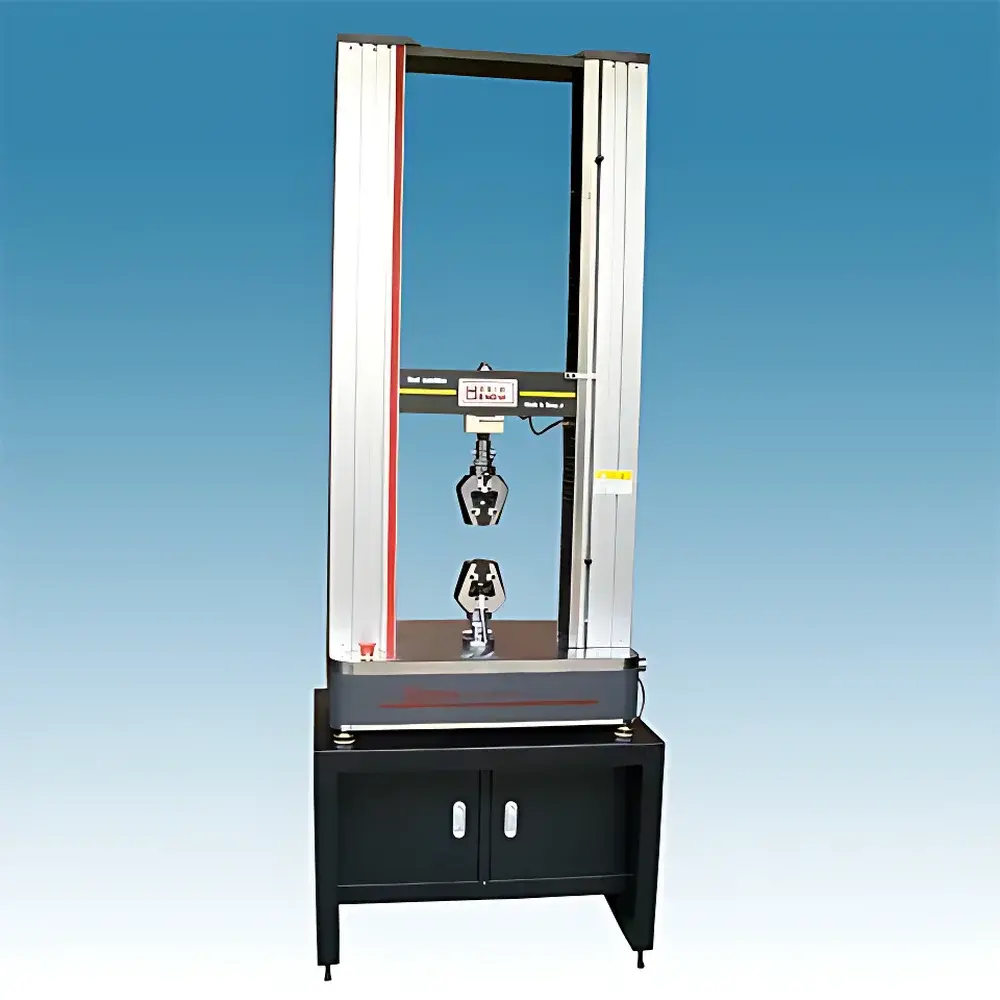
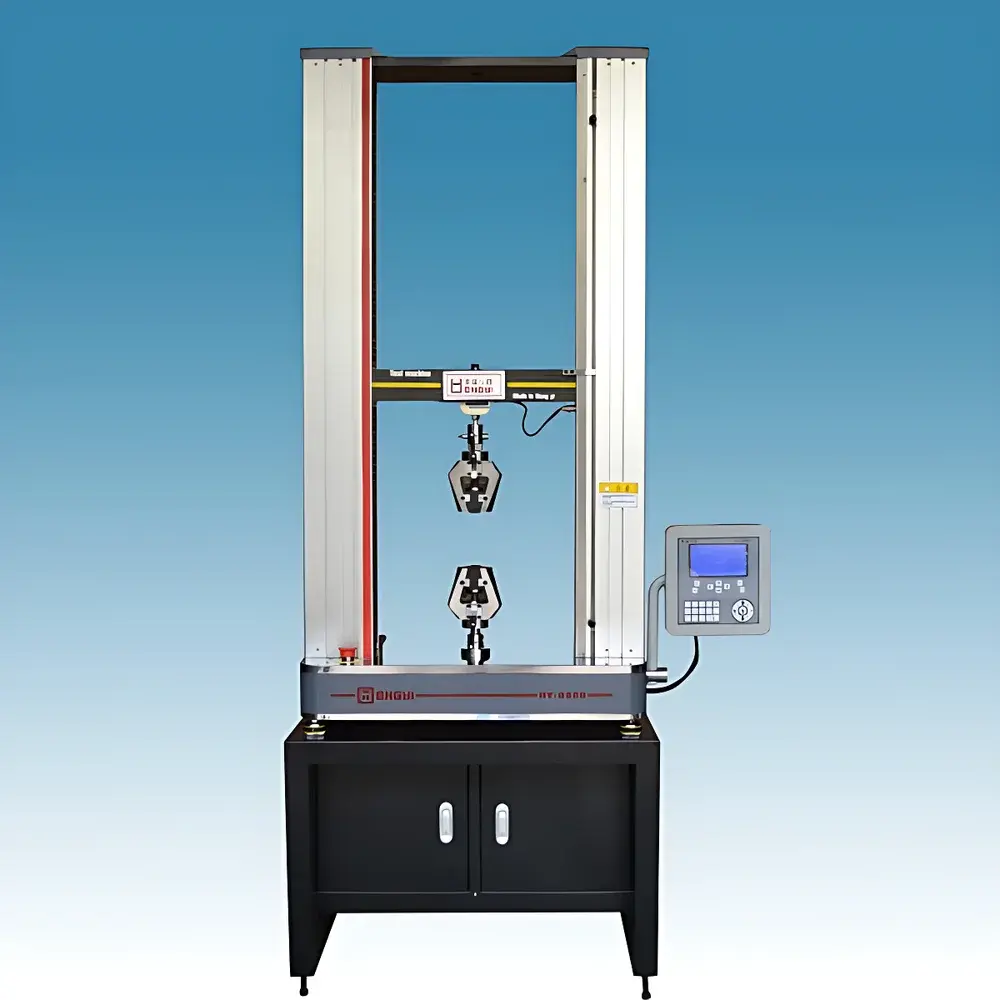
Hengyi HY-1080UIM 10 kN Universal Tensile Testing Machine for Wire and Cable
| Brand | Hengyi |
|---|---|
| Origin | Shanghai, China |
| Manufacturer | Hengyi Precision Instruments Co., Ltd. |
| Model | HY-1080UIM |
| Max. Test Load | 10 kN |
| Load Range | 0.01–100% FS |
| Load Accuracy | ±0.5% of reading |
| Stroke | 800 mm |
| Displacement Resolution | 0.001 mm |
| Speed Range | 0.001–500 mm/min |
| Speed Accuracy | ±0.5% |
| Displacement Accuracy | ±0.5% |
| Effective Width | 380 mm |
| Unit Weight | ~210 kg |
| Power Supply | AC 220 V |
| Dimensions (W×D×H) | 700 × 420 × 1600 mm |
| Safety Features | Electronic limit switches, emergency stop button |
| Compliance | Designed to support ASTM D4565, ASTM D882, IEC 60811-501, GB/T 2951.11–2008, and ISO 6892-1 test protocols |
Overview
The Hengyi HY-1080UIM is a microprocessor-controlled universal tensile testing machine engineered for high-reproducibility mechanical characterization of wire and cable materials under uniaxial loading. It operates on the principle of servo-motor-driven crosshead displacement with real-time closed-loop force feedback, enabling precise control of strain rate and load application per ISO 6892-1 Annex A and ASTM E8/E8M guidelines. The system integrates a high-stability load cell (0.01% full-scale resolution), precision ball-screw actuation, and optical encoder-based displacement tracking to ensure metrological integrity across its 10 kN capacity range. Designed specifically for the demanding requirements of cable manufacturing QA/QC labs, it delivers traceable, repeatable measurements of tensile strength, yield point, elongation at break, modulus of elasticity, and stress–strain behavior — critical parameters for compliance with IEC 60811-501 (polymeric insulations), UL 1581, and GB/T 2951 series standards.
Key Features
- 10 kN dual-range load cell with ±0.5% full-scale accuracy and 0.01% internal resolution, supporting both low-force precision (e.g., thin telecom wires) and high-force validation (e.g., armored power cables)
- Adjustable crosshead speed from 0.001 to 500 mm/min, programmable in 0.001 mm/min increments, meeting ASTM D4565 ramp-rate requirements for polymer-insulated conductors
- 800 mm effective stroke with 0.001 mm displacement resolution, accommodating full-length specimen extension without repositioning
- 380 mm clear test width — sufficient for multi-conductor bundles, armored cables, and jacketed assemblies up to Ø25 mm
- Dual-channel synchronous acquisition: simultaneous measurement of load, large deformation (via extensometer interface), small deformation (clip-on or video-based), and crosshead displacement
- Integrated safety architecture: hardware-based electronic limit switches, redundant emergency stop circuitry, and automatic overload cut-off
- Robust cast-iron frame with vibration-damped base, minimizing environmental interference during low-speed creep or relaxation tests
Sample Compatibility & Compliance
The HY-1080UIM accommodates standardized specimens per IEC 60811-501 (flat strips, round wires), ASTM D882 (thin films), and GB/T 2951.11–2008 (PVC/PE insulation and sheath materials). Grip options include pneumatic wedge grips (for stranded copper/aluminum conductors), self-tightening roller grips (for fiber-optic cables), and custom jaw inserts for flat ribbon cables or armored variants. All test methods are configurable to align with GLP/GMP documentation workflows, including audit-trail-enabled user login, method version control, and electronic signature support compliant with FDA 21 CFR Part 11 when paired with validated software modules. Calibration certificates follow ISO/IEC 17025 traceability paths via CNAS-accredited providers.
Software & Data Management
Control and analysis are performed via Hengyi’s Windows-native TMS v5.2 software — a modular platform supporting method-driven testing, real-time curve overlay, and automated pass/fail evaluation against user-defined limits (e.g., minimum elongation ≥200%, max. tensile strength deviation ≤±3%). Raw data export is available in CSV, XML, and PDF formats; all files embed metadata (operator ID, timestamp, calibration ID, environmental conditions). The software enables advanced post-processing: tangent modulus calculation at 10–30% strain, yield offset determination (0.2% proof stress), and hysteresis loop integration for cyclic loading sequences. Database management utilizes SQL Server Express backend, ensuring ACID-compliant storage for multi-user lab environments.
Applications
- Tensile property verification of PVC, XLPE, LSZH, and rubber-insulated cables per UL 1581 Section 1060
- Evaluation of conductor elongation and necking behavior in annealed vs. hard-drawn copper/aluminum wires
- Adhesion strength testing between insulation and conductor layers using peel or pull-out configurations
- Mechanical aging assessment: pre- and post-heat aging (IEC 60811-101) tensile comparisons
- Fire-resistance cable validation: measuring residual tensile strength after flame exposure (IEC 60331)
- Quality conformance for marine, mining, and aerospace-grade cable batches under MIL-DTL-24643 or EN 50267
FAQ
What standards does the HY-1080UIM directly support out-of-the-box?
Preconfigured test templates cover ASTM D4565 (rubber-insulated wires), IEC 60811-501 (polymeric compounds), GB/T 2951.11–2008, and UL 1581 Section 1060. Custom method development is supported via scripting interface.
Can the system integrate with existing LIMS or MES platforms?
Yes — via OPC UA and RESTful API endpoints, enabling bidirectional data exchange with LabWare LIMS, Thermo Fisher SampleManager, or Siemens Opcenter Execution.
Is extensometer compatibility available?
Standard configuration includes analog and digital channels for clip-on, non-contact video, or laser extensometers (e.g., Zwick Roell XScale or MTS Acumen).
What maintenance intervals are recommended for long-term accuracy?
Load cell recalibration every 12 months; ball-screw lubrication and grip jaw inspection every 6 months; annual mechanical alignment verification per ISO 7500-1 Class 1 requirements.
Does the system meet electromagnetic compatibility (EMC) requirements for CE marking?
Yes — certified to EN 61326-1:2013 (industrial environment) and EN 55011:2016 Group 1 Class B emission limits. Declaration of Conformity available upon request.



