
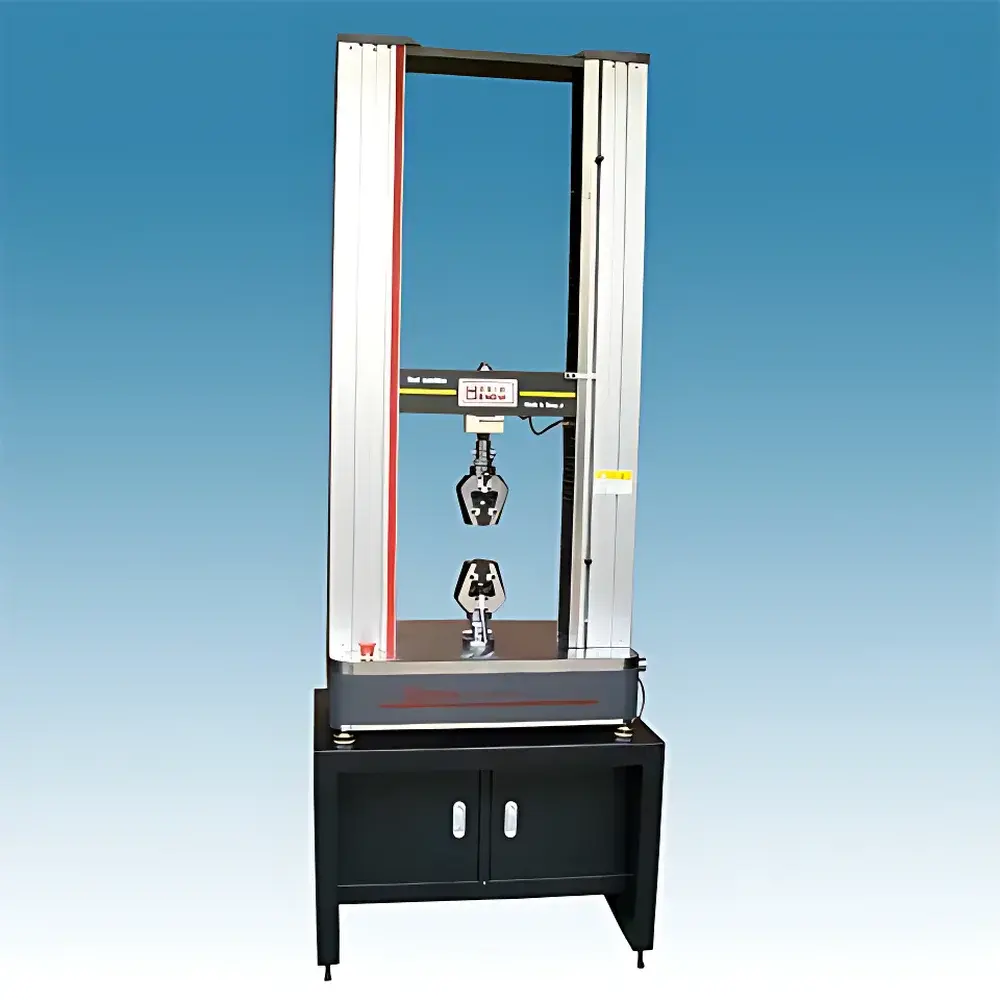
Hengyi HY-1080POOUY Universal Testing Machine for Biomechanical and Biomaterial Characterization
| Brand | Hengyi |
|---|---|
| Origin | Shanghai, China |
| Manufacturer Type | Direct Manufacturer |
| Country of Origin | China |
| Model | HY-1080POOUY |
| Instrument Type | Electromechanical Universal Testing Machine |
| Load Capacity Options | 1 N to 10 kN (multiple transducers available) |
| Accuracy Class | ≤0.5% |
| Effective Test Width | 380 mm (expandable) |
| Effective Test Height | 800 mm (extendable) |
| Speed Range | 0.001–500 mm/min |
| Speed Accuracy | ±0.5% of indicated value |
| Force Resolution | ±500,000 counts (no range switching, constant resolution) |
| Displacement & Strain Measurement Accuracy | ±0.5% of indicated value |
| Stress/Strain Control Rate Range | 0.002–6% FS/s |
| Load Cell | Imported bidirectional precision load cell (USA-sourced) |
| Drive System | Maintenance-free servo motor + driver |
| Guidance System | Dual preloaded high-precision ball screws |
| Frame | Rigid dual-column portal frame (dual-test-space optional) |
| Controller | Multilingual, multi-unit digital controller (open/closed-loop capable) |
| Safety Features | Electronic limit protection, overload auto-stop (>110% FS), real-time system diagnostics |
| Power Supply | 220 V AC, 750 W |
| Dimensions (W×D×H) | 700 × 420 × 1510 mm |
| Weight | 180 kg |
Overview
The Hengyi HY-1080POOUY is a high-precision electromechanical universal testing machine engineered for biomechanical evaluation of soft and semi-rigid biological materials, polymers, medical devices, and functional biomaterials. Based on quasi-static force-displacement transduction principles, it complies with core mechanical testing standards including ISO 527, ASTM D638, ASTM D790, ASTM D3410, ISO 604, and ISO 179—enabling rigorous quantification of tensile strength, compressive modulus, yield behavior, elongation at break, tear resistance, peel adhesion, and cyclic deformation response. Its rigid dual-column portal architecture ensures minimal frame deflection (<0.05 mm under full load), critical for reproducible measurement of low-force, high-strain specimens such as hydrogels, decellularized tissues, suture threads, vascular grafts, and drug-eluting stent coatings. Designed for laboratory environments operating under GLP-aligned workflows, the system supports audit-ready data capture and traceable calibration protocols.
Key Features
- Rigid dual-column steel frame with preloaded high-accuracy ball screws (two units) for axial stability and minimal torsional drift during off-center loading.
- Imported bidirectional load cell (USA-sourced) with ±0.5% accuracy and 500,000-count internal resolution—ensuring consistent sensitivity across the full 1 N–10 kN range without range-switching artifacts.
- Maintenance-free servo drive system delivering precise speed control from 0.001 to 500 mm/min, with closed-loop velocity accuracy maintained within ±0.5% of setpoint.
- Digital controller supporting both open-loop displacement control and closed-loop stress/strain rate control modes; configurable in English, German, French, Spanish, and Chinese with SI/imperial unit toggling.
- Integrated safety architecture: electronic travel limits, overload cutoff (>110% FS), real-time diagnostics for overvoltage, overcurrent, and drive anomalies, plus programmable stop conditions (time, load, or displacement-triggered).
- Ergonomic handheld remote pendant for rapid jog positioning, emergency stop activation, and intuitive test initiation—optimized for frequent specimen changes in high-throughput biomaterial screening.
Sample Compatibility & Compliance
The HY-1080POOUY accommodates diverse specimen geometries and mechanical behaviors relevant to biomedical R&D and quality assurance. Validated test configurations include thin-film tensile testing (e.g., electrospun PCL membranes), small-diameter filament characterization (sutures, bioresorbable monofilaments), compression of porous scaffolds (PLA, collagen, chitosan), three/four-point bending of dental composites, peel testing of transdermal patches, and tear propagation analysis of silicone elastomers. Optional accessories extend capability: video extensometry for non-contact strain mapping, pneumatic wedge grips for low-force polymer films, compression platens with load-cell-integrated top anvils, and environmental chamber interfaces (−40°C to +150°C). The system meets mechanical integrity requirements for ISO 13485-certified device manufacturing and supports FDA 21 CFR Part 11-compliant software validation when paired with qualified third-party data acquisition platforms.
Software & Data Management
While the base controller provides real-time curve plotting and basic parameter export (CSV, Excel), integration with PC-based testing software enables advanced functionality: multi-curve overlay, derivative-based modulus calculation (e.g., tangent, secant, chord), automatic yield point detection per ASTM E8/E229, hysteresis loop analysis for viscoelastic recovery, and statistical batch reporting. All raw data—including timestamps, environmental metadata (if logged), and operator ID—are stored in structured binary formats with embedded checksums. Calibration certificates (traceable to CNAS-accredited labs in Shanghai) include uncertainty budgets aligned with ISO/IEC 17025. Audit trails record user actions, method modifications, and instrument status changes—essential for GMP-regulated biocompatibility studies.
Applications
- Mechanical qualification of tissue-engineered constructs under physiological strain rates (0.01–0.1 mm/min).
- Tensile failure analysis of surgical meshes and hernia repair materials per ISO 10993-12.
- Compression testing of bone cements and injectable hydrogels simulating vertebral augmentation protocols.
- Peel strength assessment of pressure-sensitive adhesives used in wearable biosensors and ECG electrodes.
- Cyclic fatigue evaluation of polymeric heart valve leaflets (ISO 5840-3 compliant test sequences).
- Shear modulus determination of brain-mimetic gels using custom torsional fixtures.
- Quality control of sterilized medical tubing (IV sets, catheters) per ISO 8536-4 dimensional and mechanical tolerances.
FAQ
What biomaterial standards does the HY-1080POOUY support out-of-the-box?
It natively implements test methods referenced in ISO 604 (rigid plastics), ISO 527-2 (tensile testing of plastics), ASTM D882 (thin plastic sheeting), and ASTM F2100 (medical face mask material strength)—with customizable test profiles for emerging biomaterials.
Can the system be validated for ISO 17025 or GLP compliance?
Yes—when operated with documented calibration records, controlled environmental logs, and version-controlled test methods, the hardware meets foundational metrological requirements; full accreditation requires site-specific procedural documentation and third-party verification.
Is remote firmware update supported?
Firmware updates are performed via USB interface using Hengyi-provided signed binaries; network connectivity is not enabled by default to maintain cybersecurity integrity in regulated labs.
What is the minimum resolvable force for sub-gram biomaterial testing?
With the 1 N load cell option, the system achieves theoretical resolution of 2 µN (0.000002 N) at full scale—validated down to 0.01 N with ≤1% linearity error per ASTM E4.
Are custom fixture designs available for irregular biological specimens?
Hengyi offers OEM mechanical design consultation and CNC fabrication of application-specific grips, jigs, and environmental adapters—subject to NDA and dimensional specifications provided by the client lab.



