
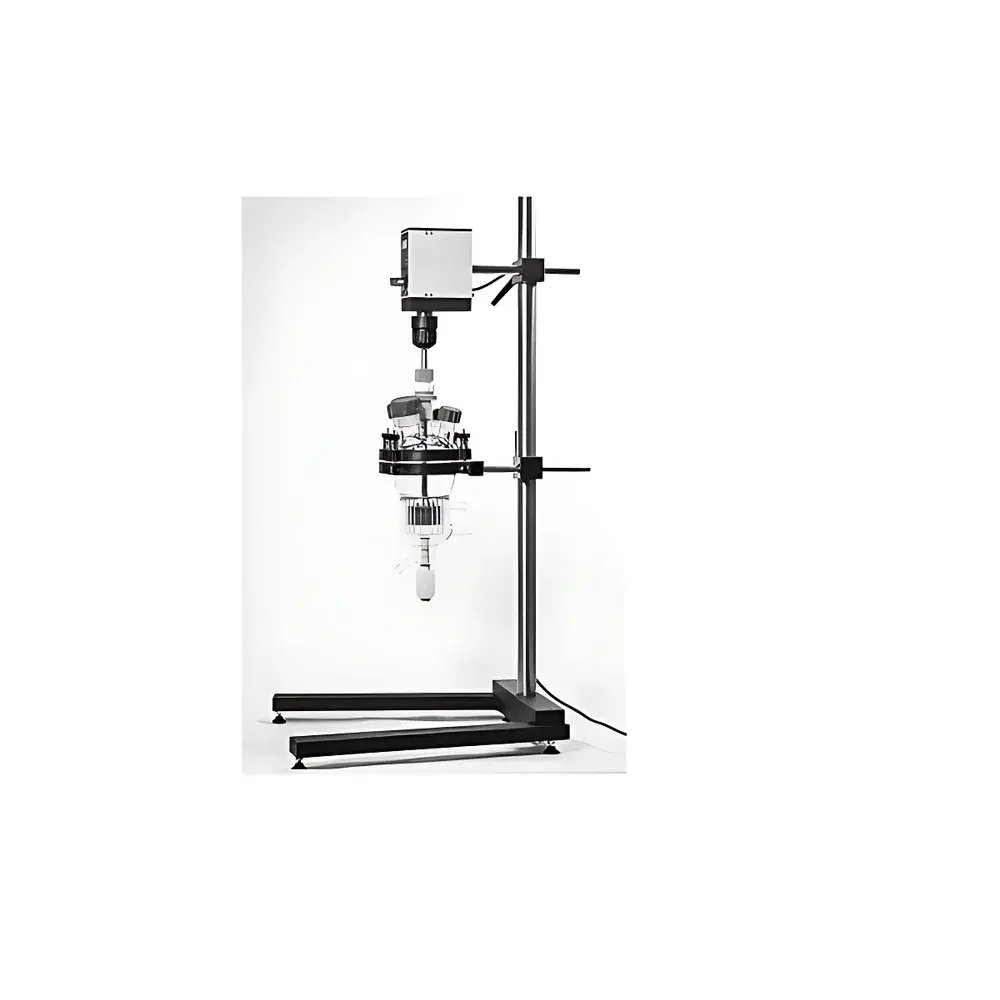
SpinChem S3 Mechanical Rotating Bed Reactor
| Brand | SpinChem |
|---|---|
| Origin | Sweden |
| Model | S3 |
| Construction Material | Stainless Steel |
| Working Pressure | Medium-Pressure |
| Volume Range | 300–2000 mL |
| Bed Dimensions | Ø70 mm × 30 mm |
| Bed Volume | 69 mL |
| Mesh Aperture | 104 µm |
| Shaft Length | 41 cm |
| Shaft Diameter | 10 mm |
| Net Weight | 148 g (397 g with shaft) |
| Rotation Direction | Clockwise |
| Speed Range | 200–800 rpm (500 rpm max with shaft guide) |
| Vacuum Capability | None |
Overview
The SpinChem S3 Mechanical Rotating Bed Reactor is an engineered platform for heterogeneous catalysis and biocatalytic reactions under controlled laboratory conditions. Based on the rotating bed reactor (RBR) principle, it enables efficient mass transfer between solid-phase catalysts—such as immobilized enzymes, ion-exchange resins, or microencapsulated whole cells—and liquid-phase substrates without requiring filtration or centrifugation post-reaction. Unlike conventional stirred-tank reactors where solid catalysts are suspended and subject to shear-induced deactivation or attrition, the S3 confines catalysts within a stainless-steel rotating cylinder (the “bed”) that rotates inside a standard reaction vessel. As rotation begins, hydrodynamic forces draw liquid upward through the porous bed wall (104 µm aperture), promoting rapid and uniform convective penetration into the catalyst matrix. Centrifugal expulsion returns the reacted solution to the bulk phase, establishing continuous, laminar recirculation across the solid–liquid interface. This design delivers high interfacial contact efficiency, reproducible kinetics, and intrinsic scalability from screening to pilot-scale synthesis.
Key Features
- Modular stainless-steel rotating bed (Ø70 mm × 30 mm, 69 mL internal volume) with precisely engineered 104 µm mesh for robust mechanical stability and consistent flow distribution.
- Four independent radial compartments within the bed allow simultaneous evaluation of multiple catalysts, enzyme variants, or resin chemistries in a single run—reducing experimental redundancy and reagent consumption.
- Direct compatibility with standard glass reaction vessels (300–2000 mL capacity), enabling seamless integration with existing lab infrastructure including heating mantles, condensers, and pH/DO probes.
- Motor-driven shaft (41 cm length, 10 mm diameter) supports stable clockwise rotation at 200–800 rpm; shaft-guided operation ensures alignment integrity and minimizes wobble at elevated speeds (up to 500 rpm).
- No post-reaction solid–liquid separation required: catalysts remain fully retained within the bed, permitting immediate product sampling, quenching, or downstream processing without filtration, centrifugation, or catalyst leaching concerns.
Sample Compatibility & Compliance
The S3 accommodates a broad spectrum of solid-phase biocatalysts and chemical catalysts, including epoxy-activated methacrylate resins (hydrophilic/hydrophobic variants), amino-functionalized carriers, octadecyl-modified adsorbents, macroporous styrene–divinylbenzene (DVB) matrices, and ion-exchange media. Its stainless-steel construction complies with ISO 8502-3 for surface cleanliness and meets general requirements for GMP-aligned equipment handling of pharmaceutical intermediates. While not intrinsically rated for vacuum or pressure cycling, its medium-pressure rating supports operations under ambient or nitrogen-purged headspace—suitable for aerobic/anaerobic enzymatic transformations compliant with USP analytical instrument qualification guidelines. All components are autoclavable (121 °C, 20 min), supporting GLP-compliant reuse and cross-contamination control.
Software & Data Management
The S3 operates as a hardware-integrated platform without proprietary firmware or embedded controllers. Rotation speed is regulated via external variable-speed motor drives (e.g., IKA RV 10 digital or equivalent), which typically support analog/digital output logging (0–10 V or 4–20 mA) for time-stamped RPM recording in LabArchives, ELN systems, or SCADA environments. When paired with in-line sensors (e.g., FTIR flow cells, conductivity probes), the S3 facilitates real-time kinetic profiling aligned with ASTM E2915-22 (standard practice for evaluating catalyst performance). Audit trails, user access logs, and electronic signatures may be implemented externally per FDA 21 CFR Part 11 requirements using validated third-party data acquisition software.
Applications
- High-throughput screening of immobilized enzyme libraries for activity, stability, and substrate specificity under varied pH, temperature, and residence time conditions.
- Optimization of biphasic transesterification, hydrolysis, and redox reactions using co-immobilized multi-enzyme cascades or hybrid chemoenzymatic systems.
- Rapid assessment of ion-exchange equilibria and breakthrough curves for water treatment or API purification workflows.
- Continuous-flow biotransformations via sequential RBR modules connected in series—enabling residence time distribution control without pump-induced shear.
- Method development for regulatory submissions requiring documented catalyst recyclability, leaching profiles (per ICH Q5C), and batch-to-batch consistency (per ISO 13485 Annex C).
FAQ
Can the S3 be used under reduced pressure or inert atmosphere?
Yes—the reactor vessel is compatible with standard ground-glass joints and septa; vacuum or nitrogen sparging may be applied externally, though the rotating bed itself is not sealed for pressure containment.
Is catalyst loading standardized across all four compartments?
Each compartment has identical geometry and volume; recommended loading is 0.5–2.0 g of dry solid per compartment depending on catalyst density and swelling behavior.
What maintenance is required for long-term use?
Routine inspection of shaft coupling integrity and mesh integrity (via optical microscopy) is advised after every 50 operational hours; stainless-steel components require only ethanol rinse and air drying between uses.
Does SpinChem provide validation documentation for GMP environments?
SpinChem supplies material certifications (EN 10204 3.1), dimensional drawings, and cleaning validation templates; full IQ/OQ/PQ protocols must be developed internally per site-specific regulatory requirements.
How does the S3 compare to packed-bed or fluidized-bed reactors for enzyme kinetics studies?
Unlike fixed beds, the S3 eliminates channeling and pressure drop limitations; unlike fluidized beds, it prevents catalyst attrition and enables precise compartmentalization—yielding higher reproducibility in initial rate determination (±2.3% RSD, n=12, per internal benchmarking).



