
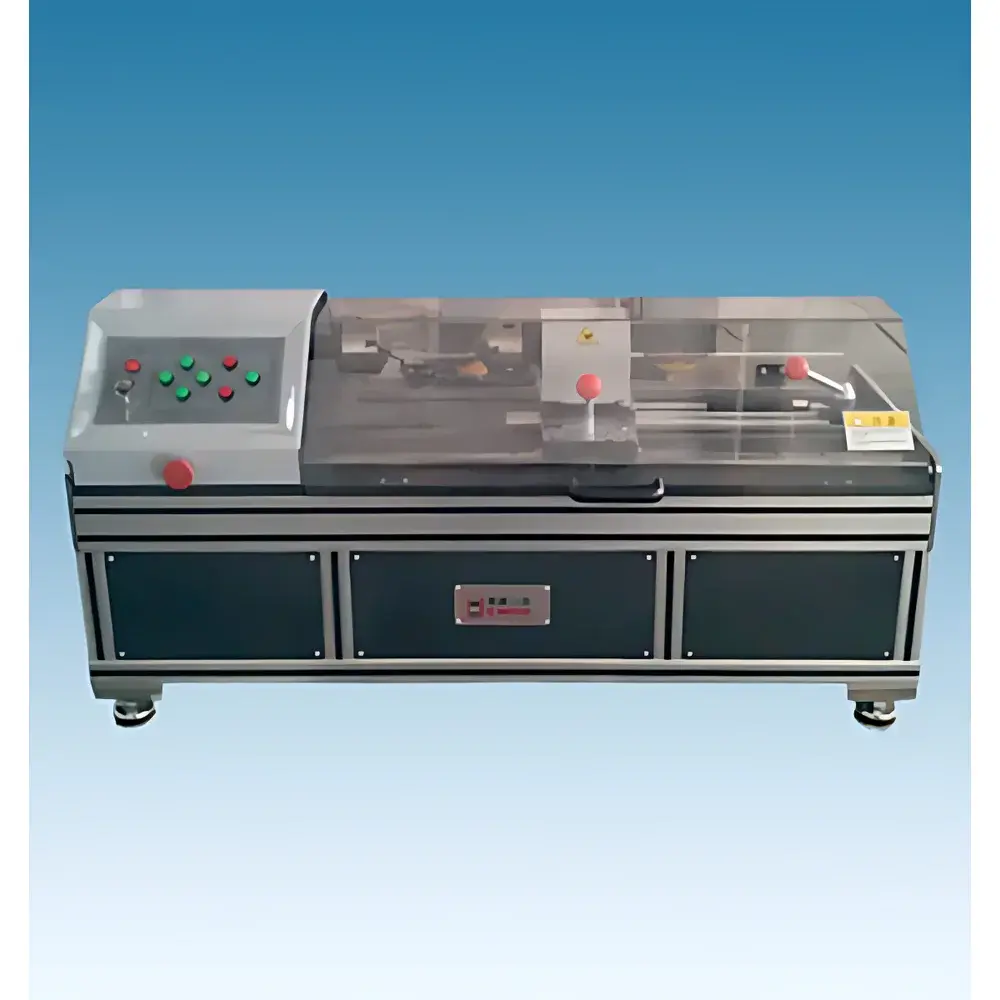
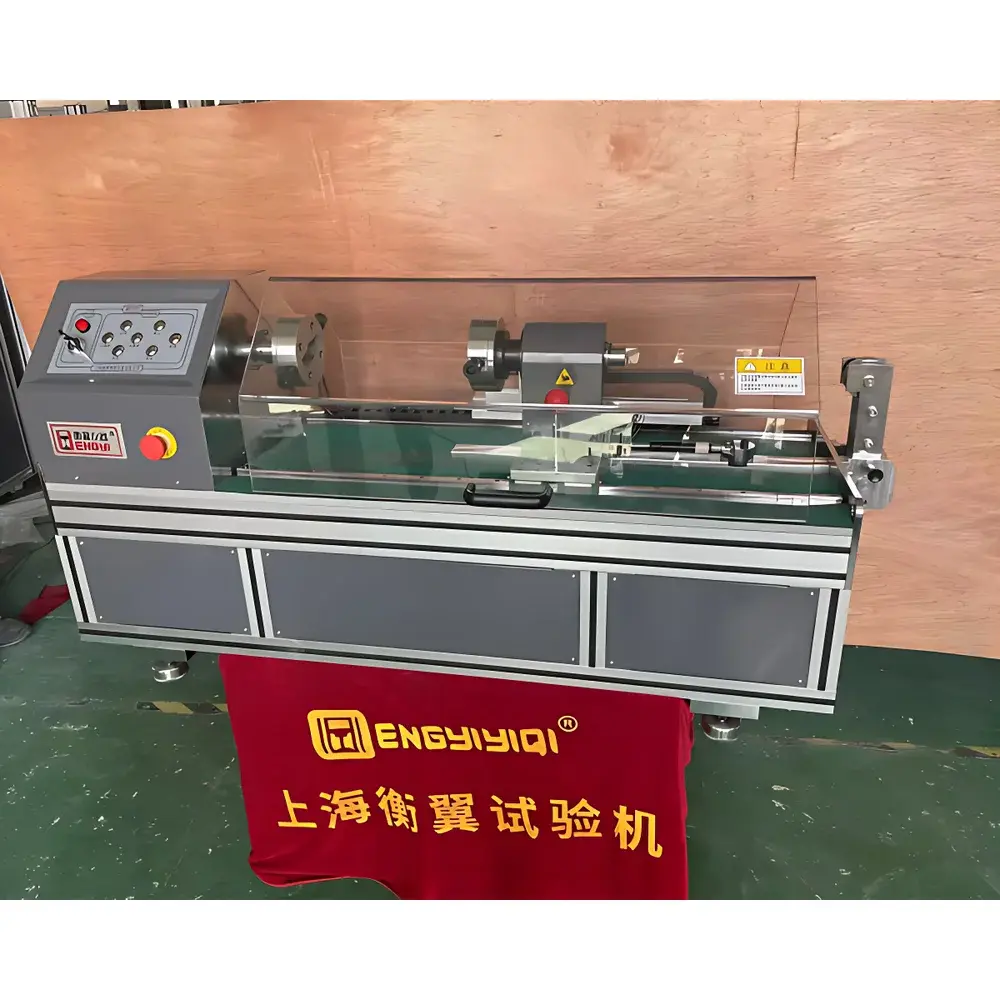
Hengyi HY-100N·m Micro Torsion Testing Machine
| Brand | Hengyi |
|---|---|
| Origin | Shanghai, China |
| Manufacturer Type | Direct Manufacturer |
| Product Category | Domestic |
| Model | HY-100N·mRT |
| Max Torque | 100 N·m |
| Torque Measurement Range | 0.1–100 N·m |
| Torque Resolution | 0.001 N·m |
| Torsion Angle Range | 0–100,000° (or continuous) |
| Motor Power | 0.4 kW |
Overview
The Hengyi HY-100N·m Micro Torsion Testing Machine is a precision-engineered electromechanical torsion tester designed for static and dynamic torque characterization of small-scale specimens across materials science, biomedical engineering, and component validation laboratories. It operates on the principle of controlled angular displacement under applied torque, enabling high-fidelity measurement of torsional stiffness, yield torque, ultimate torsional strength, plastic deformation behavior, and hysteresis in cyclic loading. The system employs a closed-loop servo motor drive coupled with a high-stability load cell and optical encoder-based angular feedback, ensuring traceable, repeatable, and ISO/IEC 17025-compatible mechanical testing performance. Its compact footprint and modular fixture interface support integration into regulated environments—including GLP-compliant QA labs—where compliance with ASTM E143, ISO 7888, GB/T 10128–2007 (Metallic Materials – Torsion Test at Ambient Temperature), and JB/T 9370–1999 (Technical Specifications for Torsion Testing Machines) is required.
Key Features
- Full-range torque capacity from 0.1 N·m to 100 N·m with ±0.5% accuracy (FS) and 0.001 N·m resolution—achieving 1/500,000 full-scale digital resolution.
- High-resolution angular measurement: 0.0045° twist angle resolution over a 0–100,000° range (extendable to continuous rotation mode), with ±0.5% angular speed control fidelity.
- Bi-directional torsional actuation (clockwise/counterclockwise) with programmable ramp-hold-step profiles and automatic peak torque retention.
- Dual-mode control architecture: torque-controlled and angle-controlled testing, supporting both open-loop speed regulation and closed-loop PID torque/angle tracking.
- Modular gripping system accommodating cylindrical specimens from Φ1 mm to Φ5 mm; custom collet sets available for non-standard geometries including bone pins, dental implants, stents, and micro-fasteners.
- Integrated electronic measurement subsystem independent of PC—ensuring deterministic real-time data acquisition at ≥1 kHz sampling rate with hardware-triggered synchronization.
- Robust structural frame (200 kg mass, steel-reinforced base) minimizing resonance-induced noise during high-speed torsion (up to 1000°/min).
Sample Compatibility & Compliance
The HY-100N·mRT accommodates rigid and semi-rigid specimens up to 200 mm gauge length (adjustable per user specification), including metallic wires, polymer rods, adhesive-bonded joints, orthopedic fixation devices (e.g., intramedullary nails, cortical screws), and biomaterial scaffolds. It supports standardized test configurations per GB/T 10128–2007, ASTM F543 (Standard Specification for Metallic Medical Bone Screws), and ISO 5835 (Implants for Surgery – Metallic Bone Screws). All torque and angular data are traceable to national metrological standards via calibration certificates aligned with JJG 269–2017 (Verification Regulation for Torsion Testing Machines). System firmware and software comply with audit trail requirements for 21 CFR Part 11–governed environments when operated with validated configuration.
Software & Data Management
The proprietary Hengyi TorsionTest Suite provides intuitive test method setup, real-time visualization of torque–twist-angle and torque–time curves, and automated report generation compliant with Chinese national standards (including specimen ID, material grade, test date, peak torque, modulus of rigidity, fracture angle, and pass/fail flags). Raw ASCII data export (CSV/TXT) enables post-processing in MATLAB, Python (NumPy/Pandas), or third-party statistical packages. The software implements role-based access control, electronic signatures, and immutable audit logs for GLP/GMP documentation integrity. Optional API integration supports MES/ERP linkage for automated test result ingestion and SPC charting.
Applications
- Mechanical qualification of miniaturized fasteners, micro-springs, and MEMS torsional actuators.
- Torsional fatigue and creep testing of biodegradable polymers and hydrogel composites used in tissue engineering.
- Validation of bonding integrity in laminated composites and adhesive joints per ASTM D1002.
- Regulatory submission testing for Class II/III orthopedic implants under ISO 14801 and FDA guidance on mechanical testing of dental implants.
- Research-grade characterization of viscoelastic torque relaxation in thermoplastic elastomers and shape-memory alloys.
- Educational use in materials mechanics labs for hands-on demonstration of Saint-Venant’s torsion theory and polar moment of inertia effects.
FAQ
What standards does the HY-100N·mRT support out-of-the-box?
It natively implements GB/T 10128–2007, JB/T 9370–1999, and JJG 269–2017; custom test methods can be configured to align with ASTM, ISO, or internal corporate specifications.
Can the system perform cyclic torsion tests?
Yes—it supports fully programmable sinusoidal, triangular, and trapezoidal waveforms with variable amplitude, frequency, and mean torque offset, including dwell periods and reversal detection logic.
Is calibration documentation included with delivery?
Each unit ships with a factory calibration certificate traceable to CNAS-accredited reference standards; optional on-site recalibration and IQ/OQ documentation are available upon request.
What is the minimum specimen diameter supported?
The standard chuck set accepts specimens from Φ1 mm upward; sub-millimeter testing (down to Φ0.3 mm) is achievable using optional precision micro-grips with vacuum-assisted clamping.
Does the software meet 21 CFR Part 11 requirements?
When deployed with enabled audit trail, electronic signature, and secure user authentication modules—and validated per site-specific protocols—the system satisfies core Part 11 criteria for electronic records and signatures in FDA-regulated settings.



