
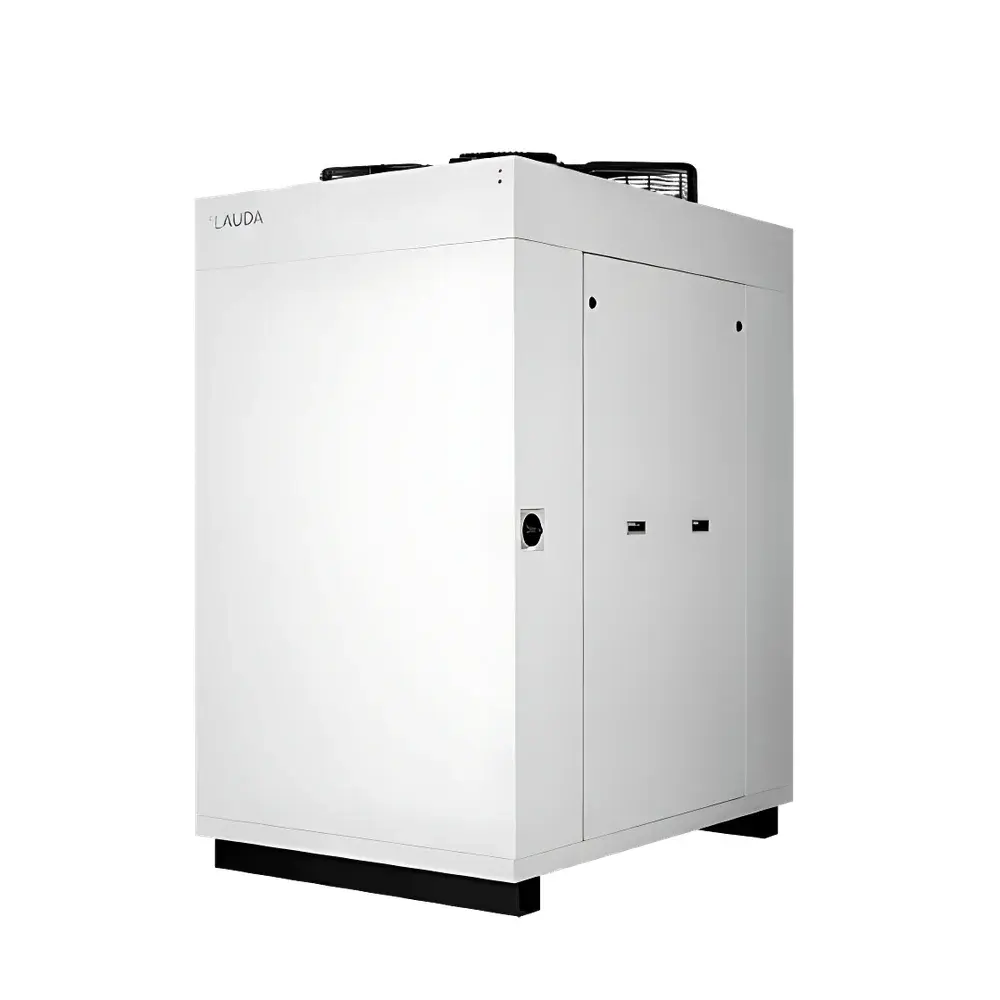
LAUDA UC 50 Ultracool Advanced Energy-Efficient Circulating Chiller
| Brand | LAUDA |
|---|---|
| Origin | Germany |
| Model | UC 50 |
| Instrument Type | Split-System |
| Cooling Method | Water-Cooled |
| Temperature Control Range | –10 to 35 °C |
| Refrigeration Capacity | 51.2 kW (at 10 °C outlet water temperature) |
| Temperature Stability | ±0.5 °C |
| Circulation Pump Pressure | 6.5 bar |
| Circulation Flow Rate | 250 L/min |
| Reservoir Volume | 210 L |
| Operation Mode | Continuous |
Overview
The LAUDA UC 50 Ultracool Advanced Energy-Efficient Circulating Chiller is a high-performance, split-system process chiller engineered for precision temperature control in demanding laboratory and industrial environments. Based on LAUDA’s proprietary thermodynamic architecture and optimized refrigerant circuit design, the UC 50 employs a variable-speed scroll compressor, electronically controlled expansion valves, and adaptive fan speed regulation—enabling dynamic load-matching and minimizing part-load energy waste. Its core operating principle relies on closed-loop refrigerant circulation (R-513A, low-GWP, A1 safety class) coupled with high-efficiency plate heat exchangers and a large-volume stainless-steel reservoir (210 L), ensuring thermal stability and consistent delivery of chilled water at flow rates up to 250 L/min and pressures up to 6.5 bar. Designed for continuous 24/7 operation, the system maintains setpoint accuracy within ±0.5 °C across its full control range of –10 to 35 °C—making it suitable for both cryogenic support and high-heat-load applications such as laser systems and CNC machining.
Key Features
- Energy-optimized architecture compliant with EU Ecodesign Directive (Regulation (EU) 2016/2281), achieving Seasonal Energy Performance Ratio (SEPR) values exceeding regulatory thresholds by >35%
- Variable-speed refrigeration components—including compressor, condenser fans, and circulation pump—enabling precise capacity modulation from 10% to 100% load without cycling losses
- Integrated cloud-ready communication interface supporting Modbus TCP, BACnet MS/TP, and LAUDA Cloud API for secure remote monitoring, firmware updates, and predictive maintenance alerts
- IP54-rated enclosure with corrosion-resistant aluminum housing and galvanized steel base frame—certified for indoor and outdoor installation per IEC 60529
- Factory-configured dual-stage safety logic: independent high-pressure cut-off, low-flow alarm, dry-run protection, and real-time refrigerant leak detection via integrated pressure transducers
- Pre-wired RS485 port and Ethernet interface for seamless integration into SCADA, MES, or LabVantage-based infrastructure
Sample Compatibility & Compliance
The UC 50 is compatible with aqueous glycol solutions (up to 35% v/v ethylene or propylene glycol), deionized water, and other non-corrosive heat transfer fluids commonly used in analytical instrumentation cooling loops. It meets EN 61000-6-2 (immunity) and EN 61000-6-4 (emission) for electromagnetic compatibility, and conforms to Machinery Directive 2006/42/EC and Pressure Equipment Directive 2014/68/EU (PED Category II). All control software adheres to FDA 21 CFR Part 11 requirements for electronic records and signatures when operated with LAUDA’s optional Audit Trail Module. The system supports GLP/GMP-aligned validation protocols—including IQ/OQ documentation packages—and is routinely deployed in ISO 17025-accredited laboratories and pharmaceutical manufacturing facilities.
Software & Data Management
The UC 50 operates under LAUDA’s proprietary ChillControl™ firmware (v4.2+), featuring an intuitive 7-inch capacitive touchscreen HMI with multilingual UI (English, German, French, Chinese, Japanese). Local data logging stores ≥12 months of timestamped operational parameters—including inlet/outlet temperatures, flow rate, compressor run time, and energy consumption—at 1-minute intervals. When connected to LAUDA Cloud, users gain access to encrypted time-series analytics, automated anomaly detection, and configurable email/SMS notifications for deviation events. Data exports comply with ASTM E2500-13 for traceability, and raw logs are exportable in CSV or .tdms format for third-party analysis in MATLAB, Python (Pandas), or LabVIEW. Role-based user authentication (admin/operator/guest) ensures compliance with internal SOPs and external audit requirements.
Applications
- Laser-based systems: Stable cooling for CO₂, fiber, and ultrafast lasers in cutting, welding, marking, and sorting applications—preventing wavelength drift and thermal lensing
- Materials testing: Thermal conditioning of tensile testers, rheometers, and DSC instruments requiring sub-ambient stability
- Process analytics: Continuous cooling of ICP-MS, LC-MS/MS, and FTIR spectrometers during extended acquisition runs
- Hydrogen generation: Precise temperature management of PEM electrolyzers to optimize membrane conductivity and gas purity
- Digital printing & UV curing: Maintaining consistent ink viscosity and LED lamp junction temperatures across high-speed roll-to-roll lines
- Automated manufacturing cells: Integration with PLC-controlled production lines for synchronized thermal management of robotic welders and CNC spindles
FAQ
What is the minimum ambient temperature for outdoor installation?
The UC 50 is rated for ambient operation between –20 °C and +45 °C; however, continuous outdoor use below 0 °C requires optional low-temperature package (heated control cabinet + refrigerant crankcase heater).
Does the UC 50 support glycol-water mixtures for freeze protection?
Yes—up to 35% v/v ethylene or propylene glycol is fully supported; flow and pressure curves are automatically compensated in firmware.
Can the chiller be validated for GxP environments?
Yes—LAUDA provides IQ/OQ templates compliant with Annex 15 and ASTM E2500-13, along with calibration certificates traceable to NIST standards.
Is remote firmware update capability available without physical access?
Yes—secure over-the-air (OTA) updates are delivered via LAUDA Cloud with SHA-256 signature verification and rollback safeguards.
What is the expected service interval for preventive maintenance?
Comprehensive PM is recommended every 12 months or 8,000 operating hours—whichever occurs first—with oil analysis and refrigerant charge verification included.
Related Products



