
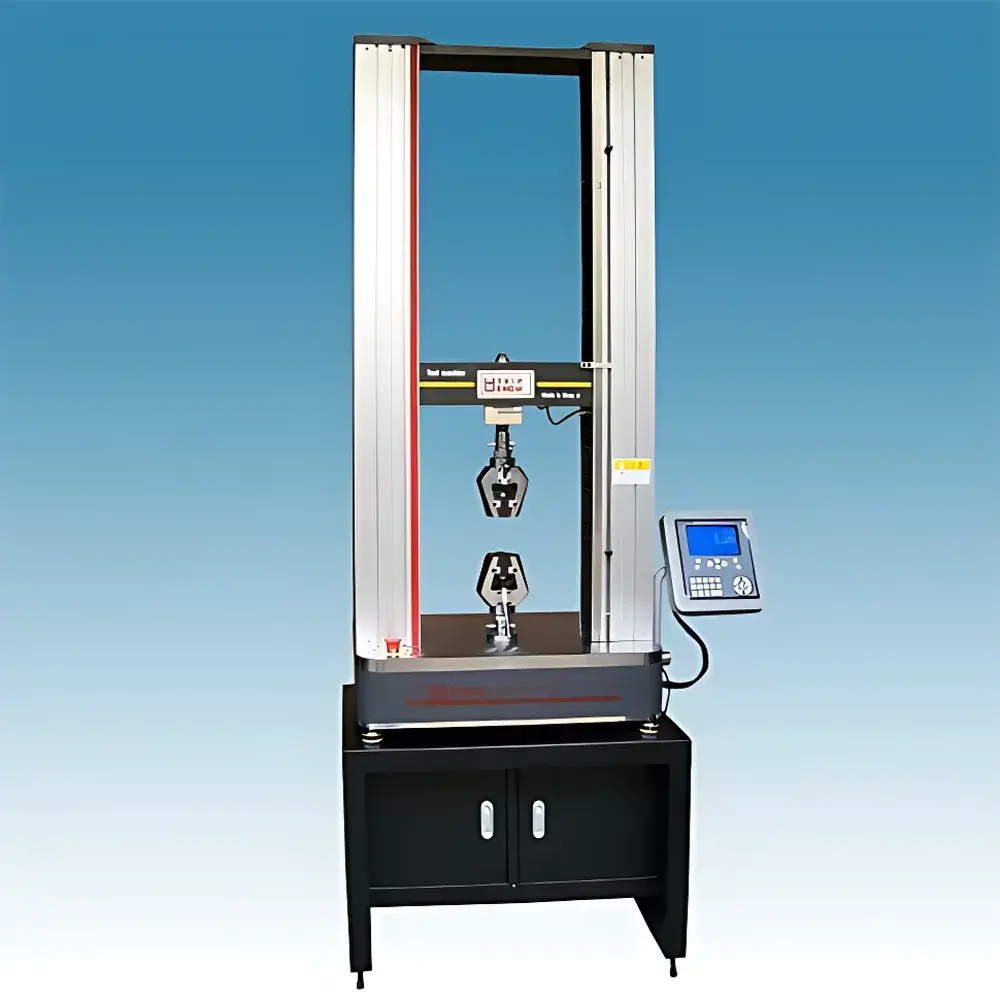
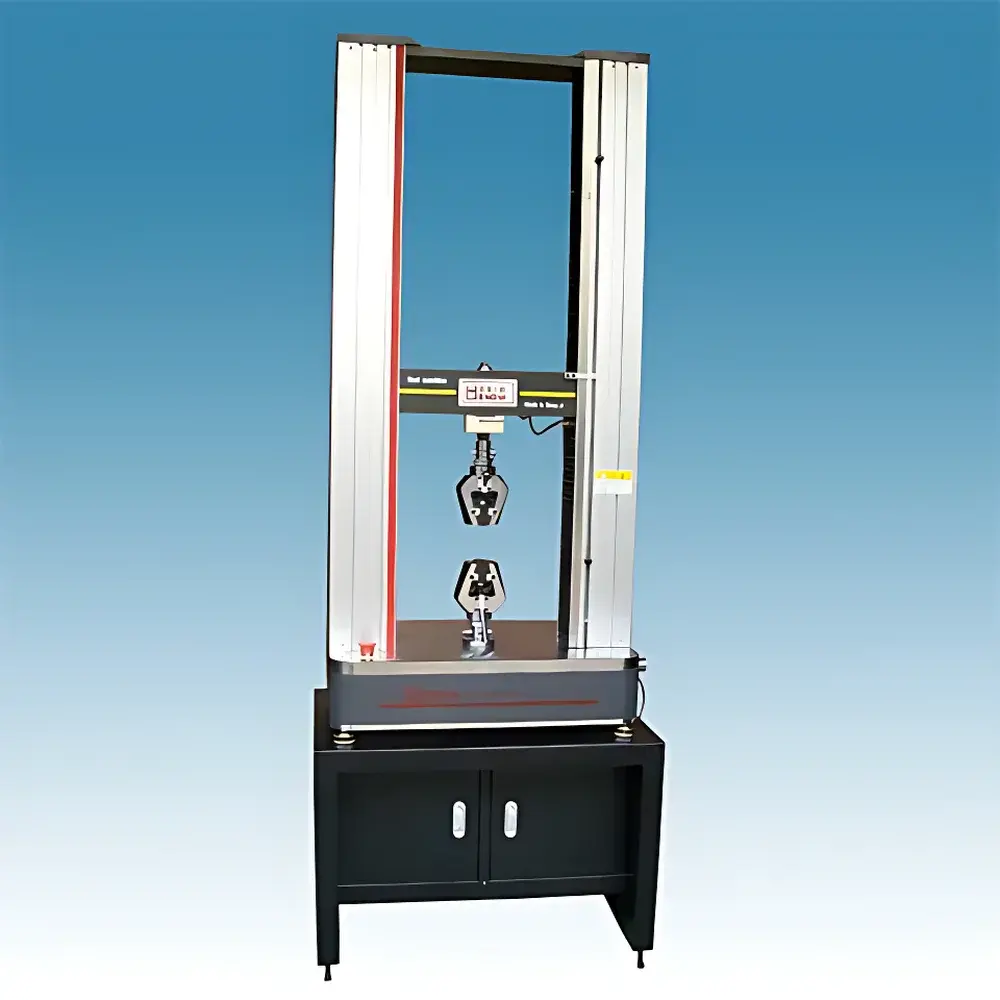
Hengyi HY-1080 Universal Electromechanical Testing Machine for Composites and Metallic Materials
| Brand | Hengyi |
|---|---|
| Origin | Shanghai, China |
| Manufacturer Type | Direct Manufacturer |
| Model | HY-1080 |
| Instrument Type | Electromechanical Tensile Testing Machine |
| Maximum Test Load | 10 kN |
| Force Measurement Range | 0.001–100% of Full Scale (FS) |
| Force Accuracy | ±0.5% of reading |
| Test Stroke | 800 mm |
| Displacement Resolution | 0.001 mm |
| Speed Range | 0.001–800 mm/min |
| Speed Accuracy | ±0.5% of set value |
| Displacement Measurement Accuracy | ±0.5% of reading |
| Strain Control Rate Range | 0.002–6% FS/s |
| Stress Control Rate Range | 0.005–6% FS/s |
| Load Cell Options | 1 N to 10 kN (multi-range configurable) |
| Effective Test Width | 420 mm (expandable) |
| Power Supply | 220 V AC, 750 W |
| Machine Weight | 210 kg |
| Dimensions (W×D×H) | 400 × 420 × 1600 mm |
Overview
The Hengyi HY-1080 is a high-precision, dual-column universal electromechanical testing machine engineered for static mechanical characterization of advanced composite materials, polymers, elastomers, metals, and thin-film substrates. Based on closed-loop servo-controlled load application and displacement feedback, the system implements standardized quasi-static testing protocols per ISO 527, ASTM D638/D3039/D7264, JIS K7113, GB/T 1040, and EN 13377. Its rigid龙门 (portal-type) frame architecture ensures minimal deflection under load, supporting repeatable force transmission across tension, compression, flexure, shear, peel, tear, and cyclic loading modes—all within a single instrument platform. The machine operates in force-, displacement-, or strain-controlled modes, enabling compliance with GLP/GMP-aligned test method validation requirements for R&D labs, quality control departments, and third-party certification facilities.
Key Features
- High-stiffness portal frame with precision-ground linear guides and preloaded ball screws for minimal axial play and long-term dimensional stability
- Integrated multi-range load cell system (1 N to 10 kN), calibrated to ISO 7500-1 Class 0.5 accuracy, with seamless auto-ranging and no internal range switching
- Real-time closed-loop control with sampling rate ≥1 kHz, supporting dynamic parameter tracking during ramp-hold tests and creep/stress-relaxation protocols
- Programmable test sequences including multi-step loading, conditional stopping (by load, displacement, strain, or time), and automatic return-to-start post-test
- Dual-speed crosshead actuation (fast jog + fine positioning) with electronic limit protection and hardware-based overload cutoff (>110% FS)
- Self-diagnostic firmware that continuously monitors drive current, encoder feedback, load cell output, and thermal drift—triggering safety shutdown upon anomaly detection
- Modular extensometer interface compliant with ASTM E83 Class B-1 and ISO 9513 requirements for direct strain measurement
Sample Compatibility & Compliance
The HY-1080 accommodates specimens ranging from micro-scale fiber bundles (with custom grips) to structural laminates up to 420 mm wide and 800 mm tall. Standard configurations support flat, round, and dog-bone geometries; optional accessories include wedge-action tensile grips, compression platens, 3-/4-point bending fixtures, peel test jigs, and environmental chambers (−40°C to +200°C). All test methods adhere to internationally recognized standards—including ASTM D695 (compressive strength), D790 (flexural properties), D1876 (peel resistance), ISO 178 (flexure), ISO 604 (compression), and ISO 527-2 (tensile behavior of plastics)—and are fully traceable to national metrology institutes via factory calibration certificates (NIST-traceable where applicable). Data integrity meets FDA 21 CFR Part 11 requirements when used with compliant software modules.
Software & Data Management
The embedded Windows-based control software provides intuitive test setup, real-time curve visualization (force vs. displacement, stress vs. strain), and automated report generation in PDF/Excel formats. Raw data export supports CSV and ASCII formats for post-processing in MATLAB, Python (NumPy/Pandas), or Minitab. Audit trail functionality logs user actions, method changes, calibration events, and system errors with timestamps and operator IDs. Optional add-ons include statistical process control (SPC) dashboards, batch test scheduling, and integration with LIMS via OPC UA or RESTful API. All software modules undergo annual verification against ISO/IEC 17025 clause 5.9.2 for measurement software validation.
Applications
- Mechanical property mapping of carbon fiber-reinforced polymer (CFRP) laminates: tensile modulus, interlaminar shear strength (ILSS), flexural stiffness, and compression-after-impact (CAI) performance
- Quality assurance of thermoplastic matrix composites (e.g., PEEK, PEKK) per aerospace specifications (AMS 2750, SAE AS4788)
- Characterization of bioresorbable polymers (PLA, PCL, PGA) for medical device validation under ISO 10993-12
- Validation of adhesive bond strength in hybrid assemblies (metal–polymer, ceramic–composite) using lap-shear and T-peel protocols
- Creep rupture analysis of geosynthetic reinforcements per ASTM D6992 and ISO 13431
- Calibration and verification of extensometers, load cells, and displacement transducers per ISO 9513 and ISO 376
FAQ
What standards does the HY-1080 support out-of-the-box?
The system includes preconfigured test methods for ASTM D638, D3039, D7264, ISO 527, ISO 178, and GB/T 1040, with editable parameters to accommodate lab-specific SOPs.
Can the machine perform cyclic fatigue testing?
Yes—when equipped with optional high-frequency actuator and waveform generator module, it supports sinusoidal, triangular, and trapezoidal waveforms at frequencies up to 5 Hz (dependent on specimen mass and stroke).
Is third-party calibration documentation provided?
Each unit ships with a full calibration certificate traceable to CNAS-accredited laboratories, covering force, displacement, and speed axes per ISO 7500-1 and ISO 4287.
How is data security ensured during regulatory audits?
With enabled audit trail and electronic signature modules, all test records comply with ALCOA+ principles (Attributable, Legible, Contemporaneous, Original, Accurate, Complete, Consistent, Enduring, Available) as required by FDA and EMA guidelines.
What maintenance intervals are recommended?
Preventive maintenance is advised every 12 months or after 2,000 test cycles, including ball screw lubrication, encoder alignment check, load cell zero-drift verification, and firmware update validation.



