
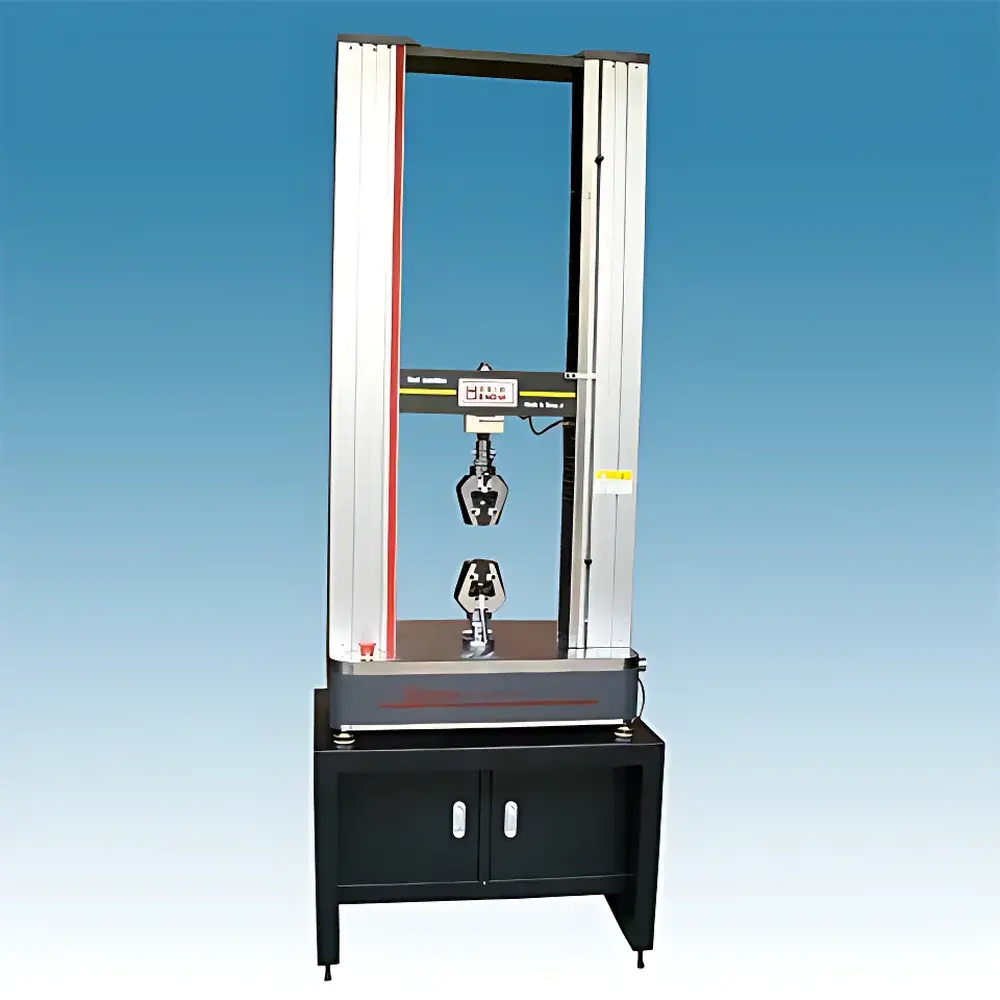
Hengyi HY-1080LQ Universal Tensile and Compression Testing Machine
| Brand | Hengyi |
|---|---|
| Origin | Shanghai, China |
| Manufacturer Type | Direct Manufacturer |
| Country of Origin | China |
| Model | HY-1080LQ |
| Instrument Type | Electromechanical Universal Testing Machine |
| Load Capacity Options | 1 N to 10 kN (multiple transducers available) |
| Accuracy Class | ≤0.5% |
| Effective Test Width | 380 mm (expandable) |
| Effective Test Height | 800 mm (extendable) |
| Speed Range | 0.001–500 mm/min |
| Speed Accuracy | ±0.5% of indicated value |
| Force Resolution | ±500,000 counts (full-scale, no range switching) |
| Displacement & Strain Measurement Accuracy | ±0.5% of indicated value |
| Stress/Strain Control Rate Range | 0.002–6% FS/s |
| Load Protection | 110% overload cutoff |
| Power Supply | 220 V AC, 750 W |
| Net Weight | 180 kg |
| Dimensions (W×D×H) | 700 × 420 × 1510 mm |
Overview
The Hengyi HY-1080LQ is a dual-column, electromechanical universal testing machine engineered for high-precision static mechanical characterization of materials under tension, compression, flexure, shear, peel, tear, and cyclic loading conditions. Based on servo-controlled displacement actuation and closed-loop force feedback, it operates in accordance with fundamental principles of uniaxial mechanical testing as defined in ISO 6892-1 (metallic materials), ASTM D638 (plastics), ASTM D3039 (composites), ISO 179 (impact-modified plastics), and ISO 1182 (fire behavior of building materials). Its rigid龙门 (gantry) architecture ensures minimal frame deflection during high-load testing, supporting reproducible stress–strain curve acquisition across diverse material classes—from sub-newton biomedical filaments to 10 kN structural alloys. The system complies with essential metrological requirements for laboratory accreditation under ISO/IEC 17025 and supports traceable calibration per national standards (e.g., JJG 475–2018 in China; equivalent to ISO 7500-1:2018 for force measurement systems).
Key Features
- High-rigidity dual-column steel frame with preloaded ball-screw drive system (dual precision ground screws, imported from Japan)
- Panasonic AC servo motor and digital drive unit — maintenance-free operation with <0.1% speed ripple at low velocities
- Imported bidirectional load cell with automatic transducer recognition and thermal compensation (rated output: 2 mV/V, nonlinearity <±0.03% FS)
- Digital controller supporting open-loop and closed-loop control modes; configurable for force, displacement, strain, or stress-rate control
- Multi-language UI (English, Chinese, Spanish, German, French) with SI/imperial unit switching and customizable test method templates
- Handheld remote control for rapid jog positioning, emergency stop, and real-time parameter adjustment without PC interface
- Integrated safety architecture: electronic travel limits, overload protection (110% FS), auto-diagnostic self-check at power-on and runtime
Sample Compatibility & Compliance
The HY-1080LQ accommodates specimens ranging from ultra-thin polymer films (≥5 µm) and fine metallic wires (Ø0.05–3 mm) to rigid composites and orthopedic implants. Standardized fixtures—including wedge-action tensile grips, compression platens, three/four-point bending assemblies, peel jigs, and shear adapters—enable compliance with ASTM D882 (thin plastic film), ISO 527-2 (rigid plastics), ASTM E8/E21 (metals at elevated temperature), and ISO 13934-1 (textile tensile strength). Optional extensometers (mechanical or video-based) and large-strain sensors extend measurement fidelity for ductile polymers and elastomers. All hardware and firmware configurations support GLP-compliant data integrity: audit trails, user access levels, electronic signatures, and 21 CFR Part 11–ready software packages are available upon request.
Software & Data Management
The embedded control software provides real-time graphical display of load–displacement, stress–strain, and time-based curves with up to 100 Hz sampling. Raw data export is supported in CSV, Excel (.xlsx), and universal .tdms formats. Advanced analysis modules calculate Young’s modulus, yield offset (0.2% proof stress), ultimate tensile strength (UTS), elongation at break, Poisson’s ratio (with biaxial extensometry), and creep/recovery parameters. Calibration certificates—traceable to NIM (National Institute of Metrology, China) or NIST-equivalent labs—are supplied with each load cell. Software updates follow IEC 62304 medical device lifecycle standards where applicable (e.g., for biomedical testing configurations).
Applications
- Mechanical validation of photovoltaic interconnect ribbons and solar cell substrates per IEC 61215
- Quality control of medical tubing, suture threads, and surgical staplers under ISO 7198 and ASTM F2102
- Characterization of packaging films, corrugated board, and adhesive tapes per ASTM D882 and FINAT test methods
- R&D of thermoplastic elastomers, hydrogels, and biodegradable polymers requiring low-force, high-resolution deformation tracking
- Testing of aerospace composites (CFRP, GFRP) per Boeing BSS 7260 and Airbus AITM 1-0002
- Validation of fasteners, springs, and miniature mechanical components per ISO 898-1 and ASTM F606
FAQ
What standards does the HY-1080LQ comply with for force calibration?
It meets ISO 7500-1:2018 Class 0.5 requirements for static force measurement systems, with factory calibration traceable to China’s NIM.
Can the system perform cyclic fatigue tests?
Yes—when equipped with optional waveform generation module and high-cycle load cell, it supports sinusoidal, triangular, and trapezoidal waveforms up to 5 Hz (dependent on specimen stiffness and stroke length).
Is third-party certification (e.g., CE, UL) available?
CE marking is provided for EU shipment; UL listing requires customer-specific configuration review and additional EMC/safety testing.
How is data integrity ensured for regulated industries?
With optional compliant software package, full 21 CFR Part 11 functionality—including role-based access, electronic signatures, and immutable audit logs—is enabled.
What is the lead time for custom fixture design?
Standard夹具 ship within 5 business days; bespoke fixtures (e.g., ASTM D624 tear dies or ISO 148-1 Charpy anvils) require 12–18 working days after drawing approval.



