
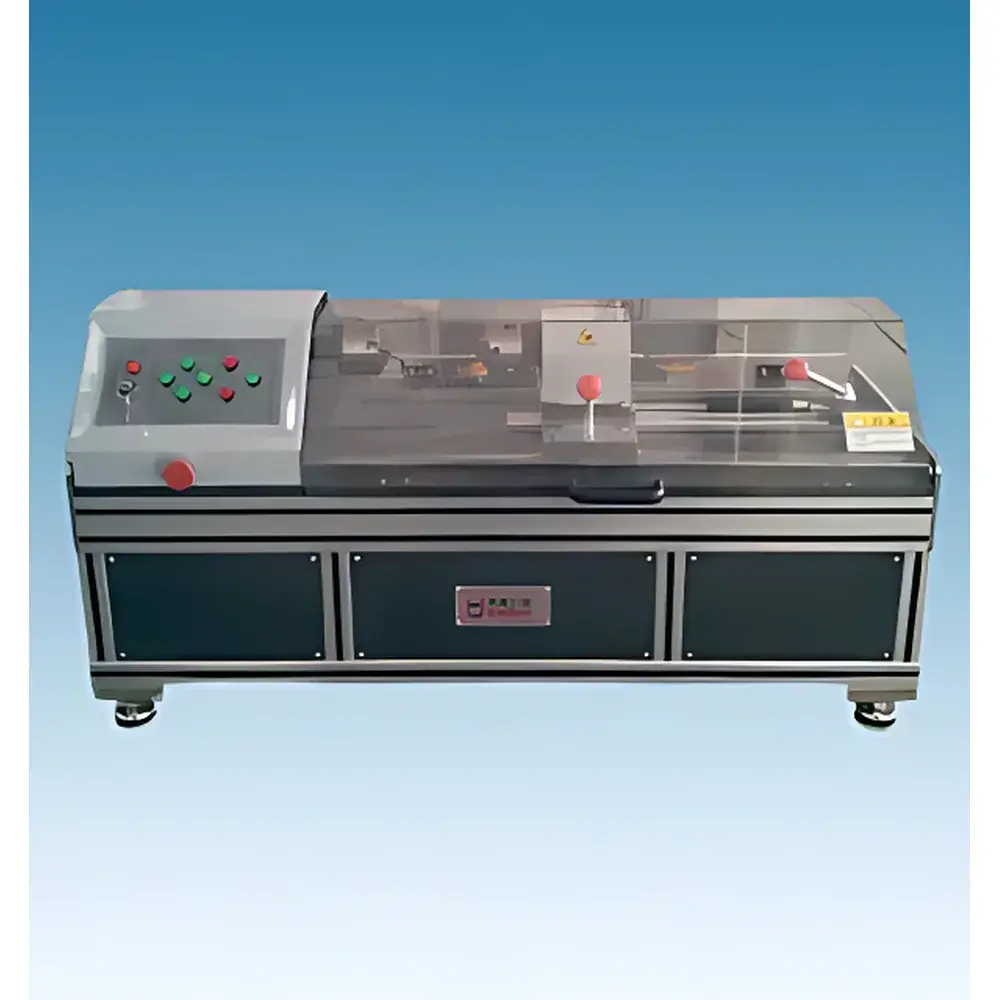
Hengyi HY-100N.MRTT Microcomputer-Controlled Electronic Torsion Testing Machine
| Brand | Hengyi |
|---|---|
| Origin | Shanghai, China |
| Manufacturer Type | Direct Manufacturer |
| Product Category | Domestic |
| Model | HY-100N.MRTT |
| Max Torque | 100 N·m |
| Torque Measurement Range | 0.1–100 N·m |
| Torque Resolution | 1/500,000 FS |
| Twist Angle Range | 0–100,000° (or continuous) |
| Motor Power | 0.75 kW |
| Torque Accuracy | ±0.5% |
| Angular Accuracy | ±0.5% |
| Angular Resolution | 0.0045° |
| Twist Speed Range | 0–1000°/min |
| Specimen Diameter Capacity | Φ1–Φ5 mm (customizable) |
| Gauge Length | 200 mm (adjustable) |
| Dimensions (L×W×H) | ≈1000×420×500 mm |
| Weight | 200 kg |
Overview
The Hengyi HY-100N.MRTT is a precision-engineered microcomputer-controlled electronic torsion testing machine designed for quantitative mechanical characterization of adhesive bonds—particularly epoxy resin adhesives—under controlled torsional loading. It operates on the principle of controlled angular displacement and real-time torque feedback, enabling high-fidelity measurement of torsional stiffness, yield torque, ultimate failure torque, and post-yield behavior. Unlike uniaxial tensile testers, this system captures the shear-dominated interfacial response critical to structural bonding integrity in aerospace, automotive, electronics encapsulation, and medical device assembly. The instrument complies with internationally recognized test standards including GB/T 10128–2007 (Metallic Materials – Torsion Testing at Ambient Temperature), JB/T 9370–1999 (Technical Specifications for Torsion Testing Machines), and JJG 269 (Verification Regulation for Torsion Testing Machines). Its closed-loop servo control architecture ensures traceable, repeatable, and auditable test execution—essential for GLP-compliant laboratories and ISO/IEC 17025-accredited quality control environments.
Key Features
- High-resolution torque transduction with 1/500,000 full-scale resolution and ±0.5% accuracy across the 0.1–100 N·m range
- Precision angular measurement system with 0.0045° resolution and ±0.5% relative error over 0–100,000° range
- Bidirectional torsional actuation (clockwise & counterclockwise) with programmable speed control from 0.01°/min to 1000°/min
- Integrated digital controller with real-time data acquisition at up to 1 kHz sampling rate
- Modular夹具 system supporting cylindrical specimens from Φ1 mm to Φ5 mm; gauge length adjustable to 200 mm (custom lengths available)
- Self-contained electronic measurement unit—no external signal conditioning or third-party DAQ required
- Automated test sequencing with pre-defined protocols for ASTM D1002, GB/T 6329, GB/T 7124, and JC/T 989 compliance
Sample Compatibility & Compliance
The HY-100N.MRTT accommodates a broad spectrum of adhesive joint configurations, including lap-shear, butt-joint, and helical-wound specimens. It is validated for use with epoxy resins, anaerobic adhesives, polyurethanes, phenolic and urea-formaldehyde resins, and cyanoacrylates—enabling comparative evaluation of cure kinetics, thermal aging effects, and environmental degradation on torsional bond strength. Mechanical compliance extends to metallic substrates (aluminum, stainless steel), composites (carbon fiber laminates), ceramics, and biomedical polymers (e.g., PMMA bone cement interfaces). All test procedures adhere to metrological traceability requirements per ISO/IEC 17025, support audit-ready data logging, and are compatible with FDA 21 CFR Part 11–compliant software configurations when integrated with validated LIMS or ELN platforms.
Software & Data Management
The proprietary Hengyi TestMaster™ software provides full I/O control via USB 2.0 or Ethernet interface. It enables synchronized acquisition of torque, twist angle, time, and calculated parameters (e.g., torsional modulus, energy absorption, failure angle). Real-time plotting includes dynamic overlays of τ–θ (torque vs. twist angle), τ–t (torque vs. time), and θ–t (twist angle vs. time) curves. Data export supports CSV, XML, and PDF formats; raw datasets include embedded metadata (operator ID, calibration timestamp, environmental conditions). Audit trails record all parameter modifications, test starts/stops, and report generation events. Optional modules provide statistical process control (SPC) charts, batch comparison tools, and automated pass/fail decision logic aligned with internal QC thresholds or regulatory limits.
Applications
- Quantification of torsional peel resistance in epoxy-bonded composite joints for wind turbine blade manufacturing
- Evaluation of anaerobic threadlocker performance under cyclic torsional fatigue per ISO 15482
- Interfacial shear strength assessment of dental resin cements bonded to zirconia abutments
- Quality assurance of structural adhesive bonds in EV battery module housings subjected to vibration-induced torsional stress
- Research into humidity- and temperature-dependent torsional relaxation behavior of aerospace-grade film adhesives
- Validation of curing profiles for UV-activated epoxy systems via real-time torsional modulus tracking
FAQ
What adhesive joint geometries can be tested on the HY-100N.MRTT?
Standard configurations include cylindrical lap-shear, double-lap torsion, and axial-torsion hybrid specimens. Custom fixtures are available for non-cylindrical substrates upon engineering review.
Does the system support automated pass/fail evaluation against specification limits?
Yes—threshold-based logic can be defined for peak torque, angular displacement at failure, or energy-to-failure; results trigger color-coded alerts and auto-generated disposition reports.
Is calibration documentation provided with the instrument?
Each unit ships with a factory calibration certificate traceable to CNAS-accredited national standards, including torque and angular calibration matrices at multiple points across the operational range.
Can test data be exported directly to enterprise quality management systems (QMS)?
CSV and XML exports are natively supported; API integration with Siemens QMS, ETQ Reliance, and MasterControl is available through optional middleware licensing.
What maintenance intervals are recommended for long-term accuracy retention?
Torque sensor recalibration is advised every 12 months or after 10,000 test cycles; angular encoder verification is recommended quarterly using certified optical rotary standards.



