
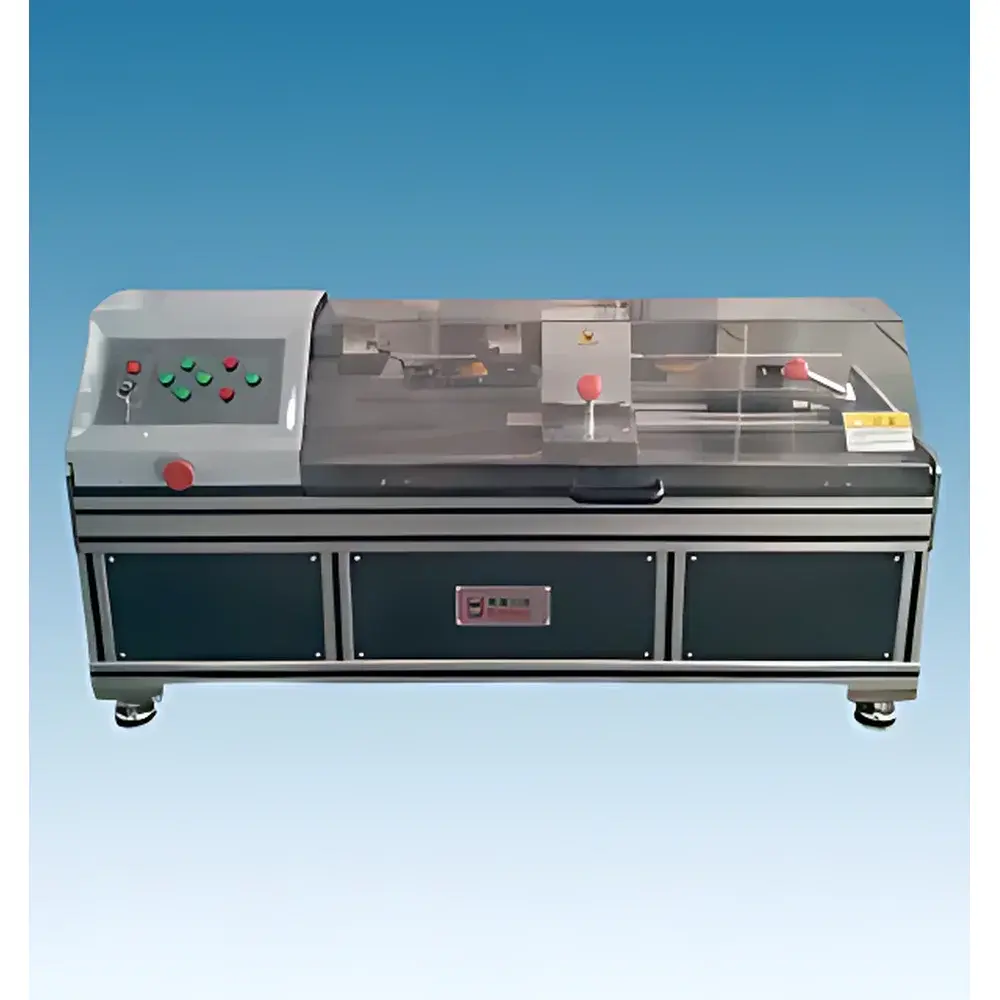
Hengyi HY-100N·m Bone Screw Torsion Testing Machine
| Brand | Hengyi |
|---|---|
| Origin | Shanghai, China |
| Manufacturer Type | Direct Manufacturer |
| Product Category | Domestic |
| Model | HY-100N·mTYUU |
| Max Torque | 100 N·m |
| Torque Measurement Range | 0.1–100 N·m |
| Torque Resolution | 0.001 N·m |
| Torsion Angle Range | 0–100,000° (or continuous) |
| Motor Power | 0.4 kW |
| Torque Accuracy | ±0.5% FS |
| Angular Accuracy | ±0.5% FS |
| Angular Resolution | 0.0045° |
| Torsion Speed | 0–1000°/min |
| Clamping Diameter Range | Φ1–Φ5 mm |
| Gauge Length | 200 mm (customizable) |
| Power Supply | Single-phase 220 V, 50 Hz |
Overview
The Hengyi HY-100N·m Bone Screw Torsion Testing Machine is a precision-engineered, microprocessor-controlled electromechanical torsion tester designed specifically for mechanical evaluation of orthopedic fasteners—including cortical and cancellous bone screws, spinal fixation devices, and biodegradable implants—under controlled torque and angular displacement conditions. It operates on the principle of direct-drive servo-motor actuation coupled with high-fidelity torque transduction and optical encoder-based angular measurement, enabling compliant, repeatable, and traceable torsional characterization in accordance with international biomechanical testing standards. The system delivers full digital control over load application profiles (e.g., quasi-static ramp, stepwise torque hold, cyclic torsion), real-time feedback regulation, and synchronized data acquisition at configurable sampling rates. Its architecture supports both open-loop speed control and closed-loop torque/angle control modes, ensuring experimental fidelity across ASTM F543, ISO 6474, ISO 14801, and GB/T 10128–2007 test protocols.
Key Features
- High-resolution torque sensing (0.001 N·m resolution, ±0.5% FS accuracy) using calibrated strain-gauge transducers with temperature-compensated signal conditioning
- Optical rotary encoder with 0.0045° angular resolution and ±0.5% full-scale accuracy over 0–100,000° range, supporting both finite-angle and continuous rotation tests
- Brushless DC servo motor (0.4 kW) delivering smooth, low-noise torsional actuation with speed control from 0.01°/min to 1000°/min and bidirectional torque application
- Dual-mode control architecture: independent torque setpoint control and angle-setpoint control, with automatic transition between modes during multi-stage test sequences
- Modular clamping system accommodating screw diameters from Φ1 mm to Φ5 mm; jaw geometry optimized for axial alignment and minimal bending moment introduction
- Integrated torsion extensometer interface for optional high-precision local twist measurement at the thread engagement zone
- Robust structural frame (200 kg mass, rigid cast-iron base) minimizing vibrational coupling and ensuring long-term metrological stability
Sample Compatibility & Compliance
The HY-100N·m is validated for testing metallic (titanium alloy, stainless steel 316L, CoCr), polymer (PEEK, PLLA), and composite orthopedic screws per ISO 6474 (ceramic implants), ISO 14801 (dental implant abutments), and ASTM F543 (standard specification for metallic medical bone screws). It supports standardized test configurations including single-screw torsion-to-failure, torsional fatigue (via optional cyclic software module), and functional loosening assessment under simulated bone-implant interface conditions. All hardware and firmware comply with electromagnetic compatibility (EMC) requirements per IEC 61326-1 and electrical safety standards per IEC 61010-1. Calibration certificates are traceable to CNAS-accredited national metrology institutes, and system validation documentation satisfies GLP audit requirements for preclinical biomechanical laboratories.
Software & Data Management
Built-in Hengyi TorsionTest v4.x software provides a validated, FDA 21 CFR Part 11–compliant environment for test method definition, execution, and reporting. Features include password-protected user roles (Administrator, Operator, Reviewer), electronic signature capture, full audit trail logging (including parameter changes, calibration events, and test interruptions), and automatic generation of PDF reports conforming to GB/T 10128–2007 and ASTM E1823 annexes. Real-time plotting displays torque–angle, torque–time, and angle–time curves with overlay capability for comparative analysis. Raw data export is supported in CSV, Excel (.xlsx), and universal HDF5 formats; all metadata (operator ID, environmental conditions, calibration date, sample ID) is embedded within dataset headers. Optional API integration enables connection to LIMS platforms via RESTful web services.
Applications
- Static torsional strength and yield behavior of orthopedic screws per ISO 6474 Clause 7.3
- Torsional stiffness quantification (torque/angular deformation slope) for comparative device evaluation
- Thread stripping resistance assessment under controlled angular displacement
- Cyclic torsional fatigue testing up to 10⁶ cycles (with optional environmental chamber integration)
- Biodegradable screw degradation monitoring via periodic torsional retesting
- Regulatory submission support for 510(k), CE Marking, and PMDA technical files
- Quality control verification in ISO 13485-certified manufacturing environments
FAQ
What standards does this machine fully support out-of-the-box?
The HY-100N·m includes preconfigured test methods for GB/T 10128–2007, JB/T 9370–1999, ASTM F543–22, and ISO 14801:2016. Custom protocol development is available upon request.
Can it test screws embedded in synthetic bone blocks?
Yes—the machine accommodates fixture-mounted bone block holders (e.g., polyurethane foams per ASTM D1622 or bovine cortical bone analogs) with adjustable vertical positioning to maintain coaxial alignment.
Is the system compatible with third-party data acquisition hardware?
It features analog voltage outputs (±10 V) for torque and angle signals, plus TTL-compatible digital I/O for external trigger synchronization, enabling integration with DAQ systems such as National Instruments PXI or Dewesoft X.
Does the software support multi-language UI and report generation?
English and Simplified Chinese interfaces are standard; additional languages (German, Japanese, Spanish) are available as licensed add-ons with localized regulatory templates.
What maintenance schedule is recommended for long-term accuracy?
Annual calibration of torque and angular sensors is advised; quarterly verification using certified reference standards (e.g., NIST-traceable torque calibrator) is required for ISO 17025–accredited labs.
Related Products



