
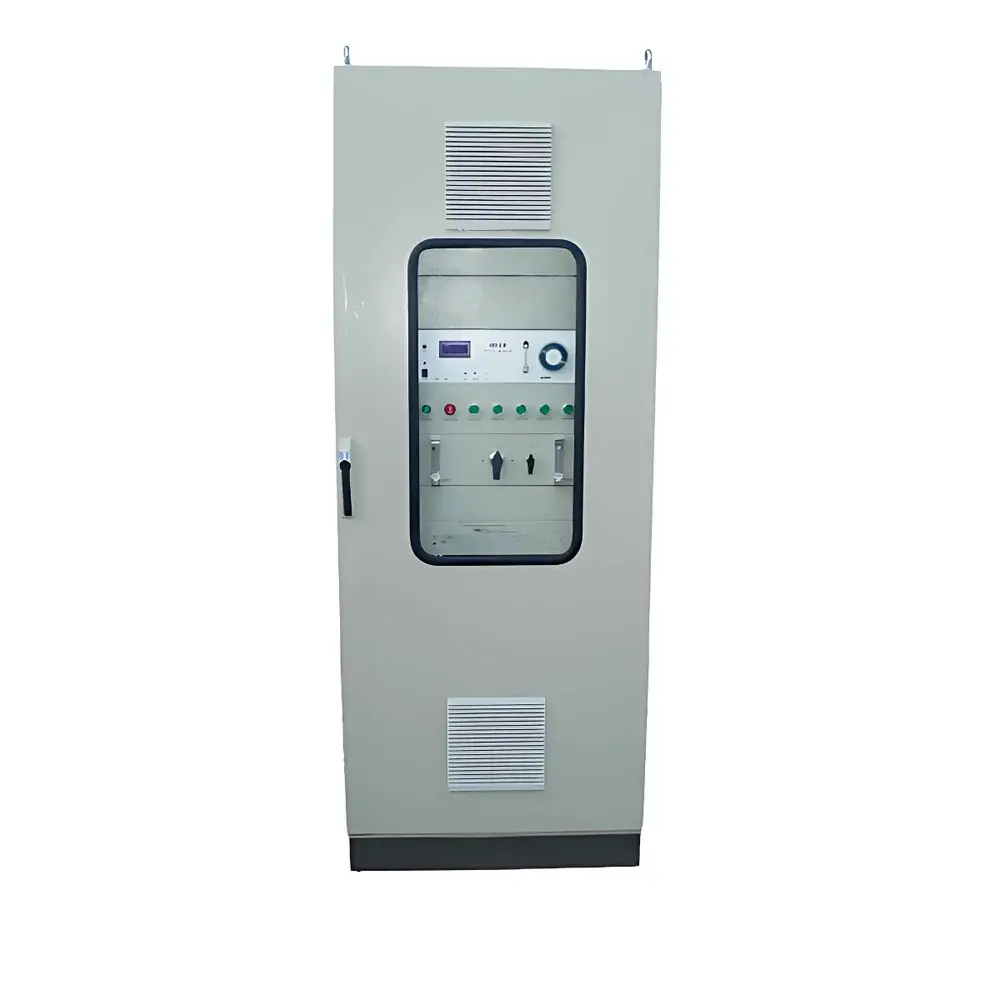
SIELINS XLZ-902 Continuous Emission Monitoring System (CEMS)
| Brand | SIELINS |
|---|---|
| Model | XLZ-902 |
| Origin | Beijing, China |
| Instrument Type | Flue Gas CEMS |
| Measurement Parameters | SO₂, NOₓ (as HOx), CO, CO₂ |
| Accuracy | ≤ ±5% FS |
| Repeatability | ≤ 2% RSD |
| Response Time | ≤ 200 s |
| Drift (24 h) | ≤ ±2% FS |
| Compliance | Designed for EPA Method 6C, 7E, 10, and ISO 15848-1 / EN 15267-3 referenced performance criteria |
Overview
The SIELINS XLZ-902 Continuous Emission Monitoring System (CEMS) is an integrated, rack-mounted analytical platform engineered for long-term, unattended measurement of regulated gaseous pollutants in industrial flue gas streams. It operates on extractive sampling principles: hot/wet or conditioned sample gas is drawn from the stack via a heated probe and transport line, conditioned (filtered, dried, and pressure-regulated as required), and delivered to certified gas analyzers—typically non-dispersive infrared (NDIR) for CO, CO₂; electrochemical (EC) or UV differential optical absorption spectroscopy (DOAS) for SO₂ and NOₓ (reported as HOx per Chinese regulatory convention). The system simultaneously acquires auxiliary flue gas parameters—including velocity (via pitot tube or ultrasonic sensor), temperature (Pt100 RTD), static/dynamic pressure (capacitive transducers), and O₂ content (zirconia or paramagnetic)—to enable mass emission rate calculation per regulatory mass balance protocols. Designed for Class I/II emission sources under China’s HJ 75–2017 and HJ 76–2017 technical specifications, the XLZ-902 supports compliance reporting with national environmental monitoring networks and meets foundational metrological requirements aligned with ISO 15267-3 (performance validation of CEMS) and EN 15267-3 (QAL1 certification framework).
Key Features
- Modular architecture with independent analyzer modules for SO₂, NOₓ (HOx), CO, and CO₂—each equipped with dual-beam optical paths or temperature-compensated electrochemical cells to minimize zero drift and cross-sensitivity.
- Integrated sample conditioning system featuring heated sampling probe (180 °C), PTFE-lined heated line (120 °C), particulate filtration (0.5 µm sintered metal), and optional Nafion® membrane dryer for dew point control without chemical desiccants.
- Real-time compensation algorithms for ambient pressure, stack humidity, and O₂ dilution—enabling dry-base, 6% O₂-corrected concentration output compliant with GB 13223–2011 and EU BREF LCP standards.
- Embedded industrial-grade PLC controller with dual-redundant Ethernet ports and RS-485/232 interfaces supporting Modbus TCP/RTU, OPC UA, and HJ 212–2017 communication protocol for seamless integration into provincial environmental monitoring centers.
- Automated calibration verification using built-in zero/span gas valves and certified reference gases (NIST-traceable), with scheduled QAL2 (Quality Assurance Level 2) checks logged with full audit trail.
- Ruggedized enclosure rated IP54 with internal temperature stabilization (15–35 °C operational range) and surge-protected power supply for continuous operation in harsh industrial environments.
Sample Compatibility & Compliance
The XLZ-902 accommodates flue gas matrices from coal-fired boilers, municipal solid waste incinerators, cement kilns, and biomass combustion units—with inlet gas temperature up to 200 °C (with optional high-temp probe), dust loading ≤ 10 g/Nm³, and moisture content ≤ 25% v/v. All gas analyzers are factory-calibrated against certified standard gases traceable to CNAS-accredited laboratories. System-level performance validation satisfies HJ 75–2017 (Technical Specification for CEMS Operation and Quality Control) and HJ 76–2017 (Technical Specification for CEMS Installation and Acceptance), including 7-day stability testing, linear range verification (0–150% FS), and interference testing per specified interferents (e.g., HCl, NH₃, H₂O vapor). Data records comply with GLP-aligned metadata tagging—timestamp, instrument ID, calibration status, maintenance logs—and support 21 CFR Part 11–compatible electronic signatures when deployed with validated third-party data acquisition software.
Software & Data Management
The embedded CEMS Data Acquisition and Handling System (DAHS) provides real-time visualization, configurable alarm thresholds (exceedance, calibration failure, communication timeout), and automated report generation in PDF/CSV formats per HJ 212–2017 message structure. Historical data is stored locally (≥180 days at 1-min resolution) and synchronized via TLS 1.2–secured HTTPS to provincial Environmental Monitoring Information Platforms (EMIP). Remote diagnostics include live analyzer status, signal-to-noise ratio trending, and spectral baseline validation (for DOAS modules). Audit logs record all user actions—including parameter edits, manual calibrations, and data exports—with immutable timestamps and operator IDs. Optional DAHS upgrade enables FDA 21 CFR Part 11–compliant audit trails, role-based access control (RBAC), and electronic signature workflows for GMP-aligned thermal treatment facilities.
Applications
- Regulatory compliance monitoring for coal- and gas-fired power plants subject to ultra-low emission standards (e.g., SO₂ ≤ 35 mg/m³, NOₓ ≤ 50 mg/m³).
- Performance evaluation of flue gas desulfurization (FGD) and selective catalytic reduction (SCR) systems—including ammonia slip quantification when paired with NH₃ module.
- Emission inventory development for municipal solid waste (MSW) incineration plants under China’s “Blue Sky Defense War” initiative.
- Process optimization in glass, ceramic, and metallurgical furnaces via real-time CO/O₂ ratio feedback for combustion efficiency control.
- Environmental impact assessment (EIA) and post-construction environmental monitoring for new industrial projects requiring continuous stack emission data submission to MEE (Ministry of Ecology and Environment).
FAQ
Does the XLZ-902 meet international CEMS certification standards such as TÜV or MCERTS?
The base configuration complies with Chinese national standards HJ 75/76–2017. For TÜV QAL1 or MCERTS certification, third-party verification with site-specific installation and performance testing is required; SIELINS provides technical documentation and interface support for such audits.
Can the system be upgraded to measure additional gases like NH₃ or HCl?
Yes—modular design allows integration of optional NH₃ (TDLAS) or HCl (FTIR/DOAS) analyzer modules, subject to updated calibration and HJ 76–2017 interference testing.
What is the recommended maintenance interval for the sampling probe and filters?
Heated probe cleaning and filter replacement are advised every 30–90 days depending on particulate load; automated back-purge cycles reduce fouling frequency in low-dust applications.
Is remote firmware update supported over the internet?
Firmware updates require authenticated local USB upload or secure intranet transfer; public internet update capability is disabled by default for cybersecurity compliance per GB/T 36631–2018.
How does the system handle high-moisture or corrosive flue gas from waste incineration?
The XLZ-902 employs corrosion-resistant 316L stainless steel wetted parts, heated sample path to prevent condensation, and acid-resistant Nafion® drying—validated for HCl concentrations up to 100 ppm and dew points up to 90 °C.
Related Products







