
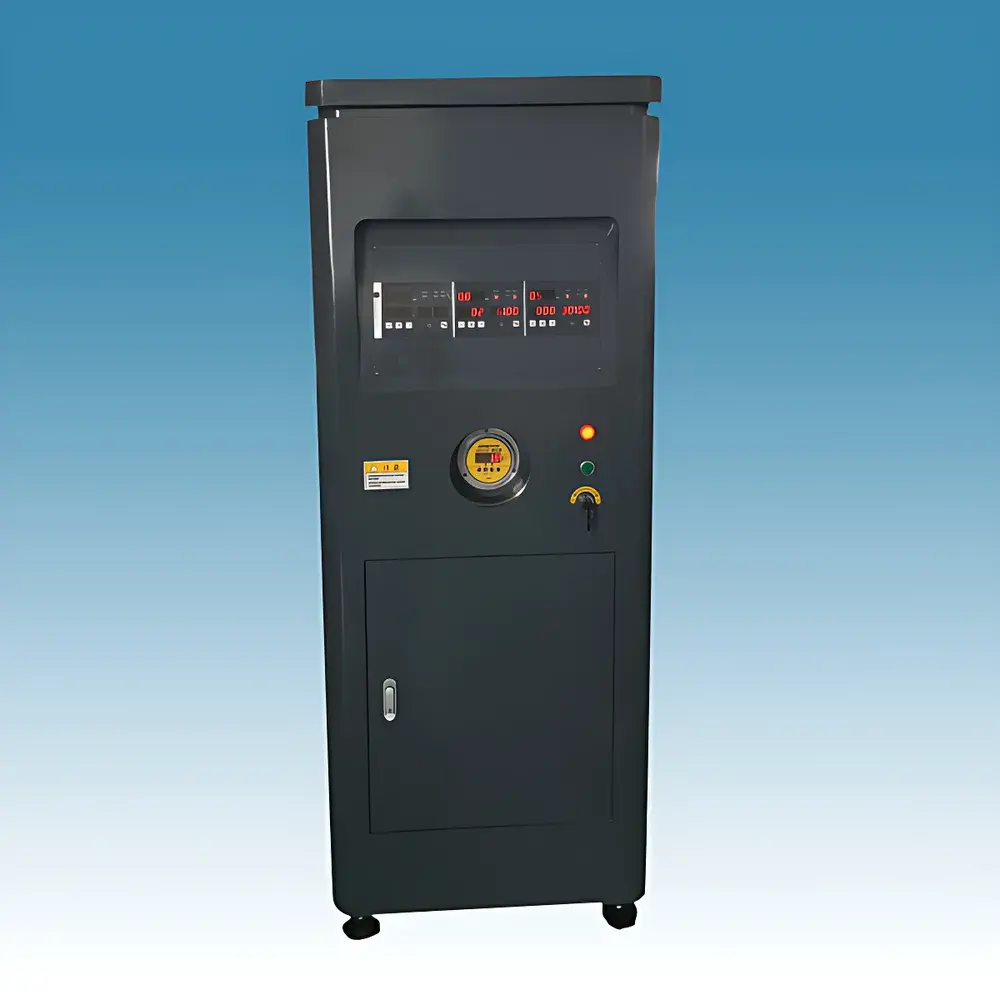
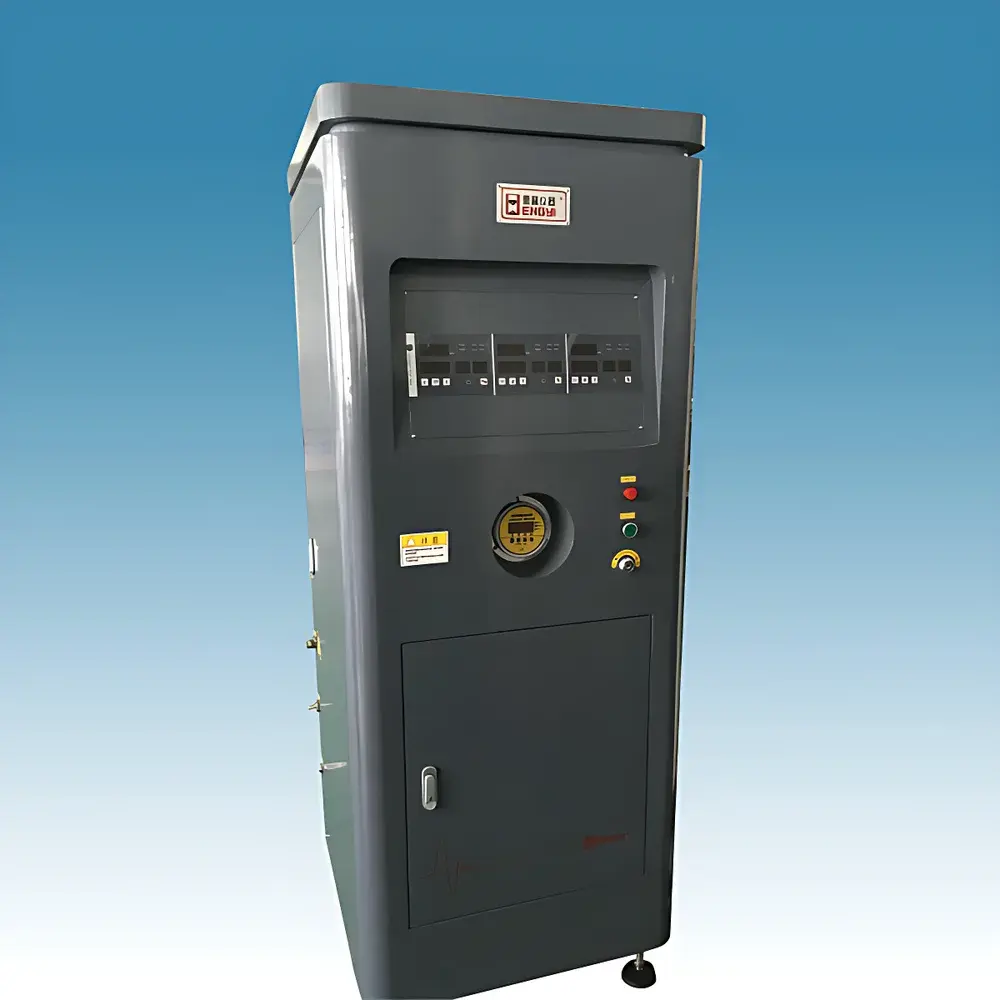
Hengyi HY(BP)hyjf Microcomputer-Controlled Pipe Hydrostatic Pressure & Burst Testing Machine
| Brand | Hengyi |
|---|---|
| Origin | Shanghai, China |
| Manufacturer Type | Direct Manufacturer |
| Country of Origin | China |
| Model | HY(BP)hyjf |
| Quotation | Upon Request |
| Pressure Range | 0–3 MPa |
| Pressure Control Accuracy | +2% / −1% |
| Timing Range | 1 min – 10,000 h |
| Timing Accuracy | <0.1% |
| Test Channels | 3 / 6 / 9 independent circuits |
| Power Supply | 220 V ±10% |
| Rated Power | 3 kW |
| Dimensions (W×D×H) | 600 × 650 × 1850 mm |
| Primary Pressure Source | Imported high-reliability positive displacement pump |
| Key Components | GIANT GXR25 triplex plunger pump (USA), Bucherma diaphragm-type accumulator (Tianjin), Parker solenoid valves (Germany), custom stainless-steel hydraulic fittings, Mitsubishi LCD HMI (Japan), 3 MPa precision pressure transducer (Anhui), Mitsubishi programmable logic controller (Japan), industrial-grade PC with embedded control software |
Overview
The Hengyi HY(BP)hyjf Microcomputer-Controlled Pipe Hydrostatic Pressure & Burst Testing Machine is an engineered solution for evaluating the long-term hydrostatic strength and instantaneous burst resistance of thermoplastic, thermoset, and composite piping systems under sustained internal pressure. Designed in accordance with ISO 1167-1:2014 (Plastics pipes and fittings — Resistance to internal pressure — Part 1: General method) and ASTM D1598 (Standard Test Method for Time-to-Failure of Plastic Pipe Under Constant Internal Pressure), this system implements a closed-loop pressure regulation architecture based on proportional-integral-derivative (PID) controlled hydraulic actuation. It subjects test specimens to precisely maintained static pressure loads over durations ranging from minutes to over one year (10,000 hours), enabling determination of time-dependent failure behavior—including creep rupture, slow crack growth, and catastrophic burst—under rigorously reproducible conditions. The machine supports both single-point burst testing and multi-stage step-pressure protocols required for regression analysis per ISO 9080 (Plastics pipes and fittings — Determination of the long-term hydrostatic strength).
Key Features
- Triple-mode operation: independent control of constant-pressure hold, step-pressure ramping, and real-time burst detection with automatic shutdown upon pressure deviation or specimen rupture.
- Modular channel architecture supporting 3, 6, or 9 parallel test stations—each with isolated pressure regulation, temperature monitoring, and individual data logging—ensuring statistical validity across replicate samples.
- High-stability pressure generation system anchored by a GIANT GXR25 triplex plunger pump (USA), delivering consistent flow with minimal pulsation and thermal drift; integrated with a Bucherma diaphragm-type accumulator (China) to suppress transient pressure spikes and maintain steady-state loading.
- Precision pressure control within ±2% upper / −1% lower tolerance band relative to setpoint, verified per ISO 1167 calibration procedures using traceable NIST-certified reference transducers.
- Industrial-grade Mitsubishi PLC (Japan) paired with a dedicated HMI interface (Mitsubishi LCD panel) and embedded Windows-based control software for deterministic real-time task scheduling, event-triggered data capture, and hardware-level fault diagnostics.
- Full compliance with electromagnetic compatibility (EMC) standards IEC 61000-6-2 and IEC 61000-6-4, ensuring stable operation in shared laboratory environments with other instrumentation.
Sample Compatibility & Compliance
The HY(BP)hyjf accommodates standard pipe specimens conforming to ISO 1167 sample preparation guidelines—including diameters from 16 mm to 315 mm and wall thicknesses up to 32 mm—with configurable end-capping fixtures (compression, flange, or threaded) to prevent leakage at terminations. All hydraulic wetted components are constructed from 316 stainless steel or PTFE-lined alloys to resist degradation from water-glycol test media and chlorine-containing potable water simulants. The system meets mechanical safety requirements per ISO 12100 and incorporates dual redundant pressure relief mechanisms: a spring-loaded safety valve (set at 110% of max rated pressure) and a PLC-monitored electronic overpressure cutoff. Data integrity protocols align with GLP principles and support audit-ready documentation for regulatory submissions under FDA 21 CFR Part 11 when configured with user authentication, electronic signatures, and immutable audit trails.
Software & Data Management
The embedded control software provides synchronized acquisition of pressure, elapsed time, ambient temperature, and system status across all active channels at configurable sampling intervals (100 ms to 10 s). Raw datasets are stored in IEEE 754-compliant binary format with metadata embedding (operator ID, sample ID, test standard, environmental conditions). Export options include CSV, Excel (.xlsx), and PDF reports compliant with ISO/IEC 17025 reporting requirements. Statistical post-processing modules compute median failure time (t50), confidence intervals (95%), and Weibull distribution parameters per ISO 9080 Annex B. Version-controlled firmware updates are delivered via secure HTTPS, and local database backups adhere to IEC 62443-3-3 cybersecurity baseline practices.
Applications
- Long-term hydrostatic strength (LTHS) evaluation of PE, PP-R, PVC-U, PB, and multilayer composite pipes for building services and district heating networks.
- Validation of pipe material formulations against ISO 4427, ISO 15874, and EN 1555 series specifications.
- Accelerated life testing of pipe joints, electrofusion couplings, and injection-molded fittings under sustained pressure load.
- Quality assurance screening in production environments—per ASTM D2837—for incoming raw materials and finished goods prior to shipment.
- Research into environmental stress cracking (ESC) mechanisms using surfactant-doped test media per ISO 22317.
FAQ
What international standards does this system support?
It fully implements ISO 1167-1, ISO 1167-2, ASTM D1598, ASTM D2837, ISO 9080, and EN 1555-2 test methodologies—including automated calculation of minimum required pressure (MRP) and predicted service life at design stress.
Can the system perform step-stress testing?
Yes—the control software supports up to 10 programmable pressure steps with user-defined dwell times and ramp rates, enabling staircase testing per ISO 1167-3 for accelerated failure analysis.
Is remote monitoring supported?
Optional Ethernet/IP or Modbus TCP interfaces allow integration with facility-wide SCADA systems and enable supervised operation via secure VPN connections.
How is calibration traceability maintained?
Each unit ships with a factory calibration certificate referencing national metrology institute (NIM) standards; annual recalibration services include full pressure loop verification using deadweight testers traceable to NIST.
What maintenance intervals are recommended?
Pump oil replacement every 2,000 operating hours; accumulator precharge verification every 6 months; pressure transducer calibration annually or after 5,000 test cycles—documented in the built-in maintenance log module.



