
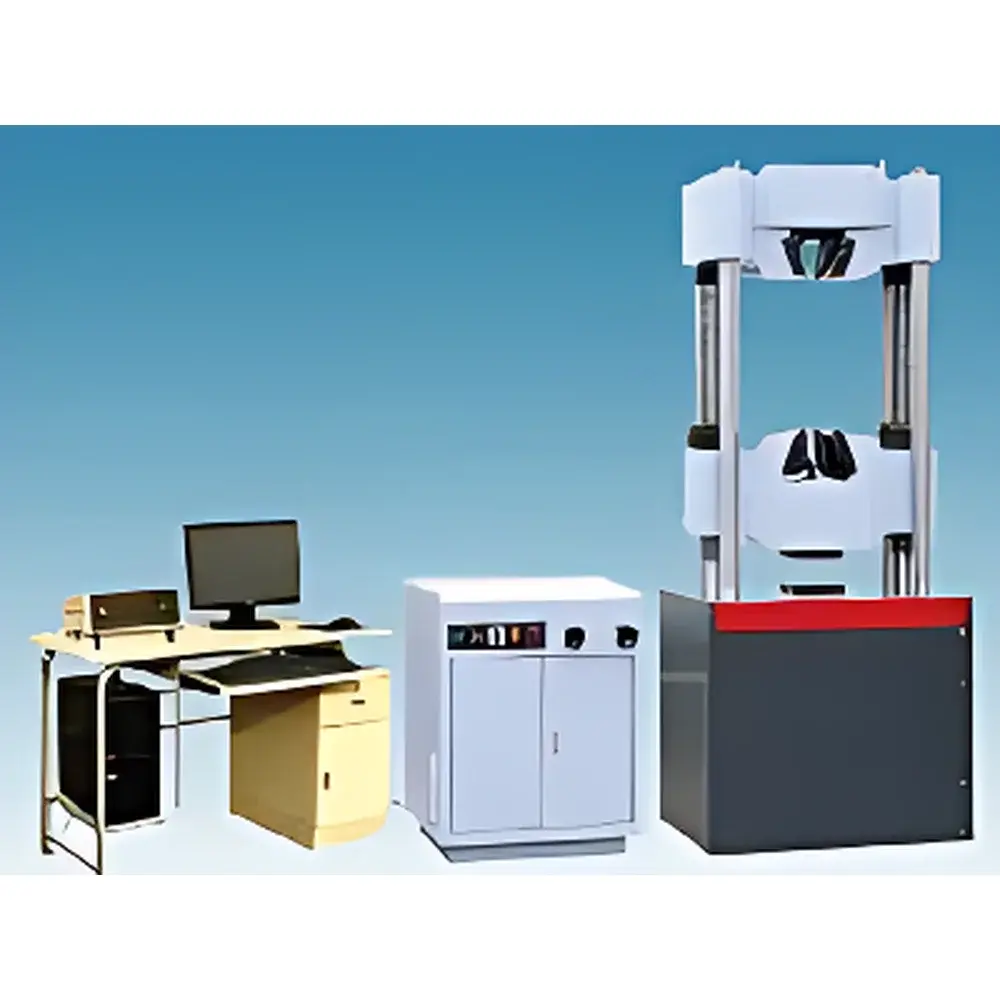
Hengyi HY(WE)100060UIOOM 1000 kN Electro-Hydraulic Servo Universal Testing Machine
| Brand | Hengyi |
|---|---|
| Origin | Shanghai, China |
| Manufacturer Type | Direct Manufacturer |
| Country of Origin | China |
| Model | HY(WE)100060UIOOM |
| Instrument Type | Electro-Hydraulic Servo Testing Machine |
| Maximum Load Capacity | 1000 kN |
| Load Measurement Accuracy | ±0.5% FS |
| Displacement Accuracy | ±0.5% of reading |
| Strain Measurement Accuracy | ±0.5% of reading |
| Compression Space | 600 mm |
| Tensile Space | 600 mm |
| Piston Stroke | 150 mm |
| Round Specimen Grip Range | Φ20–Φ60 mm |
| Flat Specimen Thickness Capacity | 0–40 mm |
| Bending Span Adjustment Range | 100–600 mm |
| Shear Specimen Diameter | Φ10 mm |
| Stress Rate Control Range | 1–60 N/mm²/s |
| Strain Rate Control Range | 0.00025–0.0025 s⁻¹ |
| Closed-Loop Control Accuracy (Force/Displacement/Strain) | ±1% of setpoint |
| Host Dimensions (W×D×H) | 880 × 580 × 2860 mm |
| Motor Power | 1.5 kW, 3-phase |
| Weight | 3500 kg |
Overview
The Hengyi HY(WE)100060UIOOM is a high-capacity electro-hydraulic servo universal testing machine engineered for precision mechanical property evaluation of structural materials under static loading conditions. It operates on the principle of closed-loop hydraulic force actuation combined with real-time digital feedback control, enabling accurate application and measurement of axial tensile, compressive, flexural, and shear loads up to 1000 kN. Designed in accordance with international mechanical testing standards—including ASTM E4, ASTM E8/E8M, ASTM E9, ISO 6892-1, ISO 15630-1, and EN 10002-1—the system delivers traceable, reproducible results suitable for quality assurance, R&D validation, and regulatory compliance in metallurgical, construction, and advanced manufacturing environments. Its oil-cylinder-down configuration ensures enhanced structural rigidity and long-term stability during high-load testing cycles, while the integrated proportional hydraulic control architecture minimizes hysteresis and improves load fidelity across dynamic rate profiles.
Key Features
- Electro-hydraulic servo actuation with proportional valve control for precise, programmable load and displacement trajectories
- High-stiffness dual-column frame with reinforced crosshead and hardened guide columns for minimal deflection under full-scale loading
- Dual-range high-accuracy load cell (±0.5% FS) with automatic range switching and auto-calibration capability
- Optical encoder-based displacement measurement (±0.5% of reading) synchronized with load acquisition at ≥1 kHz sampling rate
- Motor-driven adjustable crosshead (600 mm vertical travel) with worm-gear transmission for fine spatial positioning
- Modular grip systems: wedge-action hydraulic clamps for round specimens (Φ20–Φ60 mm), flat specimen holders (0–40 mm thickness), and standardized three-point bending fixtures (span adjustable from 100–600 mm)
- Integrated shear test assembly compliant with ASTM D732 for Φ10 mm cylindrical specimens
- Real-time closed-loop control modes: constant load, constant displacement, constant strain, and ramped stress/strain rates (1–60 N/mm²/s; 0.00025–0.0025 s⁻¹)
Sample Compatibility & Compliance
The HY(WE)100060UIOOM accommodates metallic alloys (steels, aluminum, titanium, nickel-based superalloys), concrete, cementitious composites, polymer matrix composites, and high-strength plastics. Its mechanical design conforms to ISO 7500-1 Class 1 accuracy requirements for force measurement systems and meets structural rigidity criteria per ASTM E4 Annex A2. The system supports standardized test configurations per ASTM E8 (tension), ASTM E9 (compression), ASTM E290 (bend), and ISO 15630-1 (reinforcing steel). All hardware and software components are designed to support GLP/GMP-aligned workflows, including audit-trail-enabled user access logs, electronic signature readiness, and data integrity safeguards consistent with FDA 21 CFR Part 11 principles.
Software & Data Management
The system runs on a dedicated Windows-based control and analysis platform featuring bilingual (English/Chinese) GUI, fully configurable test templates, and automated calculation of standard mechanical parameters: ultimate tensile strength (Rm), yield strength (ReH, ReL, RP0.2), Young’s modulus (E), elongation at break (A), reduction of area (Z), bending strength, and compressive strength. Raw data is stored in binary + CSV formats with embedded metadata (operator ID, timestamp, environmental conditions, calibration status). Advanced post-processing includes curve overlay, local zoom, derivative analysis (dF/dt, dδ/dt), and customizable reporting per ISO 5893 or internal QA templates. Export options include PDF, Excel, and XML for LIMS integration. Software updates and firmware patches are delivered via secure HTTPS channel with version-controlled release notes.
Applications
- Mechanical qualification of hot-rolled and cold-drawn structural steels per EN 10025, ASTM A615, and GB/T 1499
- Validation of weld joint integrity in pressure vessel fabrication (ASME BPVC Section IX)
- Compressive strength assessment of precast concrete elements and grout materials (ASTM C39, EN 12390-3)
- Flexural performance testing of fiber-reinforced polymer (FRP) rebar and pultruded profiles
- Shear resistance characterization of aerospace fasteners and rivet assemblies
- Material certification for nuclear-grade components requiring ASME III Code compliance
- Research-grade constitutive modeling input generation (stress–strain, cyclic loading, creep behavior)
FAQ
What standards does this machine comply with for calibration and verification?
It adheres to ISO 7500-1 for static force calibration, ISO 376 for load cell verification, and ASTM E4 for verification of force-measuring instruments.
Can the system perform multi-step cyclic tests?
Yes—via programmable step sequences with conditional logic (e.g., hold at peak load, switch control mode upon yield detection, terminate on fracture signal).
Is remote operation and monitoring supported?
The system supports TCP/IP-based network connectivity for remote parameter setting, real-time data streaming, and alarm notification via SMTP or SNMP protocols.
What maintenance intervals are recommended for the hydraulic subsystem?
Oil filtration and level check every 500 operational hours; full hydraulic oil replacement and valve recalibration every 2,000 hours or annually—whichever occurs first.
Does the software support automated report generation with company branding?
Yes—customizable headers, footers, logos, and compliance statements can be embedded into PDF reports using template editor tools within the software suite.
Related Products



