
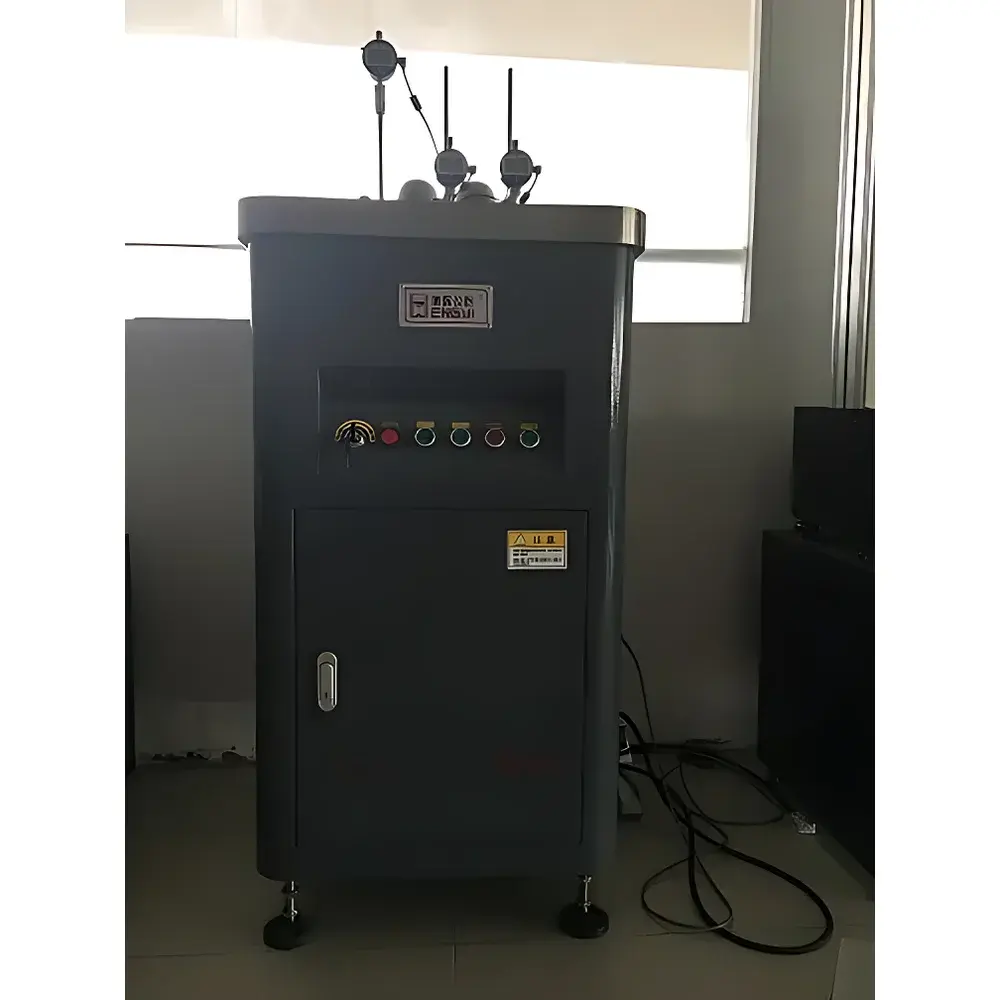
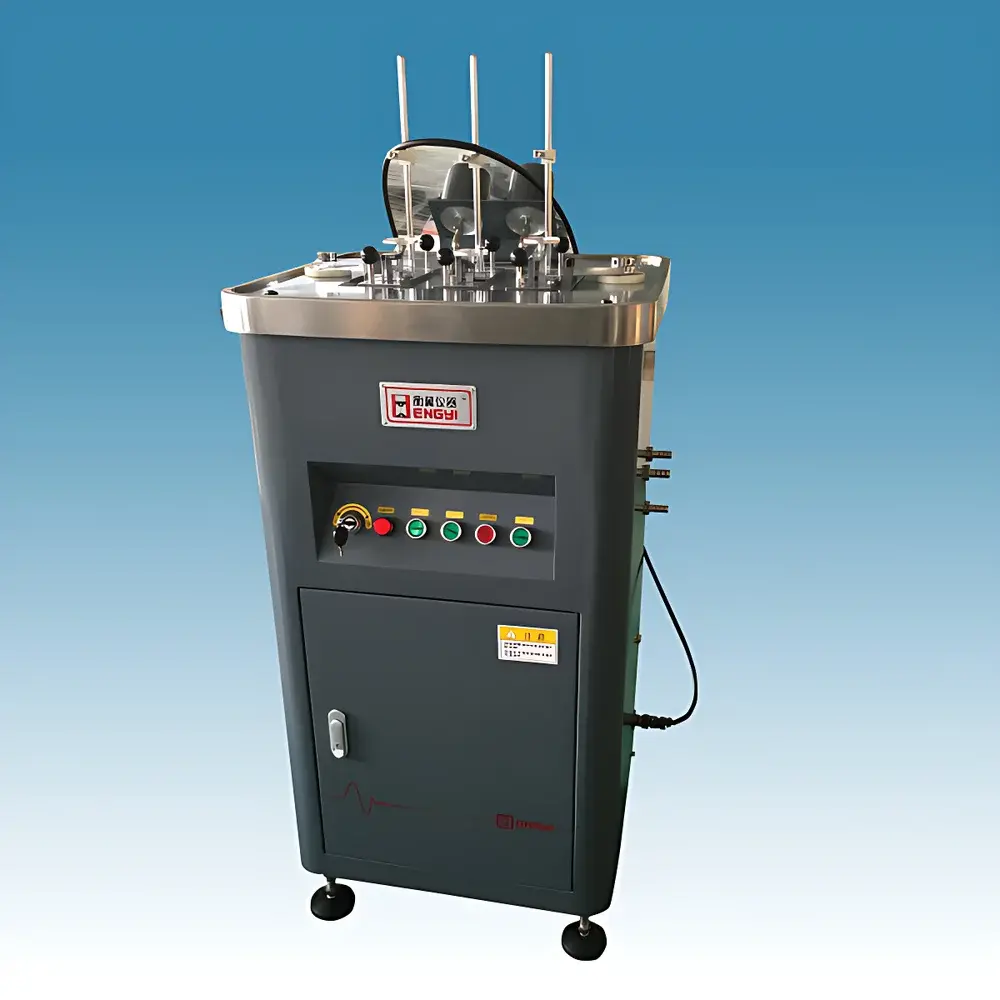
Hengyi HY(RW)-300HB Heat Deflection Temperature (HDT) and Vicat Softening Temperature (VST) Tester
| Brand | Hengyi |
|---|---|
| Origin | Shanghai, China |
| Manufacturer Type | Direct Manufacturer |
| Country of Origin | China |
| Model | HY(RW)-300HB |
| Quotation | Upon Request |
| Temperature Range | Ambient to 300 °C |
| Heating Rate Options | (120 ± 10) °C/h, (12 ± 1) °C/6 min, (50 ± 5) °C/h, (5 ± 0.5) °C/6 min |
| Temperature Accuracy | ±0.5 °C |
| Temperature Resolution | 0.1 °C |
| Deflection Measurement Range | 0–5 mm |
| Deflection Resolution | ±0.001 mm |
| Specimen Stations | 3 |
| Load Rod + Platen Mass | 68 g |
| Standard Weights | Included Set |
| Heat Transfer Medium | Methyl Silicone Oil (200 cSt) or Transformer Oil |
| Cooling Method | Natural cooling above 150 °C |
| Heating Power | 4 kW |
| Power Supply | 220 V, 50 Hz |
| Net Weight | 150 kg |
| Dimensions (W × D × H) | 528 × 545 × 850 mm |
Overview
The Hengyi HY(RW)-300HB Heat Deflection Temperature (HDT) and Vicat Softening Temperature (VST) Tester is a precision thermal-mechanical testing instrument engineered for standardized determination of two critical thermomechanical properties of polymeric and non-metallic materials: the heat deflection temperature under load (ASTM D648 / ISO 75) and the Vicat softening temperature (ASTM D1525 / ISO 306). It operates on the principle of controlled thermal ramping while applying standardized axial loads—either via dead-weight loading on a needle (VST) or a cantilevered rectangular specimen under flexural stress (HDT). The system integrates a high-stability silicone oil bath, three independent test stations, real-time displacement sensing via calibrated dial indicators, and closed-loop PID temperature regulation with second-generation ARM Cortex-M3 microcontroller architecture. Designed for compliance-driven environments—including quality control laboratories, academic research facilities, and R&D departments—the instrument delivers reproducible, traceable results aligned with international regulatory expectations.
Key Features
- Triple-test station configuration enables concurrent evaluation of up to three specimens under identical thermal and mechanical conditions, improving throughput and inter-sample comparability.
- PLC-based temperature control system with dual-mode heating rate selection: high-rate (120 °C/h) for rapid screening and low-rate (5 °C/6 min) for high-resolution softening point detection per ISO 306 Annex A.
- High-precision displacement measurement using 16-bit Σ-Δ ADCs with guaranteed error ≤ ±0.001 mm across 0–5 mm range—ensuring resolution sufficient for both coarse HDT transitions and fine VST inflections.
- Embedded real-time monitoring interface displays synchronized time-temperature-deflection curves during test execution; automatic termination upon reaching endpoint criteria (e.g., 0.34 mm deflection for HDT or 1 mm needle penetration for VST).
- Thermal stability maintained at ±0.5 °C over full 300 °C operating range, verified by NIST-traceable PT100 sensors and CRC-secured master-slave communication between control modules.
- Dual cooling strategy: passive convection cooling above 150 °C; programmable water-cooling activation below 150 °C to ensure rapid thermal recovery between consecutive runs.
Sample Compatibility & Compliance
The HY(RW)-300HB accommodates standard-compliant specimens per ISO 75-1/2/3 (HDT), ISO 306 (VST), GB/T 1633–2000, GB/T 1634.1–2019, and GB/T 8802–2001. Compatible material classes include thermoplastics (e.g., ABS, PC, PP), thermosets (e.g., epoxy, phenolic), elastomers, reinforced composites, and electrically insulating polymers. Each test station accepts standard 10 mm × 10 mm × 120 mm HDT bars or 10 mm × 10 mm × ~50 mm VST slabs. All hardware—including load rods (68 g mass), calibration weights, and silicone oil bath vessels—meets dimensional and mass tolerances specified in ISO 75-2:2013 Annex B and ISO 306:2013 Clause 6. The system supports GLP-compliant operation through audit-trail-capable data logging (timestamped temperature, deflection, load status) and configurable user access levels.
Software & Data Management
The embedded controller firmware provides local real-time visualization and manual override capability, while optional Windows-based PC software enables advanced post-test analysis. Raw data streams—including temperature (°C), elapsed time (s), and displacement (mm)—are exported in CSV format with metadata headers (test ID, operator, standard method, load condition, ambient RH/T). Software features include automated pass/fail flagging against method-defined thresholds, multi-curve overlay for comparative analysis, and PDF report generation with embedded plots, calibration certificates, and signature fields compliant with 21 CFR Part 11 requirements when paired with electronic signature modules. All data storage adheres to IEC 62443-3-3 security principles, including encrypted local database backups and role-based export permissions.
Applications
This instrument serves as a foundational tool in polymer qualification workflows: validating batch-to-batch consistency of injection-molded components; verifying thermal stability margins for automotive under-hood parts; assessing heat resistance of cable insulation and printed circuit board substrates; supporting regulatory submissions for medical device housings (ISO 10993-12); and benchmarking novel biopolymers or flame-retardant formulations. Its triple-station design makes it especially suitable for accelerated aging studies where parallel testing of virgin, UV-exposed, and hydrolyzed samples is required. Universities utilize it for teaching polymer physics concepts—including glass transition kinetics, creep compliance, and load-dependent softening behavior—in senior-level materials science laboratories.
FAQ
What standards does the HY(RW)-300HB fully support?
It complies with ISO 75-1/2/3 (HDT), ISO 306 (VST), ASTM D648, ASTM D1525, GB/T 1633, GB/T 1634, and GB/T 8802—with all mechanical and thermal subsystems validated per the respective normative annexes.
Is external PC connectivity required for basic operation?
No—the PLC interface enables standalone test initiation, real-time monitoring, and thermal/deflection data display. PC software is optional for reporting, archiving, and advanced analytics.
Can the instrument be used with alternative heat transfer media?
Yes—methyl silicone oil (200 cSt) is recommended for full 300 °C range; transformer oil may be substituted for tests below 180 °C, subject to viscosity and flash-point verification per ISO 75-2 Clause 5.2.
How is calibration traceability maintained?
Temperature sensors are factory-calibrated against NIST-traceable references; displacement transducers are verified using certified gauge blocks. Full calibration certificates—including uncertainty budgets—are supplied with each unit.
What safety protections are integrated?
Overtemperature cutoff (310 °C hard limit), dry-run detection (oil level sensor), emergency stop circuit, grounded oil bath enclosure, and thermal insulation shielding meeting IP2X mechanical protection rating.



