
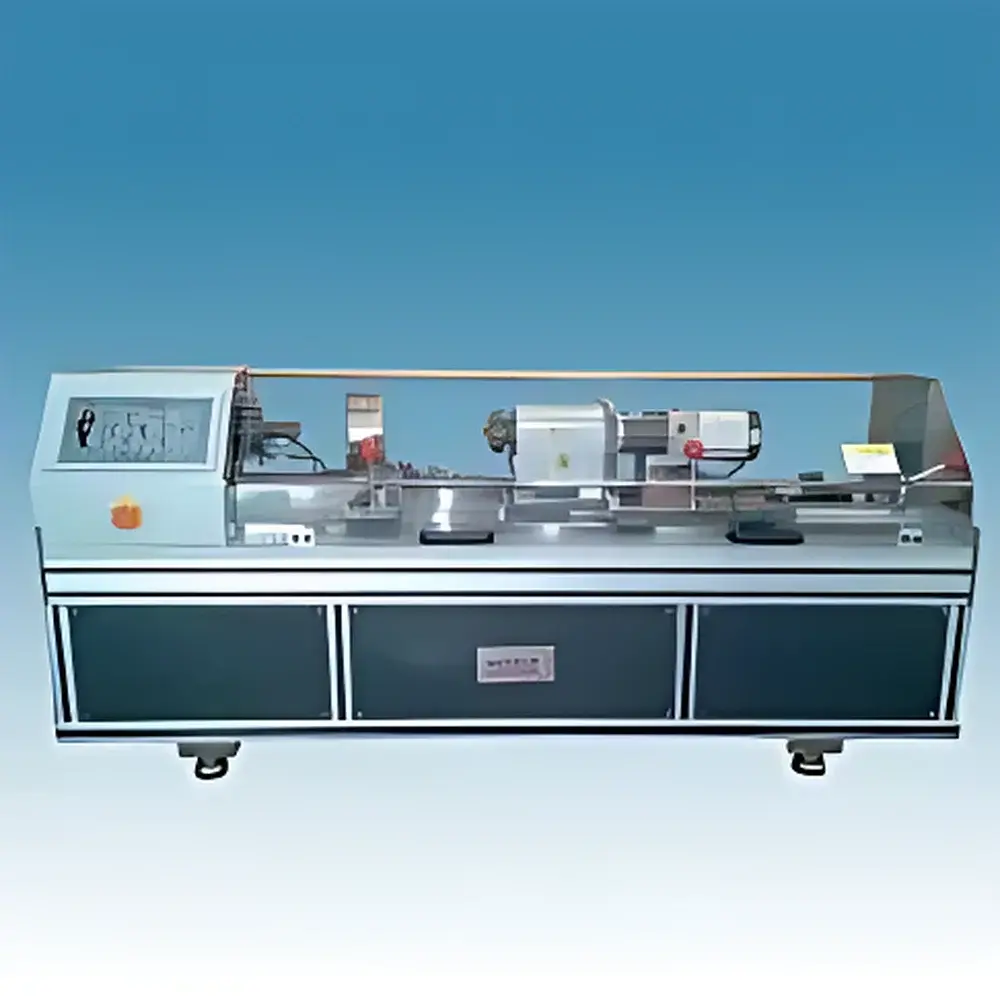
Hengyi HY-100N·m Electromechanical Torsional Fatigue Testing Machine for Knee Joint Implants
| Brand | Hengyi |
|---|---|
| Origin | Shanghai, China |
| Manufacturer Type | Direct Manufacturer |
| Region Classification | Domestic (China) |
| Model | HY-100N·m |
| Price Range | USD $14,000 – $42,000 |
| Instrument Type | High-Frequency Fatigue Tester |
| Maximum Torque Capacity | 100 N·m |
| Frequency Range | 0–50 Hz |
| Machine Weight | 150 kg |
| Torque Measurement Range | 0.5–100 N·m |
| Torque Measurement Accuracy | ±1% (typical ≤±0.5%) |
| Torsional Angle Range | 0–1000° (or continuous rotation) |
| Angular Position Accuracy | ±1% (typical ≤±0.5%) |
| Angular Velocity Accuracy | ±0.5% |
| Max Spacing Between Grips | 200 mm |
| Test Waveforms | Sine, Cosine, Square, Triangle, Sawtooth |
| Power Supply | Single-phase 2 kW |
| Dimensions (L×W×H) | ≈1000×420×500 mm |
Overview
The Hengyi HY-100N·m Electromechanical Torsional Fatigue Testing Machine is a precision-engineered system designed specifically for the biomechanical evaluation of orthopedic implants and biological tissues under dynamic torsional loading. It operates on closed-loop servo-controlled electromechanical actuation, enabling high-fidelity simulation of physiological and supra-physiological rotational stresses experienced by knee joint prostheses, spinal fusion devices, intramedullary nails, bone plates, intervertebral cages, and soft-tissue grafts. Unlike hydraulic or pneumatic fatigue systems, this machine delivers exceptional torque resolution and phase fidelity across its full 0–50 Hz operational bandwidth—critical for replicating cyclic gait-related torsional moments in ISO 14879-1 (knee joint replacements), ASTM F2117 (spinal implant torsion), and ISO 5832-3 (titanium alloy implant materials) test protocols. Its modular grip architecture supports standardized and custom specimen geometries, ensuring compatibility with both regulatory submission testing and preclinical R&D workflows in orthopedic device development.
Key Features
- High-resolution torque transduction with dual-range load cell (0.5–100 N·m), calibrated to ≤±0.5% full-scale error per ISO 376 and traceable to national metrology institutes
- Real-time digital control of angular displacement, velocity, and acceleration with encoder-based feedback (17-bit resolution, ≤0.022° repeatability)
- Programmable waveform generation including sine, cosine, square, triangle, and sawtooth profiles—enabling complex loading sequences per ASTM E466 and ISO 1099
- Adjustable grip spacing up to 200 mm with interchangeable jaw inserts for metallic, polymeric, and composite implant components
- Integrated thermal management system maintaining ambient cabinet temperature stability (±2°C) during extended multi-hour fatigue runs
- Rugged steel frame construction (150 kg mass) with vibration-damping base mount to ensure mechanical stability at resonance-sensitive frequencies
Sample Compatibility & Compliance
The HY-100N·m platform accommodates specimens ranging from 2 mm diameter cortical bone screws to 35 mm outer-diameter total knee tibial trays. Grip configurations are customizable for ASTM F543 (bone screws), ISO 14801 (dental implants), and ISO 7206-4 (hip stems) geometries. All test methods comply with GLP documentation requirements, supporting audit-ready data capture for FDA 510(k) submissions and CE Marking under MDR Annex I General Safety and Performance Requirements (GSPR). The system supports automated pass/fail criteria against ISO 14242-1 (wear testing) and ISO 14243-3 (knee simulator torsional endurance), with built-in logic for cycle counting, torque decay trending, and catastrophic failure detection.
Software & Data Management
Control and analysis are performed via Hengyi’s proprietary TestMaster v4.2 software, compliant with FDA 21 CFR Part 11 for electronic records and signatures. The software provides role-based user access, audit trail logging (including operator ID, timestamp, parameter changes, and calibration events), and encrypted raw data export in .csv and .tdms formats. Real-time plotting includes torque vs. angle hysteresis loops, torque amplitude decay over cycles, and phase lag analysis—essential for viscoelastic characterization of UHMWPE bearing surfaces and PEEK spinal spacers. Exported reports conform to ISO/IEC 17025 technical record standards and include uncertainty budgets per GUM (JCGM 100:2008).
Applications
- Fatigue life validation of cobalt-chrome femoral components under torsional shear per ISO 14242-2
- Torsional stiffness and yield assessment of titanium alloy locking plates per ASTM F382
- Cyclic durability testing of bioresorbable polymer interference screws in ACL reconstruction models
- Interface strength evaluation of plasma-sprayed hydroxyapatite coatings on femoral stems under reverse torsion
- Mechanical screening of 3D-printed porous acetabular cups under combined axial-torsional loading (via optional biaxial add-on)
- Preclinical qualification of meniscal repair anchors per ISO 15197
FAQ
What standards does this system support for orthopedic implant testing?
It natively supports ISO 14879-1 (knee replacements), ASTM F2117 (spinal implants), ISO 14242-1/2 (joint wear/fatigue), and ASTM F543 (bone screws), with method templates preloaded in TestMaster software.
Can the system perform combined loading (e.g., torsion + compression)?
The base HY-100N·m configuration is torsion-only; however, it integrates with Hengyi’s HY-CM series axial actuators for synchronized torsional-compressive testing—requiring separate controller synchronization and mechanical interface kit.
Is calibration certification included with shipment?
Yes—each unit ships with NIST-traceable torque and angular displacement calibration certificates valid for 12 months, plus on-site installation verification per ISO 9001 clause 7.1.5.
What is the maximum continuous run time at 50 Hz?
Rated for uninterrupted operation up to 72 hours at 50 Hz with active cooling and standard load conditions (≤70% of 100 N·m capacity); thermal derating applies above 85% duty cycle.
Does the software support automated pass/fail decision logic per ISO 14242-2?
Yes—TestMaster v4.2 includes configurable thresholds for torque drop >15%, angular displacement drift >2°, or cycle count deviation >0.5%, triggering automatic test termination and report annotation.



