
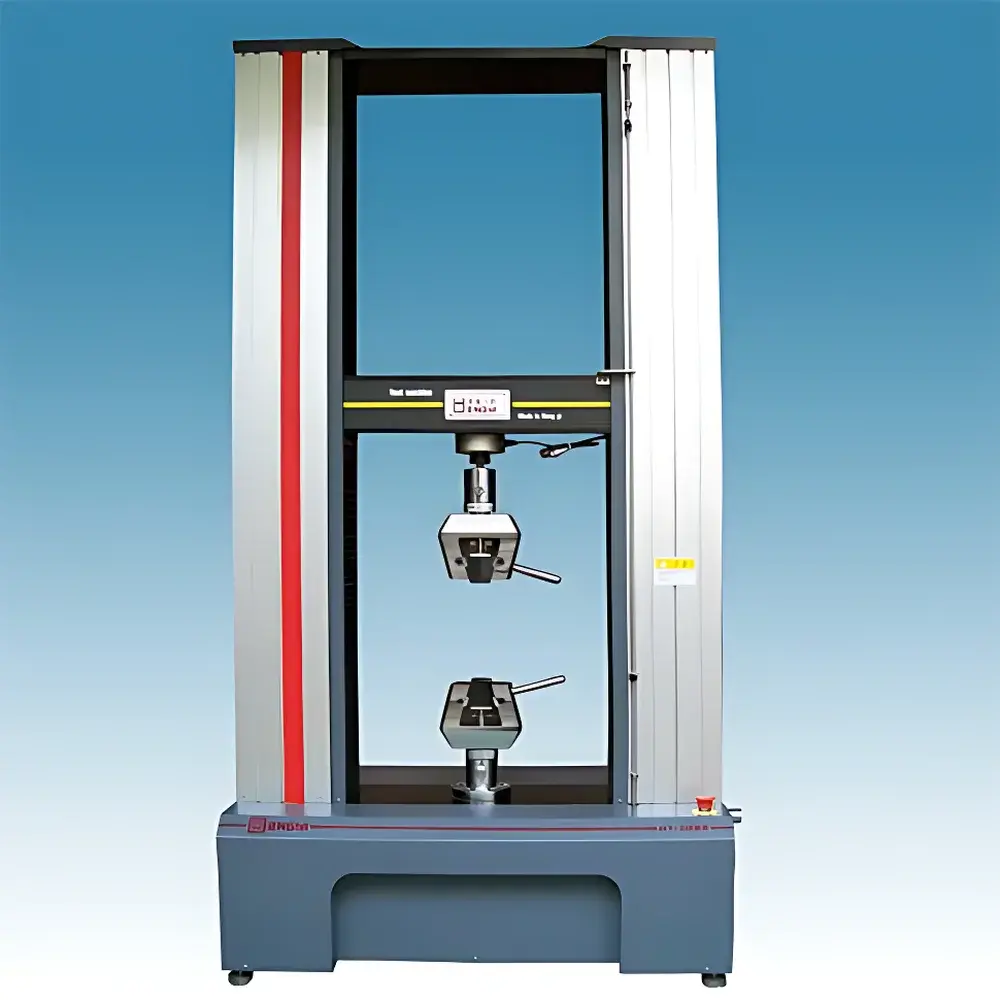
Hengyi HY-5080A Universal Tensile Testing Machine for Ropes and Cables
| Brand | Hengyi |
|---|---|
| Origin | Shanghai, China |
| Manufacturer Type | Direct Manufacturer |
| Model | HY-5080A |
| Instrument Type | Electromechanical Universal Testing Machine |
| Load Capacity Options | 10 kN, 20 kN, 30 kN, 50 kN |
| Effective Test Width | 500 mm |
| Max. Travel Distance | 600 mm / 800 mm |
| Speed Range | 0.001–1000 mm/min (adjustable in real time) |
| Force Resolution | ±1/250,000 full scale (constant across entire range) |
| Force Accuracy | < ±1% or < ±0.5% (depending on calibration class) |
| Displacement Accuracy | ±0.5% of reading |
| Strain Measurement Accuracy | ±0.5% of reading |
| Safety Protections | Electronic limit switches, overload protection (10% above rated load), emergency stop, automatic return-to-start |
| Power Supply | 1.5 kW |
| Dimensions (W×D×H) | 1015 × 540 × 1900 mm |
| Weight | 700 kg |
| Compliance | GB/T 16491–1996, ISO 6892-1, ASTM E4, ASTM D638, ASTM D412, ASTM D882, DIN 53455, JIS K7113, EN 10002-1 |
Overview
The Hengyi HY-5080A Universal Tensile Testing Machine is an electromechanical materials testing system engineered for high-reproducibility mechanical characterization of ropes, cables, fibers, and other high-strength flexible materials. It operates on a precision servo-controlled electromechanical actuation principle: a high-torque AC servo motor drives a planetary gear reducer coupled to a preloaded ball screw assembly, enabling controlled axial displacement of the crosshead with sub-micron positioning repeatability. Force is measured via high-stability S-type or load-cell-based transducers calibrated traceably to national standards; displacement is tracked via high-resolution rotary encoder feedback synchronized with closed-loop motion control. The system supports both tensile and compression modes within its specified load range, with dual-range force sensing architecture optimized for low-force sensitivity and high-load robustness—critical for evaluating breaking strength, elongation at break, modulus, yield behavior, and creep response in synthetic and natural fiber ropes per ISO 2062, ISO 2307, and ASTM D4268.
Key Features
- High-speed DSP-based control platform delivering deterministic real-time sampling at ≥1 kHz, enabling accurate capture of dynamic failure events such as sudden rope rupture.
- USB 1.1 full-speed interface (12 Mbps) with bulk-transfer protocol ensures stable, low-latency data streaming to host PC without packet loss—even during high-frequency acquisition.
- Four-layer PCB design with dedicated ground planes and differential signal routing minimizes electromagnetic interference from motor drivers and power supplies.
- Hot-pluggable standardized USB interfaces for all peripherals—including extensometers, environmental chambers, and digital video extensometry modules—enabling modular expansion without hardware reconfiguration.
- Aluminum alloy frame construction with UV-stabilized anodized finish ensures long-term dimensional stability, corrosion resistance, and consistent surface reflectivity for optical measurement compatibility.
- Dual-speed crosshead drive (fast jog + fine positioning) with programmable acceleration/deceleration profiles reduces test cycle time while preserving specimen integrity during loading transitions.
- Comprehensive safety architecture: electronic end-limit detection, hardware-triggered emergency stop, software-enforced load ceiling (110% of selected capacity), and auto-return-to-initial-position upon test completion or fault condition.
Sample Compatibility & Compliance
The HY-5080A accommodates a wide range of specimen geometries—from monofilaments and braided synthetic ropes (e.g., Dyneema®, Spectra®, nylon, polyester) to wire ropes, steel cables, and hybrid composites—via interchangeable grips including pneumatic wedge grips, roller-type rope clamps, and custom jaw inserts with serrated tungsten-carbide facing. Its 500 mm test width and 600/800 mm vertical travel accommodate standard ISO 2307 rope specimens (up to 10 m length when used with auxiliary support fixtures). The system meets essential requirements of GB/T 16491–1996 (Chinese national standard for universal testing machines), ISO 7500-1 (static calibration of force-proving instruments), and ASTM E4 (verification of force-measuring systems). When configured with validated software protocols and audit-trail-enabled operation, it supports GLP-compliant testing environments and satisfies documentation requirements under FDA 21 CFR Part 11 for regulated industries including aerospace cable qualification and medical tether validation.
Software & Data Management
HYtestV7.0 is a multilingual, standards-driven test control and analysis suite supporting nine UI languages (English, Chinese, German, French, Spanish, Japanese, Korean, Russian, Portuguese) and unit systems (N, kN, lbf, kgf, tonf, MPa, psi). All test parameters—including ramp rates, hold durations, trigger conditions (e.g., “stop at 95% of peak load”), and pass/fail criteria—are defined in reusable method templates compliant with ASTM D882 Annex A1. Raw data streams are stored in SQL Server databases with immutable timestamps, user ID logging, and version-controlled method files. Curve analysis tools include automatic yield point detection (0.2% offset method), tangent modulus calculation, hysteresis loop integration, and customizable report generation (PDF/Excel) with embedded metadata (operator, calibration date, environmental conditions). Software validation packages—including IQ/OQ documentation, traceability matrices, and electronic signature workflows—are available for GxP-regulated deployments.
Applications
This system serves as a primary verification tool across sectors requiring quantitative mechanical performance data for load-bearing flexible components. In marine and offshore engineering, it validates breaking strength and elongation consistency of mooring lines per API RP 2SK. In renewable energy, it assesses tensile fatigue resistance of wind turbine blade suspension cables under cyclic loading per IEC 61400-23. Automotive suppliers use it for seatbelt webbing certification per FMVSS 209 and ISO 6425. Textile R&D labs apply it to quantify tenacity retention after UV exposure (ISO 105-B02) or chemical immersion (ISO 105-X12). Academic researchers employ its high-resolution displacement tracking for viscoelastic modeling of natural fiber composites, while quality control labs in wire rope manufacturing rely on its statistical process control (SPC) export functions for ISO 9001-compliant reporting.
FAQ
What international standards does the HY-5080A support out-of-the-box?
It natively implements test sequences and reporting formats aligned with ASTM D638, ASTM D412, ISO 6892-1, ISO 2307, and GB/T 16491. Custom method development kits allow extension to EN 10002-1, DIN 53455, and JIS K7113.
Can the system be integrated with environmental chambers or video extensometers?
Yes—via standardized USB interfaces and SDK-accessible APIs, third-party accessories including temperature/humidity chambers (–70°C to +300°C), digital image correlation (DIC) systems, and laser extensometers can be synchronized with test execution and data acquisition.
Is the software compliant with FDA 21 CFR Part 11 for electronic records?
When deployed with optional validation packages and configured with role-based access controls, electronic signatures, and audit trail archiving, HYtestV7.0 meets technical and procedural requirements for Part 11 compliance.
What maintenance intervals are recommended for optimal accuracy?
Force sensor recalibration is recommended annually or after 10,000 cycles; ball screw lubrication every 6 months using lithium-based grease blended with mineral oil; and routine visual inspection of grip surfaces and alignment fixtures before each shift.
Does the machine support multi-step cyclic testing for fatigue evaluation?
While the base configuration supports single-cycle tension-to-failure, optional cyclic test modules enable programmable load-controlled or displacement-controlled waveforms (sine, triangle, trapezoidal) with up to 1 million cycle capability and real-time stiffness degradation monitoring.



