
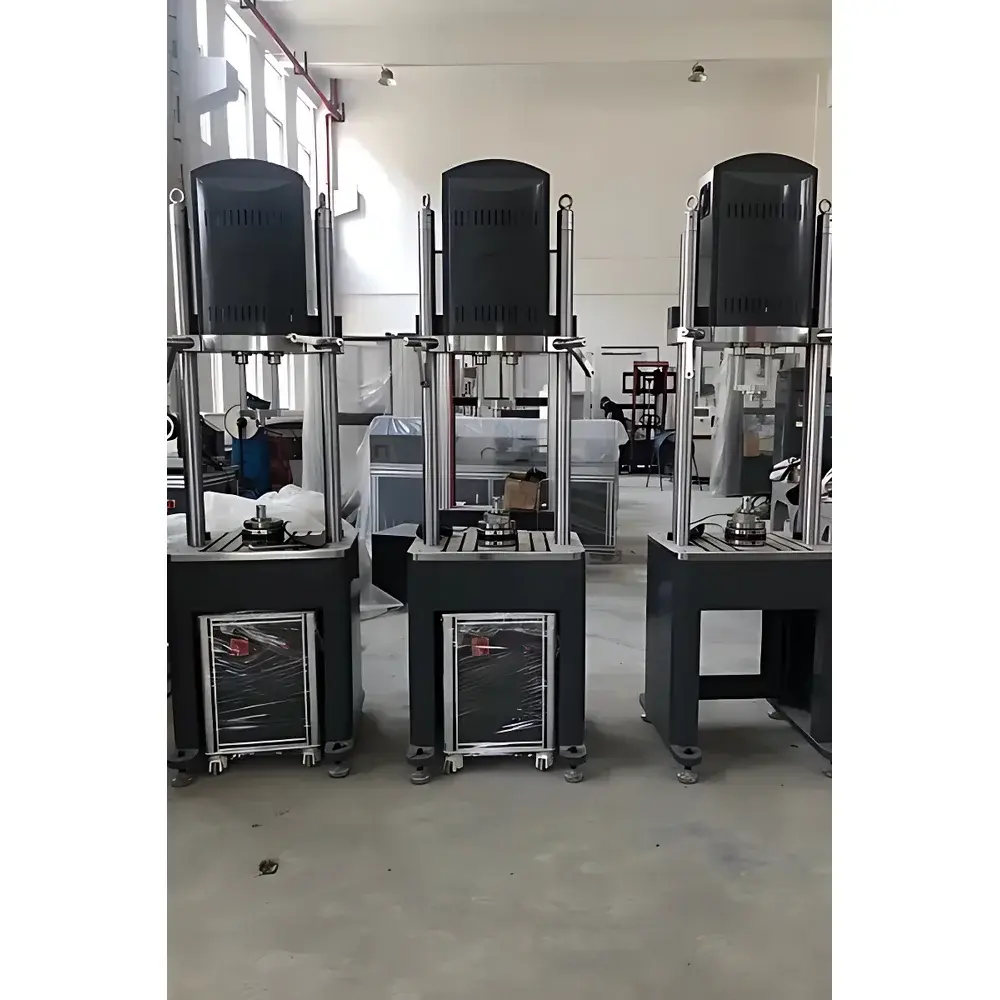
Hengyi HY(DP)5020TY Electromechanical Axial Fatigue Testing Machine for Femoral Head Implant Evaluation
| Brand | Hengyi |
|---|---|
| Origin | Shanghai, China |
| Manufacturer Type | Direct Manufacturer |
| Product Category | Domestic |
| Model | HY(DP)5020TY |
| Instrument Type | High-Frequency Axial Fatigue Tester |
| Maximum Test Load | ±5000 N |
| Frequency Range | 0–30 Hz |
| Actuator Stroke | ±100 mm (200 mm total travel) |
| Displacement Resolution | 0.01 mm |
| Force Resolution | 0.01 N |
| Force Accuracy | Class 1 (±1% of reading) |
| Displacement Accuracy | Class 1 |
| Control Accuracy | ±1% |
| Waveform Options | Sine, Cosine, Square, Triangle, Sawtooth |
| Horizontal Test Space | 450 mm |
| Vertical Test Height | 500 mm |
| Tensile Space | 300 mm |
| Compressive Space | 500 mm |
| Dimensions (L×W×H) | 680 × 700 × 2500 mm |
| Weight | 600 kg |
| Power Supply | 380 V AC, 5 kW |
Overview
The Hengyi HY(DP)5020TY Electromechanical Axial Fatigue Testing Machine is a precision-engineered system designed specifically for biomechanical fatigue evaluation of orthopedic implant components—particularly femoral heads and modular hip joint interfaces. It operates on the principle of controlled cyclic axial loading under programmable waveform profiles, enabling quantitative assessment of structural integrity, micro-crack initiation, and progressive degradation under simulated physiological loading conditions. Unlike hydraulic servo systems, this electromechanical platform delivers high repeatability at low-to-moderate frequencies (0–30 Hz), making it ideal for long-duration, high-cycle fatigue testing in compliance with ISO 14242-1 (Implants for surgery — Wear of total hip joint prostheses) and ASTM F1800 (Standard Practice for Cyclic Fatigue Testing of Modular Femoral Components). Its rigid frame architecture, integrated load cell calibration traceability, and closed-loop digital control ensure metrological consistency across thousands of cycles—critical for regulatory submission packages and preclinical validation studies.
Key Features
- Electromechanical actuation system with brushless servo motor and precision ball-screw transmission—eliminating fluid maintenance and offering superior energy efficiency over hydraulic alternatives.
- Programmable multi-waveform generation (sine, cosine, square, triangle, sawtooth) with independent amplitude, frequency, and offset control for physiologically relevant loading protocols.
- High-resolution force measurement: ±5000 N range with 0.01 N resolution and Class 1 accuracy per ISO 7500-1; calibrated traceable to national standards.
- Displacement feedback via linear variable differential transformer (LVDT) with ±100 mm stroke, 0.01 mm resolution, and Class 1 positional fidelity.
- Dual-space mechanical configuration: 450 mm horizontal clearance and 500 mm vertical test height accommodate large-diameter acetabular cups and extended stem assemblies.
- Modular fixture interface compatible with ASTM F2003-compliant test jigs—including custom-designed clamping solutions for tapered, Morse, or dual-taper femoral head–stem junctions.
- Integrated safety interlocks: overload cutoff, thermal shutdown, emergency stop circuitry, and real-time error logging compliant with IEC 61508 functional safety requirements.
Sample Compatibility & Compliance
The HY(DP)5020TY accommodates standard and custom-sized femoral heads (22–36 mm diameter), ceramic-on-ceramic, metal-on-metal, and polymer-coated variants. Its open-frame design supports mounting of environmental chambers (e.g., saline bath at 37 °C) for ASTM F2129 corrosion-fatigue coupling tests. The system meets essential requirements of ISO 14242-1:2016 Annex A for cyclic compression–tension testing of modular hip components, including minimum sampling rate (≥10× test frequency), data timestamping, and raw signal retention. All firmware and control logic are validated per ISO 13485:2016 Annex C for medical device manufacturing environments and support GLP/GMP audit trails when paired with optional 21 CFR Part 11-compliant software modules.
Software & Data Management
The proprietary Hengyi TestMaster™ v4.2 control suite provides intuitive graphical workflow setup: users define load history profiles, set pass/fail criteria (e.g., displacement drift >0.1 mm, force decay >5%), and initiate automated run sequences with zero manual intervention. Real-time plots display force–displacement hysteresis loops, cycle-by-cycle peak load trends, and cumulative energy dissipation. Raw data exports in ASCII CSV and HDF5 formats preserve full 16-bit ADC resolution for post-processing in MATLAB, Python (SciPy), or Minitab. Audit logs record operator ID, timestamp, parameter changes, and calibration events—enabling full traceability required by FDA premarket submissions and Notified Body reviews.
Applications
- Fatigue life mapping of cobalt-chromium femoral heads under ISO 14242-defined stair-step loading.
- Evaluation of fretting wear at the head–neck taper interface under combined torsional–axial waveforms.
- Validation of surface-hardened coatings (e.g., nitrogen ion implantation) against subsurface crack propagation.
- Comparative analysis of ceramic fracture toughness using R-curve methodology under cyclic indentation.
- Accelerated aging protocols for polyethylene liners in conjunction with femoral head articulation.
- Supporting ASTM F2996 (Standard Guide for Functional Testing of Hip Joint Simulators) as a standalone axial driver subsystem.
FAQ
Is the HY(DP)5020TY compliant with ISO 14242-1 for hip implant fatigue certification?
Yes—the system satisfies all mechanical and metrological requirements outlined in Clause 6 (Test Equipment) and Annex A (Test Methodology), including force accuracy, displacement linearity, and waveform fidelity verification procedures.
Can the machine perform push-in/pull-out testing of modular taper junctions?
Yes, with optional tapered mandrel fixtures and custom displacement limits, it supports ASTM F2003-compliant static and dynamic taper engagement testing.
Does the controller support third-party DAQ integration via analog I/O or EtherCAT?
Yes—standard 0–10 V analog outputs for force/displacement signals and optional EtherCAT slave interface enable synchronization with external motion capture or acoustic emission systems.
What calibration documentation is provided with delivery?
Each unit ships with NIST-traceable calibration certificates for load cell (ISO 376 Class 1) and LVDT (ISO 230-2 Positional Accuracy), plus factory verification reports for all listed performance parameters.
Is remote diagnostics and firmware update capability available?
Yes—via secure HTTPS-based web interface; firmware updates require signed digital certificates and dual-operator authentication to maintain regulatory integrity.



