
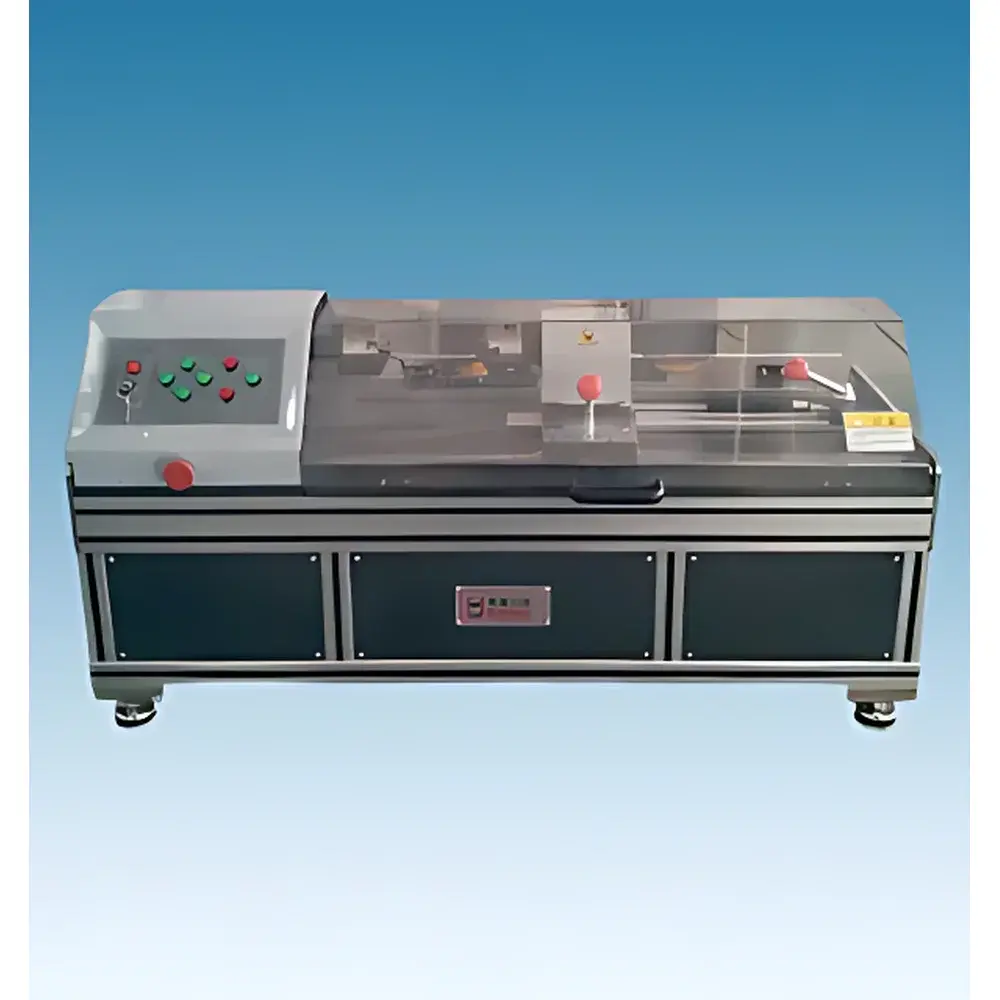
Hengyi HY-100N.MRTTY Desktop Computer-Controlled Torsion Testing Machine
| Brand | Hengyi |
|---|---|
| Origin | Shanghai, China |
| Manufacturer Type | Direct Manufacturer |
| Product Origin | Domestic (China) |
| Model | HY-100N.MRTTY |
| Max Torque | 100 N·m |
| Torque Measurement Range | 0.1–100 N·m |
| Torque Resolution | 0.001 N·m |
| Torsion Angle Measurement Range | 0–100,000° (or continuous rotation) |
| Motor Power | 0.4 kW |
| Torque Measurement Accuracy | ±0.5% FS |
| Torsion Angle Resolution | 0.0045° |
| Angular Velocity Accuracy | ±0.5% |
| Gauge Length Adjustment | 200 mm (customizable) |
| Torsion Speed Range | 0–1000°/min |
| Bidirectional Loading | Yes |
| Clamping Diameter Range | Φ1–Φ5 mm (customizable) |
| Dimensions (L×W×H) | ≈1000×420×500 mm |
| Weight | 200 kg |
Overview
The Hengyi HY-100N.MRTTY Desktop Computer-Controlled Torsion Testing Machine is an electromechanical torsion testing system engineered for precision mechanical characterization of materials and components under controlled angular displacement and torque loading. Based on the principle of direct torque transduction and high-resolution rotary encoder feedback, the instrument applies calibrated torsional moments to specimens while simultaneously measuring angular deformation with sub-arcminute resolution. It operates in closed-loop mode—supporting both torque-controlled and angle-controlled test protocols—and is validated against internationally referenced mechanical testing standards including JB/T 9370–1999 (Technical Specifications for Torsion Testing Machines) and GB/T 10128–2007 (Metallic Materials – Room Temperature Torsion Testing Methods). Its compact desktop footprint integrates a rigid load frame, servo-controlled DC motor drive, dual-channel digital measurement architecture, and real-time data acquisition hardware—all synchronized via embedded firmware and host PC software.
Key Features
- Full-range torque capacity of 100 N·m with high-fidelity measurement down to 0.1 N·m and resolution of 0.001 N·m (equivalent to 1/500,000 full scale)
- Torsion angle measurement up to 100,000° (or continuous rotation), resolved at 0.0045° with accuracy better than ±0.5% FS
- Bidirectional torsional actuation enabling clockwise/counterclockwise loading sequences without manual reconfiguration
- Programmable torsion speed from 0 to 1000°/min, with velocity control accuracy of ±0.5%
- Modular clamping system accommodating cylindrical specimens from Φ1 mm to Φ5 mm; custom jaw geometries available upon request
- Adjustable gauge length (standard 200 mm, extendable per user specification) for compliance with ASTM E143 or ISO 7888 torsion geometry requirements
- Integrated electronic controller with real-time PID regulation, eliminating external signal conditioning units
- Automatic peak torque capture, torque-angle curve plotting, and time-stamped data logging synchronized to system clock
Sample Compatibility & Compliance
The HY-100N.MRTTY supports torsional evaluation of metals, polymers, composites, adhesives, biomedical implants (e.g., bone screws, dental abutments), and orthopedic prostheses. Its mechanical design complies with structural rigidity requirements defined in JJG 269–2013 (Verification Regulation for Torsion Testing Machines) and meets essential safety provisions of IEC 61000-6-2 (EMC immunity) and IEC 61000-6-4 (EMC emissions). Test procedures may be configured to align with ASTM F543 (Standard Specification for Metallic Medical Bone Screws), ISO 5835 (Implants for Surgery – Metallic Bone Screws), or user-defined internal protocols. All calibration certificates are traceable to CNAS-accredited national metrology institutes.
Software & Data Management
The proprietary Windows-based control software provides intuitive test setup, real-time graphical monitoring (torque vs. angle, torque vs. time), and automated report generation compliant with GLP documentation standards. Raw data export is supported in CSV, Excel (.xlsx), and XML formats. Audit trail functionality logs operator ID, timestamp, parameter changes, and calibration events—enabling partial compliance with FDA 21 CFR Part 11 when deployed in regulated QA/QC environments. Software supports multi-step test profiles (pre-load, ramp, hold, reverse), statistical post-processing (mean, SD, CV%), and customizable report templates aligned with ISO/IEC 17025 reporting conventions.
Applications
- Mechanical validation of metallic fasteners, threaded implants, and miniaturized orthopedic devices
- Adhesive bond strength assessment in lap-shear or helical joint configurations
- Viscoelastic torsional response analysis of thermoplastics and elastomers at varying strain rates
- Quality control of wire torsion springs, catheter shafts, and micro-machined MEMS components
- Educational use in materials science laboratories for fundamental torsion modulus (G) determination
- Research-grade fatigue cycling under controlled torque amplitude and frequency regimes
FAQ
What standards does this torsion tester comply with?
It conforms to JB/T 9370–1999, GB/T 10128–2007, and JJG 269–2013. Optional configuration supports ASTM F543, ISO 5835, and ISO 7888 upon request.
Can the system perform cyclic torsion fatigue tests?
Yes—software-defined waveform generators support sinusoidal, triangular, and trapezoidal torque/angle profiles with programmable cycle counts and dwell periods.
Is third-party calibration certification included?
A factory calibration certificate traceable to CNAS is supplied; ISO/IEC 17025-accredited field calibration services are available separately.
What is the minimum specimen diameter supported?
Standard chucks accommodate Φ1 mm specimens; sub-millimeter fixtures can be integrated with prior engineering review.
Does the system support remote operation or networked data transfer?
Yes—TCP/IP interface enables integration into LAN-based lab networks; API access allows scripting via Python or LabVIEW for automated test sequences.



