
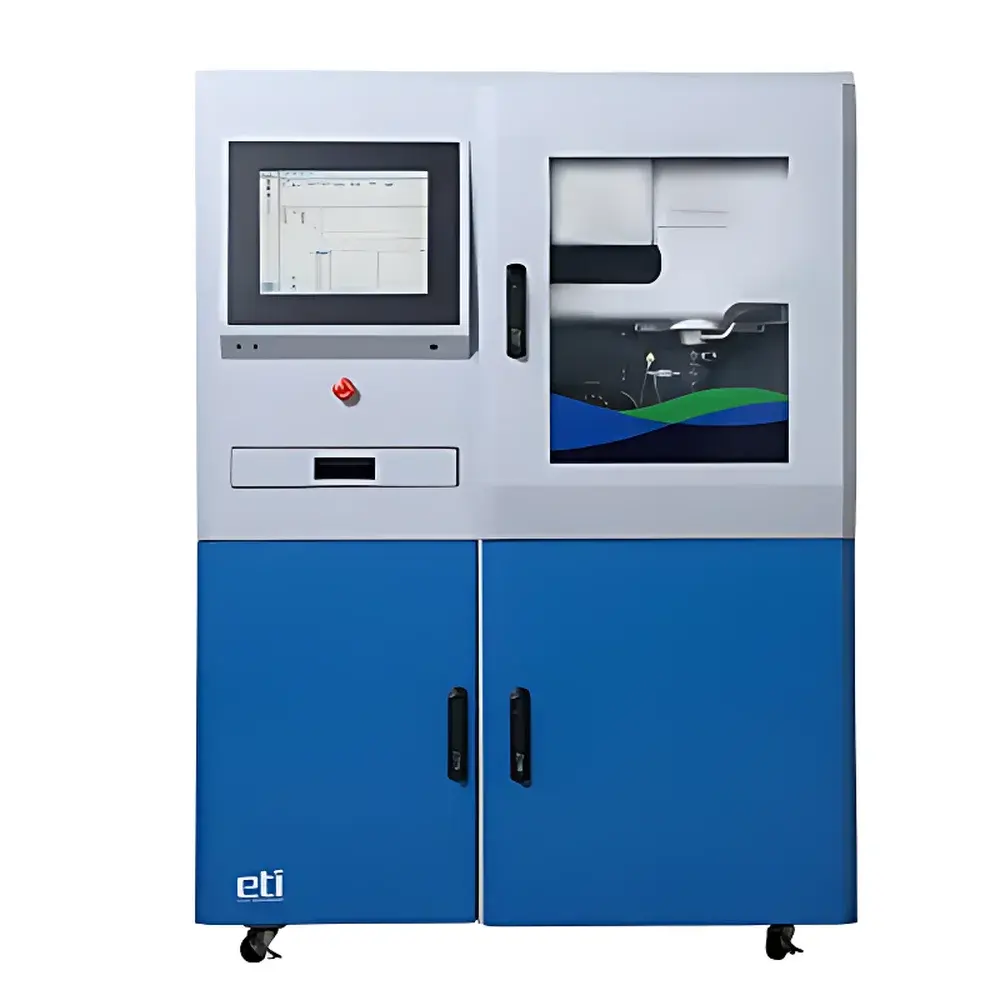
ETI 5100MP Online Microwave Plasma Atomic Emission Spectrometer
| Brand | ETI |
|---|---|
| Origin | Guangdong, China |
| Manufacturer Type | Authorized Distributor |
| Country of Origin | China |
| Model | 5100MP |
| Quotation | Upon Request |
| Detection Principle | Microwave-Induced Plasma Optical Emission Spectrometry (MIP-OES) |
| Detection Range | ppb to ppm (element-dependent) |
| Linear Dynamic Range | ≥ 4 orders of magnitude |
| Detection Wavelength Range | 176–780 nm |
| Detector | CCD array |
| Sample Throughput | ~5 min per multi-element analysis cycle (excluding pre-treatment) |
| Salt Tolerance | ≤ 3% TDS |
| Plasma Gas | Ambient air (no flammable gases required) |
| Digestion System | Integrated high-temperature wet digestion module |
| Preconcentration Capability | On-line solid-phase extraction (SPE) compatible |
| Measurement Modes | Cyclic, Trigger-Controlled, Point-Scan, Continuous, Manual |
| Verification Modes | Remote, Manual, and Auto-Triggered (threshold-exceeded or time-scheduled) |
| Communication Interfaces | RS-485, TCP/IP |
| Power Supply | 220 ± 22 VAC, 50 ± 0.5 Hz |
| Dimensions (W×D×H) | 1250 × 850 × 1600 mm |
Overview
The ETI 5100MP Online Microwave Plasma Atomic Emission Spectrometer is an industrial-grade, fully automated elemental analyzer engineered for continuous, unattended monitoring of trace and major metals in aqueous matrices. It employs microwave-induced plasma optical emission spectrometry (MIP-OES), a robust alternative to inductively coupled plasma (ICP) sources, operating at lower power consumption and without reliance on argon or other combustible support gases. In this technique, liquid samples undergo high-temperature wet digestion followed by nebulization into a stable 2.45 GHz microwave-generated plasma. Excited atoms and ions emit element-specific photons upon relaxation to ground states; the resulting spectral signatures are dispersed and resolved across a broad UV-Vis range (176–780 nm) using a high-resolution CCD detector. The system delivers quantitative multi-element data with detection limits comparable to benchtop ICP-OES instruments—typically sub-ppb for most transition and heavy metals—while maintaining operational resilience in high-TDS environments (up to 3% total dissolved solids). Designed for permanent installation in water treatment plants, effluent discharge points, and municipal monitoring stations, the 5100MP meets the functional requirements of long-term, low-maintenance environmental compliance monitoring.
Key Features
- Multi-element capability: Simultaneous quantification of up to 20+ elements including K, Na, Ca, Mg, Zn, Cd, Pb, Cu, Cr, As, Hg, Fe, Mn, Ni, Sb, and Tl—configurable per regulatory or site-specific needs.
- Air-plasma operation: Eliminates dependency on compressed argon or acetylene, reducing consumable costs and safety infrastructure requirements.
- Integrated high-temperature wet digestion: Ensures complete mineralization of organically bound metals and refractory species prior to plasma introduction.
- On-line preconcentration compatibility: Supports coupling with solid-phase extraction (SPE) modules to extend sub-ppb detection capability for ultra-trace analytes such as Hg and As.
- Modular architecture: Simplified service access, tool-free component replacement, and standardized fluidic interfaces reduce mean time to repair (MTTR).
- Monolithic torch design: Factory-aligned integrated torch eliminates field adjustment of plasma geometry and gas flow routing—minimizing drift and operator dependency.
- Real-time spectral background correction: Dual-beam referencing and pixel-wise baseline subtraction mitigate matrix-induced spectral interferences.
Sample Compatibility & Compliance
The 5100MP is validated for direct analysis of raw surface water, treated drinking water, wastewater influent/effluent, and industrial process streams—with demonstrated stability across pH 4–10 and conductivity up to 30 mS/cm. Its salt tolerance (≤3% TDS) enables deployment in estuarine, brackish, and coastal monitoring applications without dilution or desalting pretreatment. The instrument supports audit-ready data integrity per ISO/IEC 17025:2017 and aligns with methodological frameworks referenced in EPA Method 200.7, ISO 11885, and EN ISO 17294-2. All measurement events—including calibration updates, verification runs, and maintenance logs—are timestamped and stored with immutable metadata, satisfying GLP and GMP traceability expectations for regulated environmental reporting.
Software & Data Management
The embedded control software provides web-based remote access via secure HTTPS and native TCP/IP integration with SCADA and LIMS platforms. It supports configurable alarm thresholds, automatic report generation (PDF/CSV), and scheduled calibration verification per US EPA 40 CFR Part 136 guidelines. Audit trails record user actions, parameter changes, and instrument status transitions with SHA-256 hashing for tamper-evident logging. Data export complies with ASTM E1461-22 (Standard Practice for Electronic Records Management in Environmental Testing) and includes full spectral raw data, peak integration parameters, and uncertainty estimates derived from replicate analysis statistics.
Applications
- Continuous compliance monitoring of regulated heavy metals (e.g., Pb, Cd, As, Hg) at wastewater discharge permits under NPDES or EU Urban Wastewater Treatment Directive.
- Early-warning detection of metal contamination in source water intakes feeding municipal treatment facilities.
- Performance verification of ion exchange, reverse osmosis, and electrocoagulation units in industrial water recycling loops.
- Long-term trend analysis of geochemical metal fluxes in river basins and groundwater recharge zones.
- Support for ISO 14001 environmental management system documentation through automated, auditable elemental records.
FAQ
Does the 5100MP require external cooling water or chiller systems?
No—the plasma source and optical bench utilize passive thermal management and low-power air convection; no chilled water loop is needed.
Can it be integrated with existing PLC-based plant automation?
Yes—RS-485 Modbus RTU and Ethernet TCP/IP protocols enable seamless bidirectional communication with Allen-Bradley, Siemens, and Schneider PLCs.
What maintenance intervals are recommended for routine operation?
Nebulizer and spray chamber cleaning every 72 hours; torch inspection every 3 months; annual CCD dark-current recalibration and plasma alignment verification.
Is method validation support available for regulatory submissions?
ETI provides application notes, ICP-OES cross-validation datasets, and on-site IQ/OQ documentation packages compliant with ISO/IEC 17025 accreditation requirements.
How is spectral interference managed for complex wastewater matrices?
The system applies multivariate interference correction algorithms using internal reference lines and secondary wavelength selection—validated against NIST SRM 1643e and EPA 200.7 spiked recovery tests.
Related Products







