
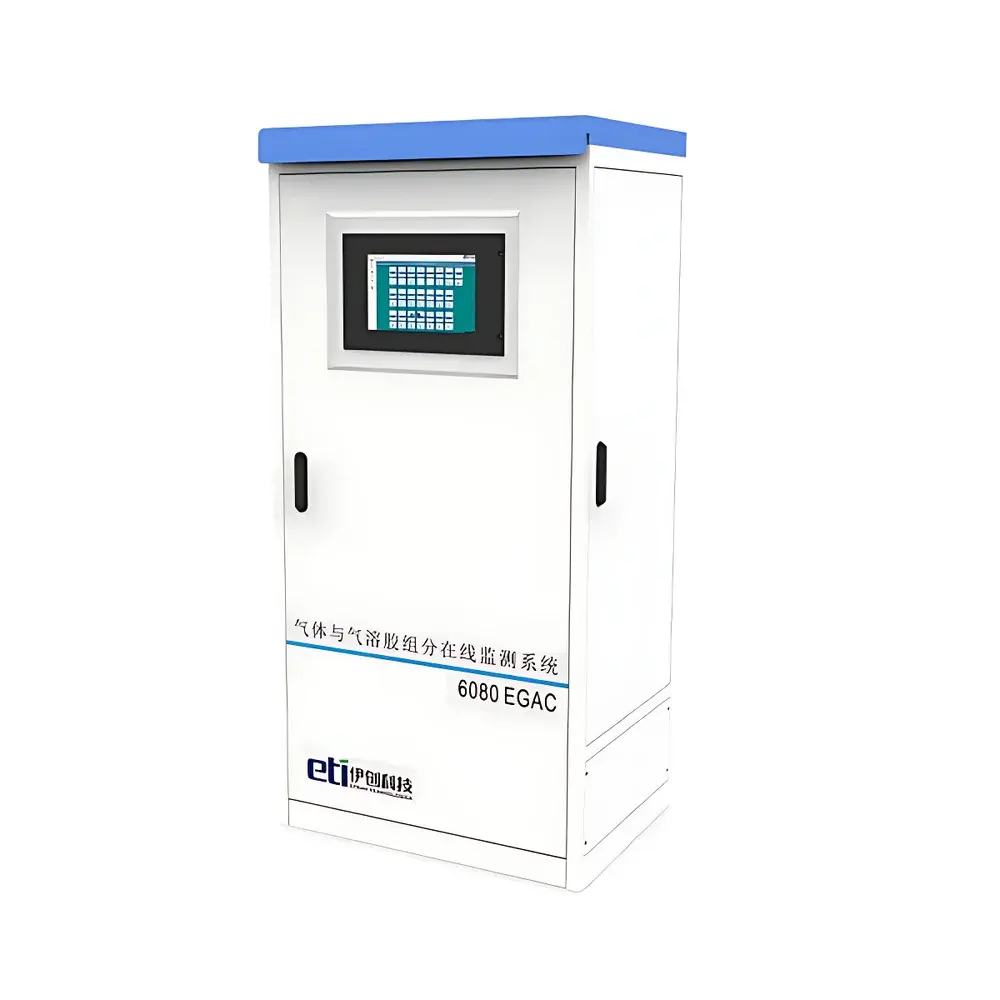
ETI 6080 EGAC Online Gas and Aerosol Composition Monitoring System
| Brand | ETI |
|---|---|
| Origin | Guangdong, China |
| Manufacturer Type | Authorized Distributor |
| Country of Origin | China |
| Model | 6080 EGAC |
| Pricing | Available Upon Request |
| Sampling Flow Rate | 0.5 m³/h or 1.0 m³/h (critical orifice) |
| User Interface | 15" Color XGA + PCAP Touchscreen |
| Data Communication | Ethernet TCP/IP, USB 2.0 |
| Relative Humidity Range | 10–80 % RH (non-condensing) |
| Operating Temperature | 20–30 °C |
| Power Supply | 220 ± 22 VAC, 50 ± 0.5 Hz |
Overview
The ETI 6080 EGAC Online Gas and Aerosol Composition Monitoring System is an integrated, field-deployable analytical platform engineered for continuous, real-time quantification of water-soluble ionic species in both gaseous and particulate phases of ambient air or emission sources. It operates on a dual-channel, sequential sampling principle grounded in established atmospheric chemistry protocols: gaseous analytes—including HCl, HNO₃, H₂SO₄, NH₃, and organic acids—are selectively absorbed via a rotating wetted-wall denuder (WRD), while size-resolved aerosol particles (PM₁.₀, PM₂.₅, or PM₁₀) are collected using a steam-jet aerosol collector (SJAC). Collected fractions are automatically delivered to two parallel ion chromatography (IC) modules—one dedicated to anion analysis (e.g., Cl⁻, NO₃⁻, SO₄²⁻, MSA⁻, C₂O₄²⁻) and the other to cation analysis (e.g., Na⁺, NH₄⁺, K⁺, Ca²⁺, Mg²⁺). The system eliminates offline sample handling, enabling sub-hourly compositional resolution with high reproducibility and minimal operator intervention.
Key Features
- Real-time internal standard calibration: Integrated reference standards are injected at defined intervals, ensuring traceable quantification without manual recalibration or external standard runs.
- No preconcentration required: Achieves method detection limits (MDLs) as low as 0.1 µg/m³ for key ions—enabled by high-efficiency collection (WRD >95% gas-phase acid capture; SJAC >85% aerosol ion recovery) and low-noise IC detection.
- Configurable flow control architecture: Dual critical orifices support selectable sampling rates of 0.5 m³/h or 1.0 m³/h; built-in self-cleaning flow restrictors maintain long-term volumetric accuracy under variable pressure and particulate loading.
- Extended unattended operation: Designed for remote diagnostics, firmware updates, and data retrieval via secure Ethernet TCP/IP; validated for continuous 30-day autonomous deployment in monitoring stations.
- Expandable analytical scope: Native compatibility with post-column derivatization and suppressed conductivity detection allows method adaptation for methylsulfonic acid (MSA), oxalic acid, low-molecular-weight organic acids, and primary/secondary amines—aligned with EPA TO-15 and ISO 10108 guidance.
Sample Compatibility & Compliance
The 6080 EGAC accommodates standard regulatory sampling configurations per ISO 12141 (ambient air quality—sampling of particulate matter), ISO 10108 (measurement of gaseous pollutants), and US EPA Method IO-3.6 (online ion chromatography for fine particle composition). Its WRD–SJAC–IC workflow meets data quality objectives outlined in EU Directive 2008/50/EC Annex IX for PM chemical speciation and supports compliance reporting under national ambient air quality standards (NAAQS) and industrial emission limit values (IELVs). All hardware and software components are designed to meet IEC 61326-1 (EMC for laboratory equipment) and IEC 61000-4 series immunity requirements. Data audit trails, user access logs, and electronic signature capability align with GLP and 21 CFR Part 11 readiness when deployed in regulated QA/QC environments.
Software & Data Management
The embedded control software provides full instrument orchestration—including flow regulation, valve sequencing, IC gradient programming, peak integration, and real-time concentration calculation—via an intuitive 15″ XGA capacitive touchscreen interface. Raw chromatograms, calibration curves, and time-series concentration plots are stored locally in vendor-neutral CSV and HDF5 formats. Remote access is enabled through encrypted HTTP(S) and Modbus TCP protocols, permitting integration into SCADA systems or centralized environmental data platforms (e.g., AirNow, EEA’s AQ e-Reporting). Automated QC flagging identifies deviations in retention time stability (>±0.2 min), baseline noise (>5 nS), or internal standard recovery (115%), triggering configurable alerts via email or SNMP trap.
Applications
- Ambient air quality networks requiring high-temporal-resolution speciated PM₂.₅ data for source apportionment modeling (e.g., PMF, CMB).
- Industrial fence-line monitoring for fugitive emissions of NH₃, HCl, or organic acids from chemical plants, refineries, or livestock operations.
- Long-term trend analysis of secondary inorganic aerosol (SIA) formation and neutralization state in urban and regional background sites.
- Validation and intercomparison studies supporting method harmonization across national monitoring programs (e.g., ACTRIS, GAW).
- Research campaigns investigating multiphase reaction pathways involving sea-salt aerosols, mineral dust, or biomass burning plumes.
FAQ
What particle size cuts are supported by the inlet system?
The system accepts interchangeable impactor stages for PM₁.₀, PM₂.₅, or PM₁₀ cutpoints, compliant with ISO 7708 and EN 12341 definitions.
Can the system operate outside the specified 20–30 °C range?
Extended temperature operation (5–35 °C) is possible with optional thermal management module; however, calibration stability and MDL performance are validated only within the nominal range.
Is the ion chromatography hardware compliant with ASTM D4327 and ISO 14911?
Yes—the dual IC modules implement suppressed conductivity detection with eluent generation, meeting resolution, precision, and linearity criteria defined in both standards.
How is data integrity ensured during extended无人值守 operation?
All raw detector signals, valve actuation timestamps, and calibration events are logged with microsecond resolution; checksummed archives are generated hourly and mirrored to external NAS upon network availability.
Does the system support integration with third-party meteorological sensors?
Yes—RS-485 and analog 4–20 mA inputs are available for synchronized acquisition of temperature, RH, wind speed/direction, and barometric pressure data.







