
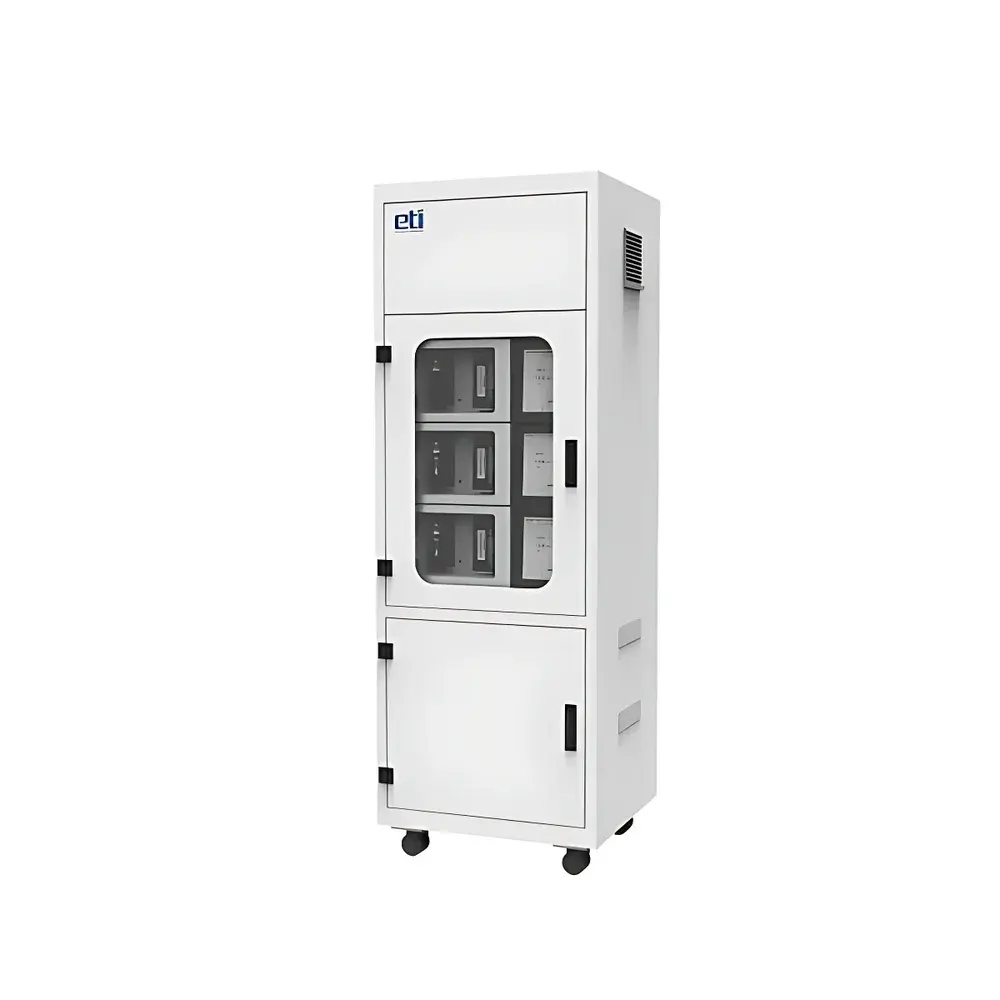
ETI 2020 Total Phosphorus Online Water Analyzer
| Brand | ETI |
|---|---|
| Origin | Guangdong, China |
| Manufacturer Type | Authorized Distributor |
| Country of Origin | China |
| Model | ETI 2020 Total Phosphorus |
| Detection Principle | Potassium Persulfate Digestion–Ammonium Molybdate Spectrophotometry |
| Measurement Range | 0–2 / 0–10 / 0–50 mg/L (selectable) |
| Measurement Modes | Cyclic, Trigger-Controlled, Point-in-Time, Continuous, Manual |
| Verification Modes | Remote, Manual, Automatic (Time-Based or Exceedance-Triggered) |
| Signal Output | 4–20 mA, RS232 / RS485 |
| Power Supply | 220 ± 22 VAC, 50 ± 0.5 Hz |
| Module Dimensions | 490 mm (W) × 400 mm (D) × 210 mm (H) |
| Cabinet Dimensions | 600 mm (W) × 550 mm (D) × 1750 mm (H) |
| Sample Compatibility | Surface water, source water, drinking water, industrial wastewater, municipal sewage |
| Compliance | Designed for routine compliance monitoring per ISO 15681-1, EPA Method 365.4, and GB/T 11893–1989 |
| Data Integrity | Audit-trail-enabled operation logs, GLP-compliant event recording |
Overview
The ETI 2020 Total Phosphorus Online Water Analyzer is an automated, laboratory-grade spectrophotometric instrument engineered for continuous, unattended quantification of total phosphorus (TP) in aqueous environmental matrices. It implements a standardized wet-chemical oxidation and colorimetric detection sequence: samples undergo high-temperature, alkaline persulfate digestion to convert all phosphorus species—including orthophosphate, condensed phosphates, and organically bound phosphorus—into orthophosphate ions. Subsequent acidification in the presence of antimony potassium tartrate catalyzes the formation of phosphomolybdic heteropoly acid, which is then reduced by ascorbic acid to yield a stable, intensely colored molybdenum blue complex. Absorbance is measured at 880 nm using a precision optical path with temperature-stabilized LED light source and matched photodiode detector, ensuring high linearity and long-term photometric stability. The analyzer is deployed in fixed-site monitoring stations, water treatment plants, and industrial effluent discharge points where regulatory reporting, process control, and early warning of nutrient loading are mission-critical.
Key Features
- Patented intelligent dilution algorithm dynamically selects optimal sample-to-reagent ratio based on real-time absorbance feedback, eliminating manual range switching and minimizing reagent waste.
- High-accuracy micro-peristaltic injection pumps (±0.5% volumetric repeatability) deliver precise, pulse-free metering of sample, digestant, and colorimetric reagents—critical for reproducible calibration and low-concentration accuracy.
- Multi-port rotary selector valve enables sequential aspiration from up to six independent sample lines or standard solutions, supporting automated multi-point calibration and cross-channel quality control without hardware modification.
- Integrated power-loss recovery logic retains system state, preserves calibration coefficients, and resumes scheduled measurement cycles upon AC restoration—no operator intervention required.
- Modular architecture allows co-location of multiple ETI analyzers (e.g., total nitrogen, ammonia, nitrate) within a single 19-inch rack-mount cabinet, sharing common power, waste, and communication infrastructure while maintaining electrical and fluidic isolation.
- Embedded watchdog timer and self-diagnostic routines continuously monitor heater temperature, digestion pressure, optical zero drift, and valve actuation timing—logging anomalies with timestamps for root-cause analysis.
Sample Compatibility & Compliance
The ETI 2020 is validated for direct analysis of raw and filtered waters across a broad physicochemical spectrum: turbid surface water (up to 100 NTU), chlorinated drinking water, high-salinity industrial discharges (TDS ≤ 15 g/L), and biologically active municipal influent/effluent. It meets the method performance criteria outlined in ISO 15681-1:2003 (Water quality — Determination of phosphorus — Part 1: Ammonium molybdate spectrophotometric method after digestion) and aligns with U.S. EPA Method 365.4 for total phosphorus in wastewater. Instrument firmware supports configurable data retention policies and time-stamped audit trails compliant with GLP and ISO/IEC 17025 requirements. Optional 21 CFR Part 11–compliant software modules provide electronic signatures, role-based access control, and immutable record archiving for regulated environments.
Software & Data Management
Local operation is managed via a 7-inch resistive touchscreen HMI running embedded Linux, offering intuitive navigation through measurement configuration, calibration management, and diagnostic utilities. All operational events—including reagent depletion alerts, digestion timeout errors, and verification failures—are timestamped and stored in non-volatile memory with configurable retention (30–365 days). Remote connectivity is supported over TCP/IP (Modbus TCP), RS485 (Modbus RTU), or optional 4G LTE, enabling integration into SCADA systems or cloud-based environmental data platforms. Data export formats include CSV (with ISO 8601 timestamps), XML (for EPA EQuIS ingestion), and JSON (for RESTful API consumption). Firmware updates are performed securely via signed OTA packages with SHA-256 verification.
Applications
- Real-time compliance monitoring at NPDES permit discharge points under U.S. Clean Water Act Section 402.
- Early-warning detection of eutrophication precursors in reservoirs and intake channels serving potable water facilities.
- Process optimization in tertiary wastewater treatment plants employing biological phosphorus removal (EBPR) or chemical precipitation.
- Long-term trend analysis for watershed nutrient load modeling in conjunction with flow meters and meteorological stations.
- Validation of membrane filtration or adsorption-based phosphorus removal technologies during pilot-scale trials.
FAQ
What digestion efficiency is achieved for organic phosphorus compounds such as phytic acid or phospholipids?
Under standard operating conditions (120 °C, 30 min, pH ≥ 12), the persulfate digestion protocol achieves ≥95% conversion of representative organophosphorus compounds referenced in ISO 15681-1 Annex B.
Can the analyzer operate reliably in outdoor cabinets exposed to ambient temperatures ranging from −10 °C to 45 °C?
Yes—the internal thermal management system maintains digestion and reaction zones within ±2 °C of setpoint across this range; optional heated enclosure kits extend operational limits to −20 °C.
How frequently must the optical path be cleaned to maintain photometric accuracy?
Automatic quartz cuvette cleaning occurs every 24 hours using deionized water flush and air purge; manual maintenance interval is recommended every 6 months or after 5,000 measurements, whichever occurs first.
Is third-party validation data available for interlaboratory comparison studies?
Yes—certified reference materials (CRM) test reports per ISO Guide 35 are supplied with each unit, including NIST-traceable phosphorus standards (SRM 3188, SRM 3189) and participation records from WTW Proficiency Testing Scheme 2023.
Related Products







