
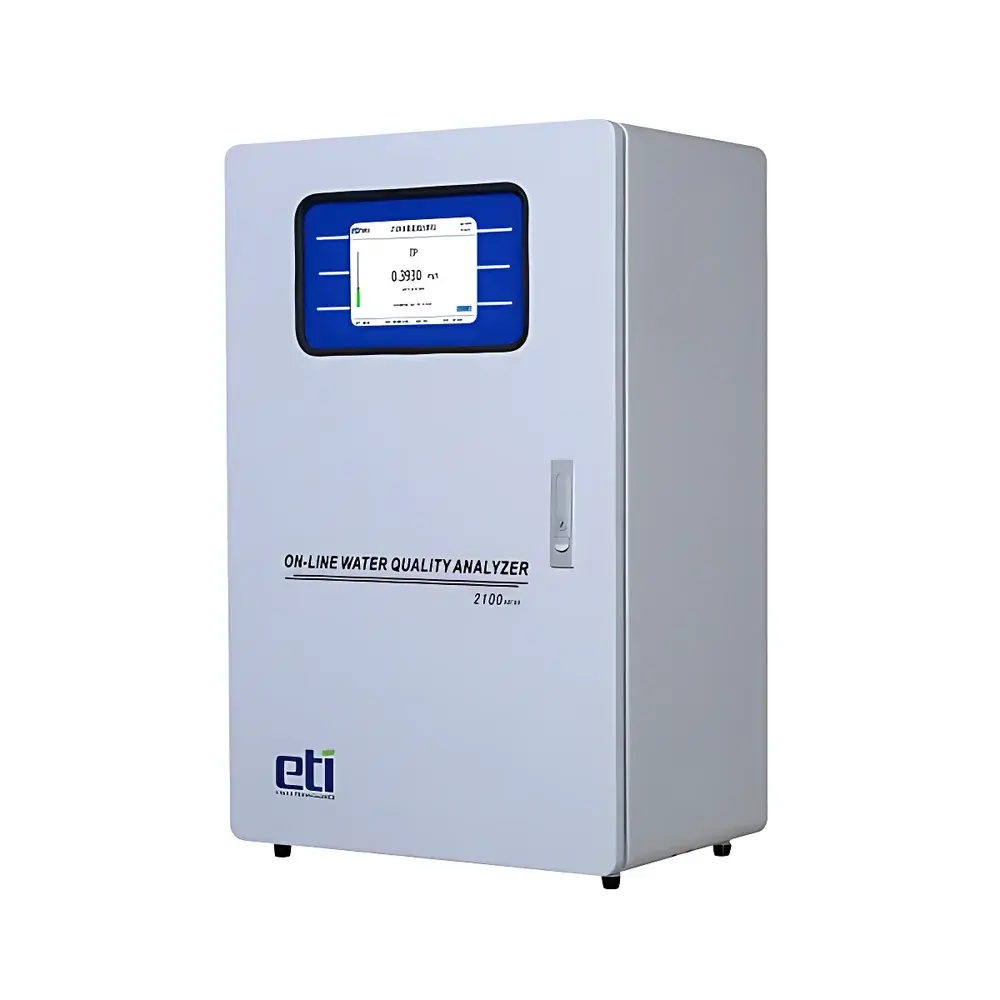
ETI 2100Plus Online Permanganate Index (CODMn) Analyzer
| Brand | ETI |
|---|---|
| Origin | Guangdong, China |
| Manufacturer Type | Authorized Distributor |
| Country of Origin | China |
| Model | 2100Plus Online Permanganate Index (CODMn) Analyzer |
| Instrument Type | Online Analyzer |
| Detection Principle | Photometric Method & Redox Potentiometric Titration |
| Target Analyte | Manganese (as KMnO₄-based oxidation capacity) |
| Analysis Time | < 10 min per cycle |
| Accuracy/Precision | ≤ ±5% of reading |
| Resolution | 0.001 mg/L O₂ equivalent |
| Measurement Range | 0–20 mg/L (CODMn), extended ranges available |
| Output Signals | 4–20 mA analog, RS232/RS485 digital |
| Power Supply | 220 ± 22 VAC, 50 ± 0.5 Hz |
| Enclosure Dimensions | 520 mm (W) × 380 mm (D) × 800 mm (H) |
| Weight | ~45 kg (excluding reagents) |
Overview
The ETI 2100Plus Online Permanganate Index (CODMn) Analyzer is an industrial-grade, fully automated water quality monitoring system engineered for continuous, real-time assessment of oxidizable organic and inorganic substances in aqueous matrices. It quantifies the permanganate index—a standardized surrogate for oxygen-demanding contaminants—expressed as milligrams of oxygen consumed per liter (mg O₂/L), following internationally recognized methodologies aligned with ISO 8467, GB/T 5750.7, and APHA Standard Methods 5210 B. The instrument implements two validated analytical modes: (1) redox potentiometric titration, where endpoint detection relies on a high-stability, maintenance-free smart oxidation electrode; and (2) photometric determination based on controlled KMnO₄–Na₂C₂O₄ reaction stoichiometry and absorbance measurement at 525 nm. Both methods employ precise oil-bath heating for consistent thermal control during acidified permanganate digestion (typically at 100 °C for 30 min), ensuring reproducible oxidation kinetics across diverse sample matrices.
Key Features
- Modular architecture enabling field-replaceable fluidic, optical, and electrochemical subsystems—reducing mean time to repair (MTTR) and supporting GLP-compliant maintenance logs.
- Patented intelligent dilution and auto-ranging functionality: dynamically adjusts sample volume and reagent dosage to maintain optimal signal-to-noise ratio across 0–20 mg/L CODMn, with optional extended ranges up to 100 mg/L.
- Ultra-precision syringe pumps with ≤0.5% volumetric repeatability (CV), calibrated traceably to NIST-traceable standards, guaranteeing stoichiometric accuracy in KMnO₄ and Na₂C₂O₄ delivery.
- Integrated power-loss recovery: retains calibration coefficients, method parameters, and recent measurement history during blackout events; resumes analysis automatically upon power restoration without manual intervention.
- Multi-mode operational flexibility: supports periodic (user-defined interval), triggered (e.g., flow-switch or level-sensor initiated), continuous, manual, and QC-locked measurement cycles.
- Low reagent consumption design: average reagent usage ≤1.2 mL per analysis cycle, minimizing hazardous waste generation and lowering total cost of ownership over 5+ years of operation.
Sample Compatibility & Compliance
The 2100Plus is validated for direct analysis of raw and treated waters without pretreatment, including surface water, drinking water sources, municipal influent/effluent, and industrial wastewater streams with turbidity ≤200 NTU and suspended solids ≤150 mg/L. It complies with data integrity requirements under ISO/IEC 17025:2017 for testing laboratories and supports audit-ready electronic records per FDA 21 CFR Part 11 when paired with ETI’s secure SCADA integration package. All critical process parameters—including digestion temperature, titrant dosing volume, endpoint potential drift, and photometric baseline stability—are logged with timestamped metadata and retained for ≥18 months. System validation protocols include initial IQ/OQ/PQ documentation, annual performance verification using certified reference materials (CRMs) traceable to NIM (China National Institute of Metrology), and inter-laboratory comparison reports.
Software & Data Management
Controlled via ETI’s Web-Based Analyzer Manager (WAM v4.2), the 2100Plus provides role-based access (operator, supervisor, administrator) with encrypted HTTPS communication. The software enables full method scripting—including custom calibration curves, multi-point QC schedules (spike recovery, blank verification, standard addition), and alarm thresholds linked to regulatory action levels (e.g., WHO Guideline Value for CODMn ≤ 5 mg/L in drinking water sources). Data export formats include CSV, XML, and MODBUS TCP for seamless ingestion into LIMS, SCADA, or cloud-based environmental dashboards (e.g., Microsoft Azure IoT Central). Audit trails record all user actions, parameter changes, and calibration events with immutable timestamps—fully compliant with GLP and GMP data governance frameworks.
Applications
- Real-time compliance monitoring at drinking water intake points and distribution network entry stations.
- Trend analysis of organic loading in municipal wastewater treatment plant influent and bioreactor effluent.
- Early-warning detection of accidental discharges in industrial park effluent channels.
- Long-term water quality trend assessment in ecological monitoring networks (e.g., river basin management authorities).
- Support for ISO 14001 environmental management system reporting through automated KPI extraction (e.g., % compliance with local CODMn limits).
FAQ
What regulatory standards does the 2100Plus meet for online CODMn monitoring?
It adheres to ISO 8467:1993 for permanganate index methodology, GB/T 5750.7-2006 for drinking water testing, and supports validation against EPA Method 410.4 (for comparative assessment) when operated in titration mode.
Can the analyzer operate unattended for extended periods?
Yes—designed for 30-day autonomous operation with standard reagent packs; remote diagnostics, predictive maintenance alerts, and automatic QC scheduling minimize site visits.
Is method switching between titration and photometry possible without hardware modification?
Yes—mode selection is fully software-configurable via WAM; no physical component replacement is required.
How is data security ensured during remote access or cloud integration?
All communications use TLS 1.2+ encryption; firmware updates require signed digital certificates; local data storage employs AES-256 encryption at rest.
Does the system support third-party SCADA integration?
Yes—native MODBUS TCP, OPC UA, and DNP3 protocol stacks are embedded; pre-certified drivers available for Siemens Desigo, Schneider EcoStruxure, and Honeywell Experion systems.







